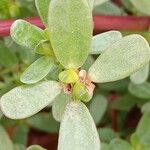
Portulaca oleracea
خرفه، پرپین · پرپهن · Common Purselane · Purslane · Common Purslane
Description
Source: leafsnapPortulaca oleracea, commonly known as purslane, is a succulent plant originally native to India and Persia. Over time, it has spread globally. This annual plant grows close to the ground and features fleshy leaves and stems. The leaves are small, oval-shaped, and can vary in color from green to reddish. Purslane produces small yellow flowers that bloom during the summer. These flowers are followed by seed capsules that contain numerous tiny black seeds. For centuries, purslane has been valued as a medicinal herb, primarily for its anti-inflammatory properties. Additionally, it is rich in vitamins A, C, and E, as well as omega-3 fatty acids, making it a popular ingredient in salads and cooked dishes. Beyond its medicinal benefits, purslane serves as an important food source for wildlife, including birds and insects. It commonly grows wild in gardens and along roadsides but can also be easily cultivated at home. In summary, Portulaca oleracea (purslane) is a versatile plant with a variety of uses, both medicinal and culinary. Its importance spans across many cultures worldwide.
💡 According to legend, the diverse colors of the leaves of Portulaca oleracea 'Granatus' can be traced back to a time when the gods enjoyed painting and creating flowers. Each god had their own unique tastes and preferences. Over time, the designs they painted on these flowers became real, giving birth to the vibrant colors of Portulaca oleracea 'Granatus.'
🌳 The plant called common purslane, often dismissed as a persistent weed, actually gives an advantage in fighting other invasive weeds and in resisting pests and diseases. This hardy species converts poor soil into a protective barrier that keeps out unwanted plants and helps maintain a pest-free area, naturally encouraging healthier landscapes without relying on harsh chemicals. Common purslane is exceptionally tough, offering organic options for gardeners who want to protect their plots with a simple yet effective groundcover.
🎭 A marriage with affection and faith.
Care Guide
💧 Water Every 3 days
Common purslane is well-suited for arid climates, requiring water only once every three weeks. It thrives in full sun and can endure dry periods, making it an ideal choice for xeriscaping. Its succulent nature allows it to store water efficiently, maintaining turgidity even when the soil appears dry.
When should I water my common purslane?
Watering common purslane is essential for its health and flowering. The best time to water it is when the top 1 to 2 inches of soil feel dry to the touch. Look out for signs like wilted or discolored leaves, which indicate the plant needs water. It's particularly crucial to water during the pre-flowering stage to avoid bud drop. In warm temperatures and high sunlight exposure, ensure to water more frequently to meet its high water needs. Avoid watering too early or too late to prevent root diseases from over-watering and dehydration from under-watering, respectively.
How should I water my common purslane?
To water common purslane effectively, using a method like bottom-watering ensures the roots get sufficient moisture without oversaturating the surface, preventing fungal diseases. If you're using a watering can, opt for one with a narrow spout to focus the water on the base of the plant, avoiding excess moisture on the foliage. This technique helps maintain targeted hydration at the root level.
How much water does common purslane really need?
The amount of water common purslane requires largely depends on factors like plant size, pot size, and soil conditions. It thrives in slightly dry environments due to its ability to store water in its leaves. Water it thoroughly until excess drains from the bottom of the pot, then wait until the soil dries out before the next watering. Over-watering manifests as wilting or yellowing leaves, while under-watering will show in shriveled leaves and drooping stems.
What kind of water is best for common purslane?
Common purslane is moderately sensitive to water quality, preferring natural sources like rainwater due to its balanced pH and absence of chemicals. Distilled water is a suitable alternative, provided that essential minerals are supplemented through fertilization. Tap water can be used if it's free of additives, but it's advisable to dechlorinate it or use filtered water to eliminate harmful contaminants. The plant prefers room temperature water, around 68-72°F or 20-22°C, to avoid root shock.
How do common purslane's watering needs change with the seasons?
Common purslane's watering needs vary throughout the year. In spring, as it begins its growth cycle, regular watering supports root development and flowering. Summers require more frequent checks for soil moisture due to higher evaporation rates, even though the plant is drought-tolerant. In autumn, reduce watering as growth slows, and during the winter, minimize watering to prevent root rot, especially if the plant remains through a mild season.
☀️ Light Full sun
Common purslane does best in bright, clear conditions and especially favors sites that are constantly bathed in sunlight. It can tolerate moderate shade, but growth may be limited. Too much shaded habitat or weak light can lead to poor development. Its natural habitats typically have plentiful sunshine.
What are the sunlight requirements for Common Purslane?
Common Purslane requires different levels of sunlight based on its growing conditions. It thrives in full sun, which means it needs above 6 hours of sunlight daily to grow optimally. It can also grow in partial sun, with about 3-6 hours of sunlight. However, it's important to observe your garden's light throughout the day to find spots that offer the right balance of light and shade, ensuring your plants' health and happiness.
How does Common Purslane grow in different lighting conditions?
Common Purslane shows a strong preference for sunny locations, growing best under clear skies and abundant sunlight. It can adjust to moderate shade, but its growth may be slower, and the plant could develop poorly in such conditions. For indoor plants, when natural sunlight is insufficient, particularly during winter or in less sunny spaces, artificial lighting can be used to supplement light, encouraging better growth. LED lights are recommended for indoor plants because they can mimic natural sunlight's specific wavelengths, with requirements varying based on the plant's natural light needs.
What are the symptoms of light deficiency in Common Purslane?
When Common Purslane doesn't receive enough light, especially if grown indoors, it may exhibit several symptoms. These include longer spaces between leaves or stems leading to a leggy appearance, early leaf drop to conserve resources, chlorosis or yellowing of leaves, damage from intense sunlight exposure like sunscald, leaf curling as a defense mechanism against excessive sunlight, wilting from increased water loss, and leaf scorching characterized by brown, dry edges on leaves. Although these symptoms indicate light stress, adjusting the plant's exposure to light can promote healthier growth.
How to address insufficient sunlight for indoor and outdoor Common Purslane plants?
For Common Purslane facing insufficient sunlight, gradually increase light exposure to at least 6 hours of direct sunlight daily for optimal growth. For indoor plants, move them to a sunnier spot each week, utilize a south-facing window, or supplement with artificial light, like professional grow lights or a desk lamp, for at least 8 hours daily. Outdoor plants should also be moved gradually to prevent sunburn. If plants are obstructed from receiving sunlight, consider pruning surrounding trees or transplanting smaller plants to a sunnier location. It’s crucial to adapt plants to new lighting conditions slowly to ensure they can acclimate without stress.
🌡️ Temperature 0–37.8°C
Common purslane originates from areas where temperatures range from 68 to 100.4 °F (20 to 38 ℃). It does best in warm environments, though it can adjust its temperature tolerance when necessary. In colder periods, it may need mild supplemental heat.
What temperatures can common purslane tolerate?
Common purslane is native to regions with a temperature range of 68 to 100.4 °F (20 to 38 °C), thriving in warm climates but capable of adjusting its temperature tolerance. While it has strong cold resistance, meaning special frost protection measures are not usually necessary, protection is still important if winter temperatures are expected to drop below the plant's growth temperature limit. In such cases, covering the plant with soil or straw and watering abundantly before the first autumn freeze can help the soil retain moisture and prevent the plant from drought and water scarcity during winter and early spring.
What should you do if common purslane experiences low temperatures?
Common purslane thrives best above its suitable growth minimum temperature and should be kept above its tolerable growing temperature minimum during winter. If temperatures fall below its growth temperature limit, the plant may show no noticeable changes during the winter but could experience decreased sprouting or even no sprouting in spring. In this situation, it's advisable to remove any parts of the plant that have failed to sprout come spring.
How does high temperature affect common purslane, and what are the solutions?
During summer, it's ideal to keep common purslane below its suitable maximum growth temperature. Exceeding its tolerable maximum temperature can cause the plant's leaves to lighten, become prone to curling, susceptible to sunburn, and, in severe cases, result in the plant wilting and drying out. To mitigate these issues, trim away sunburned and dried-up parts of the plant. Additionally, moving the plant to a shaded location or using a shade cloth can protect it from the harsh midday and afternoon sun. It's also important to water the plant in the morning and evening to maintain soil moisture.
💨 Humidity dry (<40%)
This plant prefers dry conditions, so don't mist it. However, watering it less often can also thrive in higher humidity.
🪴 Soil 5-7
🌱 Fertilizer
Common purslane benefits from regular, light fertilizer applications to encourage healthy leaf growth. You should fertilize Common purslane about once a month during the summer. Nitrogen is essential for foliage, and adding nitrogen-rich sources helps Common purslane thrive.
🪴 Pot & Repot Every 3 years
When repotting Common purslane, choose a pot that is 1–2 inches (2.5–5.1 cm) larger in diameter and that has good drainage. Use a well-draining potting mix and consider mixing in perlite for extra drainage. Repot in spring or early summer, water thoroughly, and place in a shady spot at first.
✂️ Pruning
To maintain the ornamental value of common purslane, it is important to prune it promptly during the growing season. Focus on removing branches that are crossed, growing inward, or densely packed. In late fall, prune away dried leaves to improve air circulation. When repotting, be sure to remove any rotten, weak, or excess roots to promote healthier growth.
🌿 Propagating
🐛 Diseases & pets
☠️ Toxicity
Characteristics
- Plant Type
- Herb
- Life Cycle
- Annual, Perennial
- Genus
- Portulaca
- Family
- Portulacaceae
- Hardiness Zone
- 2-12
- Mature Height
- 15 cm to 30 cm
- Mature Spread
- 20 cm to 30 cm
- Leaf Color
- Green, Red, Purple
- Leaf Type
- Deciduous
- Flower Color
- Yellow
- Flower Size
- 0.25 cm to 1.02 cm
- Bloom Time
- Late spring, Early summer, Mid summer
- Planting Time
- Spring, Summer, Autumn
- Harvest Time
- Mid summer, Late summer
- Native Area
- Burkina Faso, Belize, India, Pakistan, Nigeria, Slovenia, Guinea-Bissau, Belarus, Cameroon, Koppen, Ethiopia, Latvia, Netherlands, Central African Republic, Tunisia, Peru, Philippines, Bulgaria, Bangladesh, Laos, Chad, China, Colombia, Afghanistan, Kyrgyzstan, Kazakhstan, Japan, Mongolia, El Salvador, Eswatini, Gambia, Egypt, Angola, Austria, Namibia, Zimbabwe, Uzbekistan, Russia, Venezuela, Estonia, Oman, Ghana, Qatar, Botswana, France, Nepal, Tajikistan, Sudan, Mauritania, Armenia, Poland, Greece, Switzerland, Guyana, Bhutan, Nicaragua, United Kingdom, Algeria, Sri Lanka, Turkey, United Arab Emirates, Mexico, Guatemala, Slovakia, Montenegro, Croatia, Morocco, Fiji, Uganda, Tanzania, Benin, Germany, Sierra Leone, Indonesia, Mozambique, Romania, Portugal, Saudi Arabia, Malawi, Honduras, Cyprus, Turkmenistan, Panama, Ukraine, New Zealand, Lebanon, Syria, Italy, Senegal, Iran, Côte d'Ivoire, Ecuador, Azerbaijan, Kuwait, Costa Rica, Congo (DRC), Somalia, Lesotho, Malaysia, Rwanda, Eritrea, Yemen, Kenya, Niger, Mali, Iraq, Cambodia, Burundi, Liberia, South Korea, Congo, Czech Republic, South Africa, Zambia, Guinea, Serbia, Lithuania, Bahamas, Spain, Bolivia, Vietnam, Myanmar, Israel, Singapore, Albania, Hungary, Thailand, Gabon