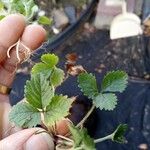
Potentilla indica
False Strawberry · Mock Strawberry · Wild Strawberry · Indian-Strawberry · Yellow-flower-strawberry
Description
Source: leafsnapPotentilla indica known commonly as mock strawberry, Indian-strawberry, or false strawberry, often referred to as a backyard strawberry, mainly in North America, is a flowering plant in the family Rosaceae. It has foliage and an aggregate accessory fruit similar to that of a true strawberry. It has yellow flowers, unlike the white or slightly pink flowers of true strawberries. It is native to eastern and southern Asia, but has been introduced to many other areas as a medicinal and an ornamental plant, subsequently naturalizing in many regions worldwide.Many sources consider this plant part of the genus Potentilla due to evidence from chloroplast genetic sequence data that the genus Duchesnea is included within Potentilla, though some still list it as Duchesnea indica.
💡 In Native American mythology, strawberries are seen as symbols of blessings from the gods and are associated with gratitude and thanksgiving. Many tribes celebrated the arrival of spring with annual Strawberry Dances or Strawberry Festivals, which symbolized new life. Having strawberries in the home was considered good luck by various Native American peoples.
🌳 Mock strawberry, which is frequently misidentified as the strawberry, fulfills a distinct ecological function. These plants usually do well in disturbed environments and are therefore often used to help control soil erosion. Their thick mats of leaves can hold soil in place, offering an ecological benefit in erosion-prone locations. In addition, their flowers supply nectar to pollinators, thereby making an important contribution to the survival of several bee species.
🎭 Good luck
Care Guide
💧 Water Every week
The mock strawberry thrives in a well-hydrated environment, while also displaying moderate tolerance to drought. It requires watering once a week and flourishes outdoors, especially during the rainy season. Its deciduous nature enhances its ability to absorb and transpire water, making it well-suited to its humid regional origins.
When Should I Water My Mock Strawberry?
Watering your mock strawberry requires paying attention to a few key indicators to ensure optimal growth and health. First, check the soil's moisture level; allow the top one inch to dry out before the next watering. You can use your finger or a moisture meter for accuracy. Drooping or wilted leaves often signal the need for water, though be cautious as this can also indicate overwatering. Look out for leaf discoloration, with leaves turning from vibrant green to dull or even yellow, which is another sign of thirst. Stunted growth could hint at insufficient water, especially outside the plant's dormancy period. It's crucial to avoid both under and overwatering to prevent issues like fungal diseases or root rot, which can severely affect your mock strawberry's health.
How Should I Water My Mock Strawberry?
For healthy mock strawberry plants, an even and consistent watering approach is key. Instead of the traditional top-down watering method, consider bottom-watering by placing the pot in a tray of water, allowing the moisture to seep up through the drainage hole. This technique ensures the roots are well-hydrated without risking water sitting on the leaves, which could lead to fungal diseases. Use a watering can with a narrow spout to direct water to the soil's base, focusing on root hydration rather than wetting the foliage, which is critical for preventing root rot and fostering strong growth.
How Much Water Does Mock Strawberry Really Need?
The mock strawberry, native to various Asian habitats, demands careful attention to watering to thrive. Typically, a medium-sized plant might need about 200-250 milliliters of water per session, keeping the soil moist but not waterlogged. Look for signs of proper hydration, like vibrant green leaves and a slightly moist soil texture. Over or underwatering manifests through yellowing leaves, root rot, or stunted growth, indicating the need for adjusting water amounts. Regular watering, especially under hot, dry conditions, and allowing the soil's top inch to dry out between sessions, will ensure your plant gets just the right amount of moisture.
What Kind of Water is Best for Mock Strawberry?
Mock strawberries show a preference for rainwater or filtered water due to their sensitivity to the chemicals in tap water. If you must use tap water, let it sit to allow chlorine to evaporate, and consider filtering to remove fluoride and excess minerals, which can harm the plant. Your mock strawberry will thrive best with water that's neither too cold nor mineral-heavy, so aim for room temperature water that's been treated to remove any harmful substances.
How Do Mock Strawberry's Watering Needs Change with the Seasons?
Seasonal changes significantly impact how you should water your mock strawberry. In spring, as the plant exits dormancy, maintain moist soil to support new growth, careful not to oversaturate. Summer requires deeper, more frequent watering to combat evaporation. Autumn brings a slowdown in growth, meaning you should reduce watering frequency. Winter calls for minimal watering, just enough to keep the root zone from drying out completely, especially since the plant may enter dormancy. Adapting your watering routine to these seasonal needs will help your mock strawberry flourish throughout the year.
☀️ Light Partial sun
Mock strawberry performs best in spots that receive sufficient sunlight for half of the day. It can, however, tolerate full sun or full shade. Too much light can reduce its overall robustness, while low light can inhibit its growth. It originated in environments with fluctuating light levels, which fosters its adaptability.
What are the sunlight requirements for Mock Strawberry?
Mock Strawberry, or Potentilla indica, needs about 3-6 hours of sunlight per day, classifying its requirement as 'Partial sun.' However, it can also thrive in 'Full sun' or 'Full shade' conditions, which means it can handle more than 6 hours of sunlight effectively. It's vital to observe the movement of sunlight through your garden to find the perfect balance of light and shade for your plants, ensuring their health and happiness.
How does Mock Strawberry adapt to different light conditions?
The Mock Strawberry plant thrives optimally when it receives adequate sunlight for half the day but is also adaptable to full sun or shade. Overexposure or insufficient light can impact its robustness and growth, respectively. Originating from environments with variable light conditions, the Mock Strawberry is incredibly adaptable, making it suitable for a variety of growing conditions.
What artificial lighting requirements do indoor plants, including Mock Strawberry, have?
Indoor Mock Strawberry plants require adequate artificial lighting to compensate for insufficient natural sunlight, especially in winter or less sunny spaces. LED lights are preferred for their customizable wavelengths suited for plant growth. Full sun plants need 30-50W/sq ft, partial sun plants 20-30W/sq ft, and full shade plants 10-20W/sq ft of artificial light. The ideal placement is 12-36 inches above the plant, for about 8-12 hours per day to mimic natural sunlight.
What are signs of insufficient light in Mock Strawberry?
Symptoms of light deficiency in Mock Strawberry include smaller new leaves, leggy or sparse growth, premature leaf drop, halted growth, pale or irregularly colored new leaves, and conditions like chlorosis (leaf yellowing due to chlorophyll breakdown), sunscald, leaf curling, wilting, and leaf scorching. These symptoms indicate the plant's struggle with inadequate light exposure.
How can you address light-related issues with Mock Strawberry plants?
To optimize growth for Mock Strawberries facing light-related issues, gradually adapt them to their ideal light conditions. For indoor plants, shift them weekly to sunnier spots or use artificial lights for at least 8 hours daily. Outdoors, acclimate plants by moving them to sunnier locations gradually. Reducing obstructions like overhanging branches can also improve sunlight exposure. If moving a plant isn't feasible, consider replanting it during its dormant period in a location with better light and drainage.
🌡️ Temperature 5–35°C
Mock strawberry is a plant that grows best in its native temperature range of 68 to 95 °F (20 to 35 ℃). It favors mild climates but can tolerate colder or hotter seasons. To promote its growth, adjust the temperature as needed.
What are the ideal temperature conditions for Mock strawberry to thrive?
Mock strawberry thrives in its native temperature range of 68 to 95°F (20 to 35°C), preferring mild climates but capable of adjusting to colder or hotter seasons. It has strong cold resistance, so it generally does not require special frost protection measures during winter. However, if winter temperatures are expected to drop below -25°C, providing cold protection by covering the plant with materials such as soil or straw is important. Before the first freeze in autumn, watering the plant abundantly to keep the soil moist can help prevent drought and water scarcity during winter and early spring.
How does Mock strawberry react to low temperatures, and what are the solutions if it's too cold?
Mock strawberry is cold-tolerant and thrives best when temperatures are above 20°C. It should be kept above 0°C during winter. However, if temperatures fall below -25°C, there may not be noticeable changes during winter, but there could be a decrease in sprouting or no sprouting at all during spring. The solution for cold-induced dormancy or damage involves removing any parts of the plant that have failed to sprout in spring.
How should Mock strawberry be cared for in high temperatures?
In high temperatures, during summer, Mock strawberry should be kept below 35°C. Exceeding 38°C can cause the leaves to become lighter in color, prone to curling, and susceptible to sunburn, with severe cases leading to the entire plant wilting and drying out. The solution for heat stress includes trimming away sunburned and dried-up parts, moving the plant to a location that provides shade from the midday and afternoon sun, or using a shade cloth. Additionally, watering the plant in the morning and evening helps keep the soil moist and supports the plant through extreme heat.
💨 Humidity normal (40-60%)
This plant will thrive in moderate humidity, which is probably the level in your home. However, misting it a few times a week can be very beneficial. Make sure the room has good ventilation.
🪴 Soil 5-7
🌱 Fertilizer
A single fertilizer application in spring is generally sufficient for Mock strawberry, though several feedings can boost growth. Feed about once every month to a month and a half. Fertilizing improves leaf appearance and function, helping maintain even color and a healthy texture. It also encourages root development and better nutrient uptake for long-term plant health.
🪴 Pot & Repot 2-3 years
When repotting Mock strawberry, select a pot 1-2 inches (2.5–5.1 cm) larger that has ample drainage. Use a well-draining potting mix. Repot in spring or fall, making sure the root ball sits slightly lower than the rim of the flower pot. Water thoroughly after repotting and place in a warm spot with indirect sunlight.
✂️ Pruning
Mock Strawberries do not require pruning to encourage healthy growth. You may deadhead blooms and remove dead or unsightly foliage after the flowering period ends.
🌿 Propagating
🐛 Diseases & pets
☠️ Toxicity
Mock Strawberry fruit is not poisonous, but as mentioned above, it is not considered to be very tasty. While Potentilla indica is not poisonous, exercise caution when foraging because many other berries in the wild can be toxic to humans.
Characteristics
- Plant Type
- Herb
- Life Cycle
- Perennial, Annual
- Genus
- Potentilla
- Family
- Rosaceae
- Hardiness Zone
- 5-9
- Mature Height
- 30 cm to 91 cm
- Mature Spread
- 76 cm
- Leaf Color
- Green
- Leaf Type
- Deciduous
- Flower Color
- White, Yellow
- Flower Size
- 1.52 cm to 2.54 cm
- Bloom Time
- Late spring, Early summer, Mid summer
- Planting Time
- Autumn, Winter, Spring
- Harvest Time
- Early summer, Mid summer
- Native Area
- Nepal, Sri Lanka, Tajikistan, Turkey, India, Philippines, Bangladesh, Pakistan, Laos, China, Afghanistan, Indonesia, Vietnam, Myanmar, Japan, Koppen, Bhutan, South Korea, Thailand