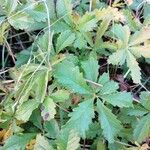
Potentilla reptans
پنجهبرگ (FA) · پنجه برگ رونده، · Creeping Cinquefoil · European fivefinger · Creeping Tormentil
Description
Source: leafsnapPotentilla reptans, commonly known as creeping cinquefoil, is a low-growing perennial plant belonging to the Rosaceae family. Native to Europe and Asia, it has also been introduced and naturalized in North America. Typically reaching up to 30 cm in height, this plant spreads through runners that root at the nodes. The leaves of Potentilla reptans are palmately compound, consisting of five oval or oblong leaflets with toothed margins. These leaflets are hairy on both sides. From May to August, the plant produces small yellow flowers with five petals. Creeping cinquefoil prefers moist, well-drained soils but can tolerate a wide range of soil types. It thrives in both full sun and partial shade and is commonly found along roadsides, in meadows, woodlands, and disturbed areas. Historically, Potentilla reptans has been used medicinally for its anti-inflammatory properties and topically for skin conditions like eczema and psoriasis. Overall, Potentilla reptans is a hardy groundcover that offers attractive foliage throughout the growing season and bright yellow flowers during the summer months. Its resilience and aesthetic appeal make it an excellent addition to any garden or landscape design.
Care Guide
💧 Water Every 3 days
Creeping cinquefoil is native to temperate regions and prefers moderately moist conditions. It thrives when the soil is consistently hydrated, benefiting from weekly watering to maintain its health. Despite its preference for regular moisture, this plant is resilient and can adapt to different rainfall patterns, making it well-suited to both rainy and dry conditions. As a result, creeping cinquefoil is often found spreading across meadows and fields.
How should I water my Creeping cinquefoil plant?
To properly care for the Creeping cinquefoil plant, it is best to use filtered water at room temperature. Tap water may contain harmful particles that can affect the plant's health. Additionally, the water should be warm because the plant is accustomed to a warm environment, and cold water can be shocking. Avoid overhead watering to prevent issues with the foliage. Instead, focus on thoroughly soaking the soil with filtered room temperature water. This method helps moisten the roots, allowing them to spread and extract the necessary nutrients from the soil.
What should I do if I give my Creeping cinquefoil too much or too little water?
Overwatering is a common issue that can harm your Creeping cinquefoil plant. When it receives too much water, the stems and leaves can wilt and turn yellow. Prolonged overwatering can also lead to diseases like root rot, mold, and mildew, which can be fatal to the plant. On the other hand, underwatering is less common for this plant because it can withstand drought to some extent. However, if underwatering does occur, the leaves may become brittle and brown. To care for your Creeping cinquefoil, it is important to notice the signs of overwatering early on. Some diseases resulting from overwatering, such as root rot, may become irreversible if not addressed promptly. If you observe early signs of overwatering, reduce your watering schedule immediately. Additionally, check the quality of the soil where your plant grows. If the soil drains poorly, replace it with a loose, well-draining potting mix. Alternatively, if you see signs of underwatering, increase the frequency of watering until the signs diminish.
How frequently should I water my Creeping cinquefoil plant?
To determine if your Creeping cinquefoil plant needs water, perform a soil test. If your plant is in a pot, simply stick your finger into the soil. If the top two to three inches are dry, it's time to water. For outdoor plants in the ground, use a similar method. Once the first few inches of soil have dried out, water is needed. Typically, during spring and early fall, watering once a week is sufficient. However, during extremely hot weather, watering may need to be increased to at least twice a week. It's important to note that mature and well-established Creeping cinquefoil plants have a remarkable ability to tolerate drought.
How much water does my Creeping cinquefoil plant need?
To properly water your Creeping cinquefoil, don't hold back on the amount of water you give. Make sure the top two to three inches of soil are dry before watering, and then water the plant thoroughly until the soil is completely soaked. It's important to add enough water that it drains out of the drainage holes at the bottom of the pot. If you don't see any excess water draining, you haven't watered enough. However, be careful not to let water accumulate inside the soil, as this can harm the plant. Also, if water isn't draining properly, it could be a sign of poorly draining soil, which is bad for the plant's health. If the plant is outside, 1 inch of rain per week should be enough.
How do I give my Creeping cinquefoil the right amount of water as it grows?
The water needs of the Creeping cinquefoil can vary depending on its growth stages. When it is in the early years or if you have recently transplanted it, more water than usual is required. During these stages, the plant focuses on developing new roots, which need extra moisture to support future growth. As the plant matures, it will require less water. Additionally, during the bloom period, the flower development requires significant moisture, so it may be necessary to provide additional water at this time.
☀️ Light Full sun
Creeping cinquefoil does best in conditions where it receives uninterrupted sunlight throughout the day. This preference for all-day light helps it prosper and supports healthy development. Excessive sun exposure or insufficient sunlight can negatively affect its growth.
What are the sunlight requirements for Creeping cinquefoil?
Creeping cinquefoil requires full sun, meaning it needs above 6 hours of sunlight daily to thrive optimally. It's important to observe how sunlight moves through your garden, choosing locations that offer a perfect balance of light and shade, ensuring the plant's well-being. Creeping cinquefoil favors unobstructed exposure to sunlight throughout the day, which supports its healthy growth. Insufficient or excessive sunlight can negatively affect its growth, so careful consideration of planting location is crucial.
How can artificial lighting be used for Creeping cinquefoil?
When natural sunlight is insufficient, especially during winter or in less sunny areas, artificial lighting serves as an essential alternative for indoor plants, including Creeping cinquefoil. LED lights are recommended because they can be customized to provide specific wavelengths needed by plants. The required intensity varies: full sun plants need 30-50W/sq ft, partial sun plants 20-30W/sq ft, and full shade plants 10-20W/sq ft of artificial light. Position the lights 12-36 inches above the plant to mimic natural sunlight and ensure they're turned on for 8-12 hours per day.
What are the symptoms of inadequate lighting for Creeping cinquefoil?
Symptoms of inadequate lighting in Creeping cinquefoil include smaller new leaves, leggy or sparse growth, faster leaf drop, slower or no new growth, and lighter-colored or chlorotic new leaves. Excessive sunlight can cause symptoms like sunscald, leaf curling, wilting, and leaf scorching. These signs indicate the plant is struggling with the current light conditions, either needing more light or protection from too much direct sunlight.
How can I address lighting issues for my Creeping cinquefoil?
To address lighting issues for Creeping cinquefoil, gradually move plants to a sunnier location each week if they're not receiving enough light, aiming for at least 6 hours of direct sunlight daily. For indoor plants, consider using artificial light sources like desk or ceiling lamps for at least 8 hours daily, or professional grow lights for sufficient light exposure. If the plant is outdoors and experiencing too much light, moving it to a slightly shaded area can prevent sunburn. When dealing with obstructions like trees blocking sunlight, pruning may help. For smaller plants, transplanting during the dormant period to a sunnier location with good drainage is recommended. Note that parts of the plant already affected by poor light might not recover, but new growth should be healthier following these adjustments.
🌡️ Temperature 5–32.2°C
Creeping cinquefoil is native to temperate regions and grows well in temperatures of 41 to 89.6 °F (5 to 32 ℃). In warmer seasons, providing shade and additional watering can help maintain suitable temperature conditions.
What is the native climate for Creeping cinquefoil?
Creeping cinquefoil is native to temperate climates, thriving in temperatures ranging from 41 to 89.6 °F (5 to 32 °C). It has a strong cold resistance, making it well-suited for environments with cooler temperatures. However, during hotter seasons, it's beneficial to provide shade and extra watering to help maintain optimal temperature conditions.
How to protect Creeping cinquefoil from extreme cold?
Creeping cinquefoil usually does not require special frost protection measures during winter due to its strong cold resistance. Yet, if winter temperatures are expected to plummet below -30°C, it's crucial to provide cold protection by covering the plant with materials like soil or straw. Additionally, watering the plant abundantly before the first freeze in autumn is recommended to keep the soil moist and prevent drought and water scarcity during winter and early spring.
What to do if Creeping cinquefoil experiences low temperatures?
Creeping cinquefoil is cold-tolerant and thrives best when temperatures remain above 5°C. In winters, it's advisable to keep it above -25°C. If the temperature falls below -30°C, the plant might not show any immediate changes, but there can be a decrease in sprouting or no sprouting at all come springtime. In such cases, it's best to remove any parts that have failed to sprout as the weather warms.
How should Creeping cinquefoil be cared for during high temperatures?
In summer, it's essential to keep Creeping cinquefoil's temperature below 32°C. Exceeding 35°C can cause the leaves to lighten in colour, become prone to curling, suffer from sunburn, and in severe cases, cause the plant to wilt and dry. To mitigate this, trim away sunburned and dried parts, move the plant to a shaded location or use a shade cloth, and water the plant in the morning and evening to maintain soil moisture.
What are the botanical details of Creeping cinquefoil?
The botanical name for Creeping cinquefoil is Potentilla reptans. It's recognized for its adaptability to various temperature conditions and for being a resilient plant in both cold and warm environments, making it a versatile plant suitable for a range of garden settings.
💨 Humidity
🪴 Soil 5-7
🌱 Fertilizer
The best time to fertilize a Creeping cinquefoil is in early spring, as it returns from dormancy and starts active growth. Fertilizing supplies essential nutrients needed for healthy development. Although Creeping cinquefoil has fairly low fertilizer requirements, applying fertilizer once a year can improve its survival and encourage fuller, longer-lasting blooms.
🪴 Pot & Repot
✂️ Pruning
Creeping cinquefoil has trailing stems adorned with yellow flowers. To encourage growth and manage its spread, prune the plant from early to late spring, removing no more than one-third of it. Regular pruning not only boosts blooming but also reduces disease risk and helps control its invasiveness.
🌿 Propagating
🐛 Diseases & pets
☠️ Toxicity
Non-toxic to humans and pets.
Characteristics
- Plant Type
- Herb
- Life Cycle
- Perennial
- Genus
- Potentilla
- Family
- Rosaceae
- Hardiness Zone
- 4-8
- Mature Height
- 30 cm to 91 cm
- Mature Spread
- 91 cm
- Leaf Color
- Green
- Leaf Type
- Deciduous
- Flower Color
- Yellow
- Flower Size
- 2.03 cm
- Bloom Time
- Early summer, Mid summer
- Planting Time
- Spring, Autumn
- Harvest Time
- Mid summer
- Native Area
- Libya, India, Austria, Turkey, Sweden, Slovakia, Montenegro, Eritrea, Pakistan, Croatia, Slovenia, Morocco, Yemen, Belarus, Uzbekistan, Russia, Iraq, Germany, Estonia, Ethiopia, Romania, Latvia, Belgium, Portugal, Netherlands, France, Tajikistan, Tunisia, Czech Republic, Cyprus, Bulgaria, Poland, Greece, Ukraine, Serbia, Lebanon, Lithuania, Norway, China, Afghanistan, Syria, Kyrgyzstan, Kazakhstan, Italy, Spain, Switzerland, Denmark, Finland, Iran, Albania, Ireland, United Kingdom, Hungary, Algeria, Turkmenistan