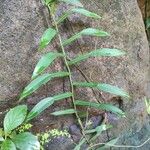
Pothos scandens
Description
Source: leafsnapPothos scandens is a climbing tropical forest plant in the family Araceae. It is the type species of the genus Pothos. No subspecies are recorded in the Catalogue of Life.The distribution of P. scandens is: Bangladesh, Brunei, Cambodia, China (Yunnan), Comoros, India (including Andaman and Nicobar Islands), Indonesia (Java, Kalimantan, Maluku, Nusa Tenggara, Sumatera), Laos, Madagascar, Malaysia (Peninsular Malaysia and Sabah), Myanmar, Philippines, Seychelles, Sri Lanka, Thailand and Vietnam. In Vietnamese it is called tràng phao dây or ráy leo.
Care Guide
💧 Water
Climbing aroids originally come from the understory of tropical rainforests, where they thrive in high humidity and prefer consistent moisture. They require weekly watering to stay healthy. This evergreen plant is ideal for low-light indoor environments and maintains its lush foliage best in rooms with higher ambient humidity.
☀️ Light Partial sun
The climbing aroid naturally occurs in habitats like forest understories or rocky areas, where it is exposed to natural shade. It prefers partial sun but can also tolerate full sun or full shade, demonstrating its versatile and hardy nature.
🌡️ Temperature 20–35°C
The climbing aroid is native to areas with moderate climates and prefers temperatures of 68 to 95 °F (20 to 35 ℃). It adapts well to seasonal changes, but temperatures below 68 °F may slow its growth.
What is the native climate for Climbing Aroid?
Climbing Aroid, also known by its botanical name as Pothos scandens, is native to regions with moderate climates. It thrives in a temperature range of 68 to 95 °F (20 to 35 °C). This plant adapts well to seasonal changes, however, temperatures dropping below 68 °F might slow its growth.
💨 Humidity
🪴 Soil 6-6
🌱 Fertilizer
Correct fertilization is essential for a Climbing aroid's health and appearance. Fertilize Climbing aroid during summer, applying fertilizer once a month throughout the season. Nutrients support growth and preserve the plant's components. Fertilization improves the Climbing aroid's floral display, ensuring the best blooms.
🪴 Pot & Repot Once a year
Repot a climbing aroid in spring or summer once it's warm enough, choosing a pot slightly larger that has good drainage. Water thoroughly after repotting and place it in bright, indirect light. Consider installing a moss pole to support the plant as it grows.
✂️ Pruning
To ensure healthy growth and maintain their shape, climbing aroids need to be pruned periodically. Important steps in this process include trimming overgrown vines and removing dead leaves, ideally from early to late spring. It is crucial to use clean, sharp tools to prevent damage and to promote a fuller, more vigorous plant.
🌿 Propagating
🐛 Diseases & pets
☠️ Toxicity
Characteristics
- Plant Type
- Herb
- Life Cycle
- Perennial
- Genus
- Pothos
- Family
- Araceae
- Hardiness Zone
- 10
- Mature Height
- 3.96 m to 6.1 m
- Mature Spread
- 0.91 m to 2.13 m
- Leaf Color
- Green
- Leaf Type
- Evergreen
- Flower Color
- Yellow, Green
- Flower Size
- 0.51 cm to 0.51 cm
- Bloom Time
- Summer, Early fall
- Planting Time
- Spring, Summer
- Harvest Time
- Late summer, Fall
- Native Area
- Sri Lanka, India, Malaysia, Indonesia, Cambodia, Vietnam, Myanmar, Philippines, Madagascar, Bangladesh, Laos, Thailand, China