Proboscidea parviflora
Doubleclaw · Doubleclaw Unicorn Plant · Small-flower Unicorn-plant
Description
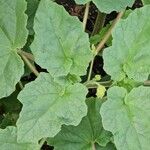
Source: leafsnapProboscidea parviflora is a species of flowering plant in the family Martyniaceae known by the common names doubleclaw and red devil's-claw. It is native to the desert southwest of the United States and northern Mexico, where it grows in sandy, dry, and disturbed habitat and blooms during the hot summer. This is an annual herb growing from a taproot and producing sprawling, spreading stems. The leaves have rounded, oval, or roughly triangular blades up to 15 centimetres (6 in) long which have smooth edges or faint lobes or teeth. The inflorescence is an array of several showy bell-shaped flowers with five lobes flaring several centimeters wide. The flower is white to pink or purple, sometimes with mottling or lines of spots in the throat, and often a purple blotch on the upper lip. A yellow nectar guide extends along the lower lip. The fruit is a large seed pod many centimeters long, a cylindrical body tapering into a very long, thin, curving tail. As the fruit dries the tail cracks open and splits into two hooked, claw-like halves. The young fruits and seeds were used for food and the dark-colored hardened dry fruits were used in basketry by local Native Americans.
Care Guide
💧 Water
Doubleclaw is well-suited for arid environments, thriving in dry conditions and requiring minimal watering. It is drought-tolerant and ideal for xeric landscapes, thanks to its deep root systems that can reach moisture reserves. When cultivating doubleclaw, it is recommended to water it weekly to mimic its natural growth patterns, ensuring its survival even in challenging climates.
☀️ Light Full sun
Doubleclaw does best in full sun and can tolerate moderate light levels. This plant, native to arid regions, develops most effectively in sunny environments but still grows satisfactorily when sunlight is somewhat reduced. However, too much or too little light can impede Doubleclaw's vigorous growth.
🌡️ Temperature 10–37.8°C
Doubleclaw is native to temperate regions and prefers temperatures from 68 to 100 °F (20 to 38 °C). When cultivating it through different seasons, keep the plant toward the warmer end of that preferred range.
💨 Humidity
🪴 Soil 6-7
🌱 Fertilizer
Doubleclaw benefits from regular, diluted fertilizer applications to encourage healthy leaf growth. You should fertilize Doubleclaw about once a month during the summer. Nitrogen is essential for foliage, and adding nitrogen-rich sources helps Doubleclaw thrive.
🪴 Pot & Repot
✂️ Pruning
Doubleclaw, known for its distinctive claw-shaped seed pods, benefits greatly from regular pruning. Key techniques include removing dead branches and thinning out crowded areas, ideally from early to late spring. Pruning during this period encourages vigorous growth, enhances air circulation, and improves both the health and appearance of the plant.
🌿 Propagating
🐛 Diseases & pets
☠️ Toxicity
Characteristics
- Plant Type
- Herb
- Life Cycle
- Annual
- Genus
- Proboscidea
- Family
- Pedaliaceae
- Hardiness Zone
- 6-11
- Mature Height
- 61 cm to 91 cm
- Mature Spread
- 0.91 m to 1.22 m
- Leaf Color
- Light Green, Dark Green
- Leaf Type
- Deciduous
- Flower Color
- Lavender
- Flower Size
- 2.54 cm to 5.08 cm
- Bloom Time
- Summer, Early fall
- Planting Time
- Spring
- Harvest Time
- Late summer, Fall