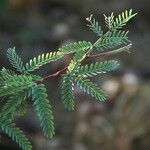
Prosopis pallida
Algarrobo · Kiawe · American carob · Mesquite
Description
Source: leafsnapProsopis pallida is a species of mesquite tree. It has the common names kiawe () (in Hawaii), huarango (in its native South America) and American carob, as well as "bayahonda" (a generic term for Prosopis), "algarrobo pálido" (in some parts of Ecuador and Peru), and "algarrobo blanco" (usually used for Prosopis alba). It is a thorny legume, native to Colombia, Ecuador and Peru, particularly drier areas near the coast. While threatened in its native habitat, it is considered an invasive species in many other places. The kiawe is a spreading bush or moderately sized tree, bearing spines, spikes of greenish-yellow flowers, and long pods filled with small brown seeds. It is a successful invasive species due to its ability to reproduce in two ways: production of large numbers of easily dispersed seeds, and suckering to create thick monotypic stands that shade out nearby competing plants. It survives well in dry environments due to a long taproot which can reach deep watertables. It is so efficient at extracting moisture from soil that it can kill nearby plants by depriving them of water, as well as by shading them out. It can be found in areas where other plants do not grow, such as sandy, dry, degraded slopes, salty soils, disturbed areas, and rocky cliffs. The tree grows quickly and can live for over a millennium. It makes a good shade tree, if one does not mind the nasty thorns of the fallen branches. Its hard wood is a source of long-burning firewood and charcoal. Kiawe pods can be used as livestock fodder, ground into flour, turned into molasses or used to make beer. The light yellow flowers attract bees, which produce from them a sought-after white honey.Fallen Kiawe branches usually contain sharp spines that can puncture both feet and tires. At times the tree was used to replace forest and prevent erosion, and once it was established it generally dominates the habitat. It was introduced to Puerto Rico and Hawaii as well as New South Wales and Queensland in Australia and is now naturalized in those places. The first kiawe was planted in Hawaii in 1828; today it is a ubiquitous shade tree and invasive weed on the Hawaiian Islands, but provides firewood for heating and cooking.The clearing of kiawe (huarango) has been suggested as a major reason for the collapse of the Nazca culture in southern Peru at the beginning of the 6th century AD after an El Niño event led to flooding, erosion and desertification.Ecologists consider the huarango important to the ecosystem of the desert area west of the Andes in southern Peru, because of its ability to bind moisture and counter erosion. Despite prohibitions by regional authorities, poor villagers continue to harvest the trees to make charcoal. Efforts are under way to reforest the area with huarangos.In the southwest of Ecuador, Prosopis pallida and Prosopis juliflora both display substantial genetic variability due to the (intraspecific) cross-pollination of their self-incompatible flowers which are typical of the genus Prosopis. As a result, trees of these species display a range of physical traits that lead to trees of one species resembling descriptions of the other, and the two species are often confused. To compound the difficulty in discerning the species of a given tree, these two species hybridise readily where their ranges overlap. In the semi-arid Zapotillo Canton of Ecuador, both thorn-bearing and thornless strains of Prosopis pallida exist with thorn-bearing trees being more common. It is the preferred tree of the local people for making charcoal and is sometimes also cut for firewood or fence posts.
Care Guide
💧 Water
☀️ Light Full sun
Kiawe comes from open habitats like sunny meadows and forest edges, which offer abundant light. It thrives in Full Sun but can also tolerate Partial Sun, adapting well to a range of sunlight conditions.
🌡️ Temperature 20–37.8°C
Kiawe comes from tropical areas, where the climate is usually warm and humid. Consequently, it is well suited to high temperatures and moisture. It does not tolerate sudden temperature shifts and prefers a consistent thermal environment, so avoiding indoor temperature fluctuations is important. It typically cannot endure cold and needs higher temperatures to grow. If the ambient temperature falls too low, the plant may stop growing or even die.
💨 Humidity normal (40-60%)
This plant will thrive in moderate humidity, which is probably the level in your home. However, misting it a few times a week can be very beneficial. Make sure the room has good ventilation.
🪴 Soil 6-8
🌱 Fertilizer
Providing fertilizer is vital for Kiawe care. Applying nutrients regularly throughout the growing season maintains the vigor needed for its showy leaves and supports overall development. If fertilization is neglected, leaves can become unhealthy, the plant’s ornamental value may decline, and growth may be stunted or weak and more prone to breaking.
🪴 Pot & Repot
✂️ Pruning
Kiawe trees have thorny branches and produce woody pods. To maintain their health and appearance, it's important to prune them strategically in early spring. By making thinning cuts, you can improve air circulation and light penetration, which encourages healthier growth and helps reduce pest problems. Additionally, using clean tools for pruning is crucial to prevent the spread of diseases.
🌿 Propagating
🐛 Diseases & pets
☠️ Toxicity
Characteristics
- Plant Type
- Tree
- Life Cycle
- Perennial
- Genus
- Prosopis
- Family
- Leguminosae
- Hardiness Zone
- 9-11
- Mature Height
- 4.88 m to 20.12 m
- Mature Spread
- 6.1 m to 14.94 m
- Leaf Color
- Light Green, Olive Drab
- Leaf Type
- Evergreen
- Flower Color
- Yellow
- Flower Size
- 0.51 cm to 0.76 cm
- Bloom Time
- Late spring, Summer
- Planting Time
- Spring, Summer, Autumn
- Harvest Time
- Late summer, Fall
- Native Area
- Colombia, Bolivia, Ecuador, Peru