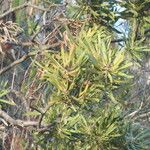
Protea neriifolia
Oleander-leaf protea · Narrowleaf protea · Narrow-leaved Sugarbush · Blue Sugarbush · Oleander-leaved Sugarbush
Description
Source: leafsnapProtea neriifolia, also known as the narrow-leaf sugarbush, oleander-leaved sugarbush, blue sugarbush, or the oleanderleaf protea, is a flowering plant in the genus Protea, which is endemic to South Africa.Common names for the species in the Afrikaans language include blousuikerbos, baardsuikerbos, baardsuikerkan, blou-suikerbos, blousuikerkan, roosboom and suikerbos.The tree's national number is 93.1.
💡 The Protea flower, widely cultivated for its long-lasting blooms, symbolizes hope, courage, and transformation. As an easy-to-grow houseplant or a shade-loving garden plant, the Protea makes an ideal gift to give or receive.
🎭 Creativity, variety, change and bravery
Care Guide
💧 Water
The narrow-leaf sugarbush, a plant native to the fynbos region of South Africa, is adapted to drought conditions and thrives in well-drained soils. It should be watered every 2 to 3 weeks, allowing the soil to dry out between waterings. This plant prefers full sun and can pause its growth during dry periods, reflecting the climate of its natural habitat.
☀️ Light Full sun
Native to habitats with strong sunlight, the narrow-leaf sugarbush performs best in high light levels, which speed its growth. It can also grow in lower-light sites, but inadequate exposure may harm its health. At different stages of development it needs sufficient light. Both excessive and insufficient light can cause damaging effects.
What are the sunlight requirements for narrow-leaf sugarbush?
Narrow-leaf sugarbush requires full sun, meaning it needs more than 6 hours of sunlight daily to thrive best. However, it can also tolerate partial sun, which is about 3-6 hours of sunlight. It's important to observe your garden to find spots that offer a good balance of light and shade to ensure the health and happiness of your plants. Insufficient or excessive exposure to sunlight can lead to various health issues, emphasizing the need for the right amount of sunlight.
How can artificial lighting help indoor narrow-leaf sugarbush plants, and what are the best practices?
When natural sunlight is insufficient, especially during winter or in less sunny spaces, artificial lighting can be crucial for the growth of indoor narrow-leaf sugarbush plants. LED lights are recommended due to their ability to provide specific wavelengths needed by plants. Full sun plants require 30-50W/sq ft, partial sun plants need 20-30W/sq ft, and full shade plants need 10-20W/sq ft of artificial light. The light source should be placed 12-36 inches above the plant and turned on for 8-12 hours per day to mimic natural daylight hours, promoting healthier and faster growth.
What are the symptoms of insufficient light in narrow-leaf sugarbush, and how does excessive sunlight affect it?
Insufficient light can cause symptoms such as smaller new leaves, leggy or sparse growth, faster leaf drop, delayed or halted growth, and paler new leaves indicating a lack of chlorophyll. Excessive sunlight can lead to chlorosis (leaves turning yellow), sunscald (damaged leaves or stems), leaf curling, wilting, and leaf scorching, which shows as brown, dry edges or patches on leaves. Both insufficient and excessive sunlight negatively impact the plant's health, highlighting the importance of optimal light exposure.
What solutions can be applied for narrow-leaf sugarbush suffering from light-related issues?
For indoor plants, gradually moving them to sunnier locations each week until they receive at least 6 hours of sunlight daily is recommended. Using south-facing windows and keeping curtains open during the day, or using artificial lights for at least 8 hours daily can also be beneficial. For outdoor plants, a gradual adjustment to sunnier spots is crucial to avoid sunburn. Pruning or transplanting to reduce shade obstructions can increase sunlight exposure. While damaged parts may not recover, new growth should be healthy with improved light conditions.
🌡️ Temperature 20–41.1°C
Narrow-leaf sugarbush is native to habitats with temperatures between 68 and 105.8 °F (20 to 41 ℃). It is ideally suited to warmer conditions. If temperatures drop substantially, seasonal adjustments may be necessary.
What is the ideal temperature range for a Narrow-leaf sugarbush?
The Narrow-leaf sugarbush, or Protea neriifolia, thrives in environments with temperatures between 68°F (20°C) and 105.8°F (41°C), making it well-suited for warmer climates. As a heat-loving plant, it endures seasonal variations poorly, particularly cold temperatures. To ensure its well-being, it's recommended to move the plant indoors during autumn to a bright but not too hot location. Keeping temperatures above 20°C during winter is beneficial, while exposure to temperatures nearing 5°C or lower is harmful.
How does the Narrow-leaf sugarbush react to low temperatures?
The Narrow-leaf sugarbush prefers warm conditions and struggles with low temperatures, thriving best when it's above 20°C and requiring it to be kept above 5°C during winter. Exposure to temperatures below 1°C can cause the leaves to lighten in color, and following frost damage, they gradually turn brown or black. Wilting and drooping are common symptoms of cold stress. To mitigate damage, trim the frost-affected areas and move the plant to a warmer indoor space, ideally near a south-facing window for sufficient sunlight while avoiding excessive dryness from heaters or air vents.
What should I do if my Narrow-leaf sugarbush experiences high temperatures?
During the summer, it's crucial to ensure the Narrow-leaf sugarbush remains below 41°C to prevent heat stress. Temperatures exceeding 45°C can cause the leaves to lighten and increase susceptibility to sunburn. Mitigation strategies include trimming sunburned and dried parts, relocating the plant to a shaded area during peak sun hours, and maintaining soil moisture with watering routines in the cooler morning and evening hours.
💨 Humidity
🪴 Soil 6-7
🌱 Fertilizer
The best time to fertilize a Narrow-leaf sugarbush is in early spring when it comes out of dormancy. This supports overall growth and flower development. Applying fertilizer improves the foliage, stems, and branches, and encourages flowers that are large, vibrant, and long-lasting. It also helps move nutrients from the roots to the flowers and strengthens the plant's health and resistance to disease.
🪴 Pot & Repot 2-3 years
Repot the narrow-leaf sugarbush every 2 to 3 years in early spring. Use a larger pot with well-draining soil. After repotting, place the plant in a sunny location and be careful not to overwater it. This will help ensure healthy growth and beautiful blossoms.
✂️ Pruning
Narrow-leaf sugarbush benefits from regular pruning in early spring before new growth begins. To encourage a bushy shape and increased blooms, remove dead or crossing branches and trim stems that have already flowered. Making lighter cuts improves air circulation and light penetration, which promotes the plant's overall health and vigor.
🌿 Propagating
🐛 Diseases & pets
☠️ Toxicity
Characteristics
- Plant Type
- Shrub
- Life Cycle
- Perennial
- Genus
- Protea
- Family
- Proteaceae
- Hardiness Zone
- 10-13
- Mature Height
- 1.22 m to 1.83 m
- Mature Spread
- 1.83 m to 2.44 m
- Leaf Color
- Dark Green
- Leaf Type
- Evergreen
- Flower Color
- Pink, Red
- Flower Size
- 12.70 cm to 15.24 cm
- Bloom Time
- Winter, Early spring, Mid spring
- Planting Time
- Spring, Summer, Autumn
- Harvest Time
- Spring, Early summer
- Native Area
- South Africa