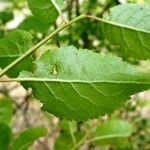
Prunus domestica
آلو وحشی · آلو · آلو و گوجه سبز · Δαμασκηνιά (Damaskinia) · Plum
Description
Source: leafsnapPrunus domestica, the European plum is a species of flowering plant in the family Rosaceae. A deciduous tree, it includes many varieties of the fruit trees known as plums in English, though not all plums belong to this species. The greengages and damsons also belong to subspecies of P. domestica. Its hybrid parentage was believed to be Prunus spinosa and P. cerasifera; however recent cytogenetic evidence seem to implicate 2×, 4×, 6× P. cerasifera as the sole wild stock from which the cultivated 6× P. domestica could have evolved.
🌳 In the medieval period, master painters frequently used european plum as a source of long-lasting, vivid purple pigments. The fruit supplied this surprising yet valuable colorant, which was also used in the fabric industry for dyeing. Beyond lending hues to art and clothing, european plum has fruits high in pectin, making them a popular choice for sweets and helping to regulate blood sugar.
🎭 The arrival of spring, life changes, persistence, optimism, plenty, temptation
Care Guide
💧 Water Every 1-2 weeks
European plum trees, which originate from a variety of climates, thrive in conditions with moderate moisture and can tolerate short periods of dryness. It is advisable to water them once every 1 to 2 weeks, but you should adjust this schedule during the colder months when the trees are dormant, as their water needs decrease during this time.
When should I water my European Plum?
Watering your European Plum should be based on several indicators. The right time to water is when the soil moisture around the plant's base is low. To check this, insert your finger into the soil up to the second knuckle; if it feels dry, it's time to water. Additionally, look for signs in the leaves, such as drooping, limpness, or discoloration, as these indicate the plant needs water. Wilting and drought stress symptoms, like curling leaves and leaf scorch, also suggest a need for watering. Important to note is the increased water requirement during fruit development stages, hot, dry periods, and when exposed to direct sunlight. However, be cautious of watering too early or too late, which can respectively lead to root diseases or negatively impact growth and fruit production.
How should I water my European Plum?
European Plum thrives with deep watering sessions that encourage deep root growth while avoiding the risks of root rot associated with over-watering. This can be effectively achieved using a soaker hose or drip irrigation system targeting the root zone to minimize moisture loss through evaporation and prevent diseases. Ensure the watering is focused on the plant's base, avoiding the leaves, and strive for balance, avoiding both under-watering and over-watering. Tools like a soaker hose, drip irrigation system, or a long-spouted watering can are recommended for efficient watering. Additionally, using a moisture meter can help avoid over-watering by gauging when the soil is dry and in need of water.
How much water does the European Plum really need?
The amount of water needed by a European Plum varies with several factors such as the plant's size, pot size, and root depth. Generally, watering once a week with about 1 to 2 gallons (4-8 liters) per session is sufficient, ensuring the water penetrates to a depth of about 12-18 inches (30-45 cm), reaching the root system adequately. Signs of a well-hydrated plant include healthy foliage and vigorous growth. Be aware of the symptoms of both over and under-watering, including yellowing leaves and wilting, and adjust your watering routine to strike the right balance. It's crucial to base watering on the plant's actual needs rather than a strict schedule, taking into account the current soil moisture and environmental conditions.
What kind of water is best for the European Plum?
The best water types for European Plum include distilled water, which is free from harmful minerals and chemicals, and rainwater, known for its ideal pH level and absence of chemicals. Filtered water is a good alternative, provided it removes harmful contaminants. Tap water is acceptable but not preferred due to potential chlorine and fluoride content, which European Plum is sensitive to. To minimize the adverse effects of chlorine in tap water, letting it sit out for at least 24 hours before use is recommended. The plant generally prefers water at room temperature (68-72°F or 20-22°C) to avoid shocking the root system.
How do European Plum's watering needs change with the seasons?
European Plum's watering needs vary through the seasons. In spring, its prime growing season, the plant requires more water to support new growth. As temperatures rise in summer, so does the plant's need for water due to increased evaporation and ongoing growth. Come autumn, the plant's water requirements decrease as it begins to prepare for dormancy, necessitating less frequent watering. During winter, the plant is dormant, and its water needs significantly drop. It's essential to adjust your watering routine accordingly, focusing on keeping the soil lightly moist in winter and ensuring consistent moisture during the active growth periods in spring and summer.
☀️ Light Full sun
European plum requires abundant sunlight for healthy growth. The range of solar light encourages vigorous development at every stage of growth. Having originated in a setting with high levels of sunlight, it can experience adverse effects if exposed to too little light and likewise if exposed to an excess of natural light.
What are the sunlight requirements for a European plum?
The European plum (Prunus domestica) thrives in conditions ranging from full to partial sun. Full sun exposure means the plant should receive above 6 hours of sunlight daily, while partial sun refers to about 3-6 hours of sunlight. It's crucial to observe how sunlight moves through your garden, choosing locations that offer a balanced mix of light and shade, ensuring the plants' well-being. Originating from environments with substantial sunlight, European plums can suffer from ill effects if exposed to too little or too much natural light.
How can artificial lighting benefit European plum indoors?
When natural sunlight is insufficient, especially during winter or in less sunny spaces, artificial lighting can be a significant boon for indoor European plum plants. Adequate lighting promotes faster, healthier growth by mimicking the spectrum of solar illumination required for vigorous development. LED lights are a popular choice, customizable to provide the wavelengths needed by the plants. Full sun plants need 30-50W/sq ft of light, partial sun plants need 20-30W/sq ft, and shade plants 10-20W/sq ft. Positioning the light source 12-36 inches above the plant for 8-12 hours per day can simulate natural daylight conditions.
What are the signs of inadequate lighting in European plums?
European plums show distinct symptoms when they receive insufficient light, including smaller new leaves, leggy or sparse growth, early leaf drop, stalled growth, and pale or irregularly colored new leaves. Other issues may arise from excessive sunlight, such as chlorosis (leaves turning yellow due to chlorophyll breakdown), sunscald (damage from intense sunlight), leaf curling, wilting, and leaf scorching. Observing these signs can indicate the need to adjust the plant's exposure to light.
What solutions can alleviate light-related issues in European plums?
To address light-related issues in European plums, gradually increasing sunlight exposure is key. For indoor plants, moving them closer to a south-facing window or supplementing with artificial light for at least 8 hours a day can be beneficial. Outdoor plants should be moved to sunnier spots gradually to avoid sunburn. Pruning obstructions or transplanting to sunnier locations can also help. It's important to note that parts of the plant damaged by light stress may not recover, but adjusting the light condition will promote healthy new growth.
🌡️ Temperature 5–35°C
The European plum plant species is native to temperate regions and prefers temperatures between 41 and 95 ℉ (5 to 35 ℃). It can tolerate higher heat in the warmer months, but it requires cooler conditions in winter. To promote optimal growth, it is advisable to adjust temperatures across the seasons.
What is the optimal temperature range for the growth of European Plum (Prunus domestica)?
The European Plum (Prunus domestica) species thrives in temperate regions, favoring a temperature range between 41 to 95°F (5 to 35°C). It can withstand higher temperatures during the warmer months and requires cooler temperatures in the winter to ensure optimal growth. The plant possesses strong cold resistance, thereby making special frost protection measures usually unnecessary. However, if temperatures are expected to fall below the tolerance limit during winter, cold protection should be provided by using insulating materials like non-woven fabric or cloth to wrap the trunk and branches. Additionally, the plant should be watered abundantly before the first autumn freeze to maintain soil moisture and prevent drought and water scarcity during winter and early spring.
How does low temperature affect the European Plum, and what solutions are recommended?
European Plum is notably cold-tolerant and generally thrives best at temperatures above its minimal suitable growth threshold. However, when winter temperatures fall below its tolerance limit, the plant might not exhibit immediate distress, but its branches can become brittle and dry come spring, failing to produce new shoots. The recommended solution for this scenario involves pruning away any dead branches that have failed to produce new leaves in spring, thereby preventing possible spread of damage and encouraging new growth.
What are the effects of high temperature on the European Plum, and how can they be mitigated?
During the summer, the European Plum should ideally be kept below its maximum suitable growth temperature. When temperatures exceed its higher tolerance threshold, the plant's leaves may lighten in color, and tips can become dry and withered, indicating susceptibility to sunburn. To mitigate these effects, it's advisable to trim away sunburned and dried parts, and move the plant to a shadier location or use a shade cloth for protection against the midday and afternoon sun. Furthermore, watering the plant in the morning and evening can help keep the soil moist, thus alleviating stress from heat.
💨 Humidity normal (40-60%)
This plant will thrive in moderate humidity, which is probably the level in your home. However, misting it a few times a week can be very beneficial. Make sure the room has good ventilation.
🪴 Soil 6-7
🌱 Fertilizer
The European plum plant needs adequate nutrients to achieve optimal fruit production. Apply fertilizer in early spring to encourage new growth and bloom development. Regular feeding helps the plant remain healthy, produce more delicious fruit, and prevents nutrient deficiency problems such as yellowing leaves and poor fruit production.
What kind of fertilizer does my European plum tree need?
Using fertilizer that contains a balance of nitrogen, phosphorus, and potassium can bring many benefits to plants. Nitrogen is important for leaf growth and chlorophyll production. Phosphorus helps support the root system and promotes the development of blossoms, fruits, and seeds. Potassium plays a role in photosynthesis and the movement of water and nutrients throughout the plant. When choosing a fertilizer, you can opt for a commercial one that is specifically designed for a particular type of tree. Alternatively, you can use organic sources of nitrogen such as manure, feather meal, or blood meal. To ensure you apply fertilizer accurately, conducting a soil test can give you a better understanding of the condition of your soil. For commercial fertilizers, if your soil lacks sufficient phosphorus and potassium according to the soil test, you can use a balanced granular fertilizer with a ratio of 10-10-10 or similar. In most cases, nitrogen in the soil is continuously depleted with rainfall. If your soil already has enough phosphorus and potassium, it would be more appropriate to use a high-nitrogen fertilizer with a ratio of 6-2-1 or 10-2-2.
Why do I have to add fertilizers to my European plum?
Plants need nutrients from the soil to grow, especially fast-growing plants. European plum trees are no exception and require regular fertilization to maintain their health and produce delicious fruit. If plants are not fertilized for an extended period, they may encounter various problems. Nutrient deficiency can result in visible issues with the foliage, such as yellowing leaves or leaves developing a reddish color. It can also lead to deformities in leaf shape, withered tips, or significant portions of the plant dying back. In addition, nutrient deficiency can affect the bark, slowing down growth, inhibiting shoot development, and causing a lack of fruit production.
When should I fertilize my European plum tree?
The best time to fertilize European plum trees is in early spring, right before the buds start to appear. During this time, the tree utilizes the energy reserves it stored up during winter to support new growth. It is crucial to provide enough energy for the blossoming process, so fertilizing about 2 to 4 weeks before the expected bloom time is recommended. This allows the nutrients to fully seep into the soil, be absorbed, and distributed throughout the plant. While you can continue to fertilize during spring, it is not advisable to do so in autumn as it may lead to excessive foliage growth late in the season, making the leaves vulnerable to damage during winter.
When should I not put fertilizer on my European plum?
Here are some tips for fertilizing European plum trees: 1. In the first year of growth, avoid fertilizing altogether. If it's not necessary, be cautious about providing fertilizer. 2. If you pruned 20% or more of the plant the previous year, refrain from fertilizing. 3. Do not fertilize plants that are diseased or damaged, as it can do more harm than good. Address the underlying issue first. 4. Avoid fertilizing after the peak of summer, as this can cause excessive growth before winter. 5. During hot and dry periods, such as droughts, refrain from fertilizing. Dry soil doesn't effectively deliver fertilizer and can stimulate growth that requires more water. 6. The best time to apply fertilizer is earlier in the season when temperatures are cooler. 7. Be mindful that European plum trees can absorb fertilizer applied to nearby plants or lawns, so be cautious to avoid giving plants a double-dose of fertilizer.
How can I make my European plum tree grow better?
To properly fertilize your European plum tree, it is important to follow specific directions for the type of fertilizer you are using. Avoid over-fertilization by determining the correct amount to use, especially for fruit trees. Typically, you can use the age of the tree (if known) or the diameter of the trunk as a guide. Estimate about one-tenth of a pound of fertilizer per year or per inch of trunk, up to a maximum of one pound. However, note that European plum trees should not be fertilized during the first few years of growth. For granular or organic fertilizers like blood meal, apply them by sprinkling the substance around the base of the tree, extending all the way to the drip line (the area below the farthest-reaching branches). Avoid letting the fertilizer come into contact with the trunk. Over time, the granules will break down and filter into the soil, being absorbed by the roots. After fertilizing, spread a layer of compost around the base of the tree, about an inch deep, and thoroughly water the area.
🪴 Pot & Repot Every 12 months
✂️ Pruning
European plum trees produce sweet, juicy fruits and thrive when pruned carefully in late winter. This practice helps reduce the risk of disease, enhances sunlight penetration, and improves air circulation. When pruning, focus on removing dead wood and thinning the canopy to maintain the tree's shape and increase its yield.
🌿 Propagating
🐛 Diseases & pets
☠️ Toxicity
Characteristics
- Plant Type
- Tree
- Life Cycle
- Perennial
- Genus
- Prunus
- Family
- Rosaceae
- Hardiness Zone
- 4-9
- Mature Height
- 6.1 m to 14.94 m
- Mature Spread
- 10.06 m
- Leaf Color
- Green
- Leaf Type
- Deciduous
- Flower Color
- White
- Flower Size
- 1.02 cm to 1.52 cm
- Bloom Time
- Mid spring, Late spring
- Planting Time
- Spring, Autumn
- Harvest Time
- Mid summer
- Native Area
- Western Asia