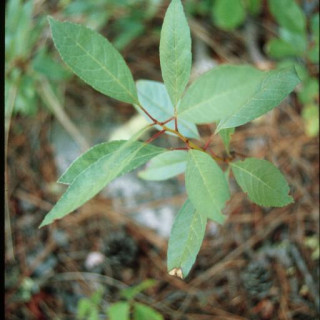
Prunus pumila
Sand cherry · Dwarf cherry · Môxôhe'êstámenôtse · Dwarf American cherry
Description
Source: leafsnapPrunus pumila, commonly called sand cherry, is a North American species of cherry in the rose family. It is widespread in eastern and central Canada from New Brunswick west to Saskatchewan and the northern United States from Maine to Montana, south as far as Colorado, Kansas, Indiana, and Virginia, with a few isolated populations in Tennessee and Utah. It grows in sandy locations such as shorelines and dunes. Prunus pumila is a deciduous shrub that grows to 2-6 feet tall depending on the variety. It forms dense clonal colonies by sprouts from the root system. The leaves are leathery, 4–7 centimetres (1.6–2.8 in) long, with a serrated margin. The flowers are 15–25 millimetres (0.59–0.98 in) in diameter with five white petals and 25–30 stamens. They are produced in small clusters of two to four. The fruit is a small cherry 13–15 millimetres (0.51–0.59 in) diameter, ripening dark purple in early summer. Varieties Prunus pumila var. besseyi (Bailey) Gleason, western sand cherry (also called Rocky Mountain cherry) - Saskatchewan, Manitoba, western Ontario, south to Colorado and Kansas Prunus pumila var. depressa (Pursh) Gleason, eastern sand cherry - Ontario, Québec, New Brunswick south to Pennsylvania Prunus pumila var. pumila, Great Lakes sand cherry - shores of Great Lakes Prunus pumila var. susquehanae (hort. ex Willd.) Jaeger, Susquehana sand cherry - from Manitoba east to Maine, south to Tennessee Prunus × cistena (purple leaf sand cherry) is a hybrid of Prunus cerasifera (Cherry Plum) and Prunus pumila. It was developed by Niels Ebbesen Hansen of South Dakota State University in 1910. They grow to be about 7 feet tall and can live for up to 20 years.
🌳 Beyond its decorative appeal, sand cherry fulfills an important ecological function as a larval host plant for several butterfly species, including the eastern tiger swallowtail. This species interaction reveals a little-known ecological importance, with sand cherry directly supporting the feeding and life cycle of certain butterflies by supplying its leaves as food for caterpillars.
Care Guide
💧 Water
The sand cherry thrives in temperate regions with moderate moisture and prefers well-drained soils. Once established, it is moderately drought-tolerant. For optimal care, water it sparingly, ideally every three weeks, and maintain consistent soil moisture during colder, dormant periods. Due to its size and growth habit, the sand cherry is typically grown outdoors.
☀️ Light Full sun
Sand cherry prefers steady sunlight throughout the day for best growth, though it can withstand periods with less light. It has evolved in an environment with abundant light, and its overall health and growth could be impeded by a prolonged, habitual lack of intense illumination.
🌡️ Temperature 0–32.2°C
Sand cherry naturally occurs in habitats with temperatures ranging from 32 to 90 °F (0 to 32 ℃). It does best in milder temperatures. Reducing its exposure to temperature extremes, especially during winter, could benefit the plant.
💨 Humidity
🪴 Soil 6-7
🌱 Fertilizer
The sand cherry plant needs adequate nutrients to achieve optimal fruit production. Fertilize in early spring to promote new growth and bloom development. Regular feeding keeps the plant healthy, encourages production of more tasty fruit, and prevents nutrient-deficiency problems like yellow leaves and poor fruit production.
🪴 Pot & Repot
✂️ Pruning
Sand cherry, celebrated for its drought tolerance and ornamental appeal, greatly benefits from selective pruning in late spring. Start by removing dead branches, then thin out dense areas to enhance airflow. Regularly remove suckers as well. Proper pruning enhances the plant's health, growth, and shape, resulting in a vigorous and attractive appearance.
🌿 Propagating
🐛 Diseases & pets
☠️ Toxicity
Characteristics
- Plant Type
- Shrub
- Life Cycle
- Perennial
- Genus
- Prunus
- Family
- Rosaceae
- Hardiness Zone
- 3-8
- Mature Height
- 0.61 m to 1.83 m
- Mature Spread
- 91 cm
- Leaf Color
- Green, Orange
- Leaf Type
- Deciduous
- Flower Color
- White
- Flower Size
- 1.52 cm to 2.54 cm
- Bloom Time
- Mid spring, Late spring
- Planting Time
- Spring, Autumn
- Harvest Time
- Early summer, Mid summer