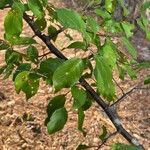
Prunus umbellata
Sloe plum · Allegheny plum · Flatwoods plum · Hog plum
Description
Source: leafsnapPrunus umbellata, called flatwoods plum, hog plum and sloe plum, is a plum species native to the United States from Virginia, south to Florida, and west to Texas.Prunus umbellata can reach 6.1 meters (20 feet) in height with a 4.6 m (15 ft) spread. It has alternate serrate green leaves that turn yellow in autumn. Flowers are white, creamy, or grayish. Fruits are round, purple, and 1.3–2.5 centimeters (1⁄2–1 inch) in diameter. The trees bloom and bear fruit later than other plums. The fruits mature August–October. Large crops appear only every 3–4 years.P. umbellata trees can live up to 40 years and are very difficult to distinguish from P. angustifolia, with which it hybridizes easily.The fruits are made into jellies and jams.
Care Guide
💧 Water
Hog plum naturally thrives in moist, well-drained soils. While it prefers consistent moisture, it becomes moderately drought-tolerant once established. To maintain its health, water it twice a week, allowing the soil to dry out slightly between waterings. When grown outdoors, mulch around the plant to help retain moisture and regulate temperature, which is essential for its growth cycle.
☀️ Light Full sun
Hog plum comes from open habitats, such as sunny meadows and forest edges, which supply abundant light. It does best in Full Sun but can tolerate Partial Sun, adapting well to a range of sunlight conditions.
What are the sunlight requirements for Hog plum (Prunus umbellata)?
Hog plum (Prunus umbellata) thrives in different sunlight conditions but requires specific amounts to flourish. It needs full sun, characterized by over 6 hours of sunlight daily, to foster growth and bloom. Alternatively, it can grow in partial sun, which means about 3-6 hours of sunlight daily. It's essential to observe the movement of sunlight in your garden to find spots that offer the right mix of light and shade, ensuring your Hog plum plants are happy and healthy.
🌡️ Temperature 5–35°C
Hog plum shows strong adaptability to a wide range of climates, from extremely hot summers to cold winters. Nonetheless, it has a preferred temperature range for growth. If temperatures become too high, the plant is susceptible to heat and humidity stress, which can lead to its death. In areas where temperatures approach the lower limit of its cold tolerance, it is necessary to use insulation measures to protect the plant.
What is the botanical name of Hog plum?
The botanical name of Hog plum is Prunus umbellata.
💨 Humidity normal (40-60%)
This plant will thrive in moderate humidity, which is probably the level in your home. However, misting it a few times a week can be very beneficial. Make sure the room has good ventilation.
🪴 Soil 6-7
🌱 Fertilizer
The hog plum plant needs adequate nutrients to achieve optimal fruit production. Apply fertilizer in early spring to encourage new growth and bloom development. Regular feeding keeps the plant healthy, yields more delicious fruit, and prevents nutrient-deficiency problems like yellowing leaves and poor fruit production.
🪴 Pot & Repot
✂️ Pruning
To promote healthy growth, it is beneficial to prune hog plum plants in early spring. Focus on removing dead wood, thinning out branches, and enhancing airflow. Since this timing aligns with the plant's dormancy, it minimizes stress and encourages new growth. Regular pruning not only improves the size and quality of the fruit but also contributes to the overall health of the plant, making it an essential part of its care routine.
🌿 Propagating
🐛 Diseases & pets
☠️ Toxicity
Characteristics
- Plant Type
- Tree
- Life Cycle
- Perennial
- Genus
- Prunus
- Family
- Rosaceae
- Hardiness Zone
- 5-9
- Mature Height
- 3.66 m to 6.1 m
- Mature Spread
- 3.66 m to 6.1 m
- Leaf Color
- Dark Green, Forest Green
- Leaf Type
- Deciduous
- Flower Color
- White
- Flower Size
- 1.02 cm to 2.03 cm
- Bloom Time
- Early spring, Mid spring
- Planting Time
- Summer
- Harvest Time
- Mid summer, Late summer, Early fall