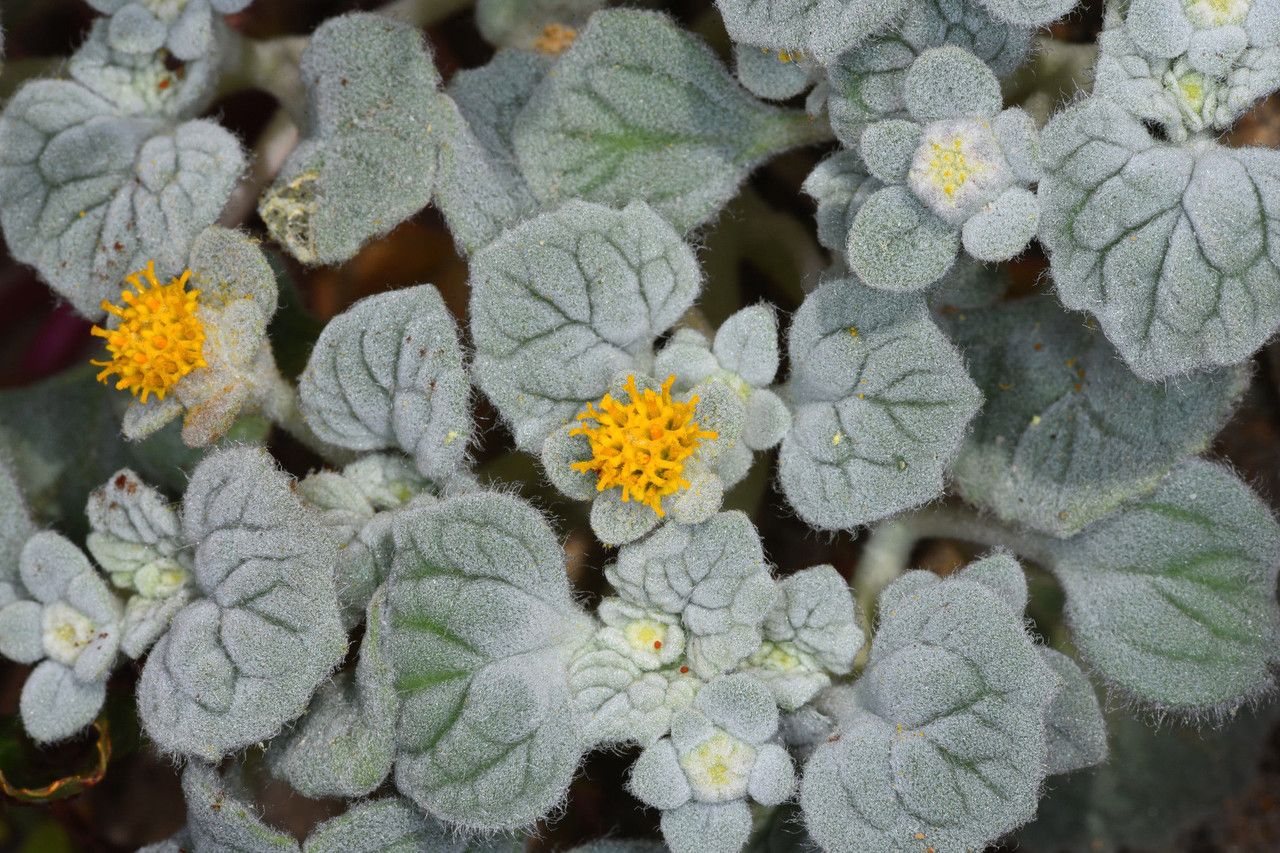
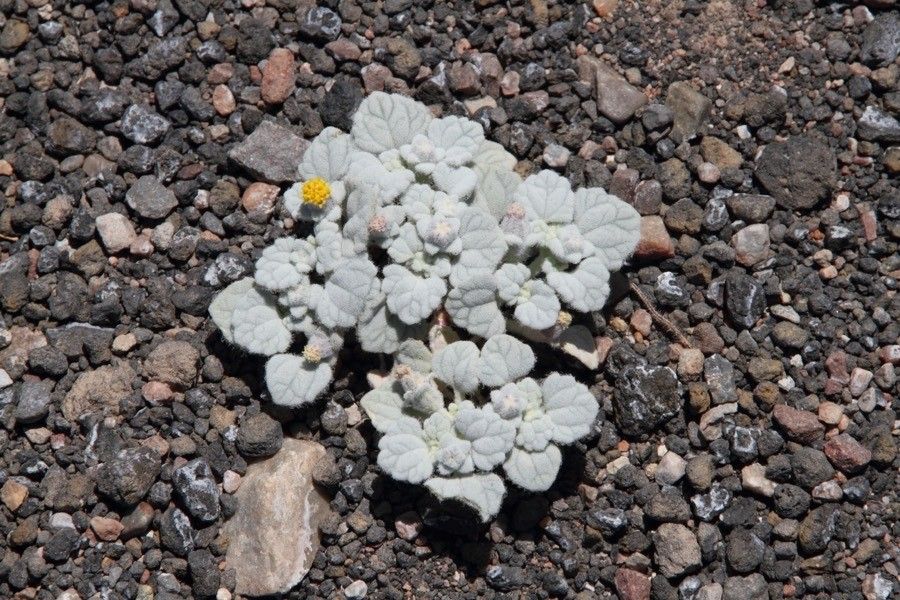
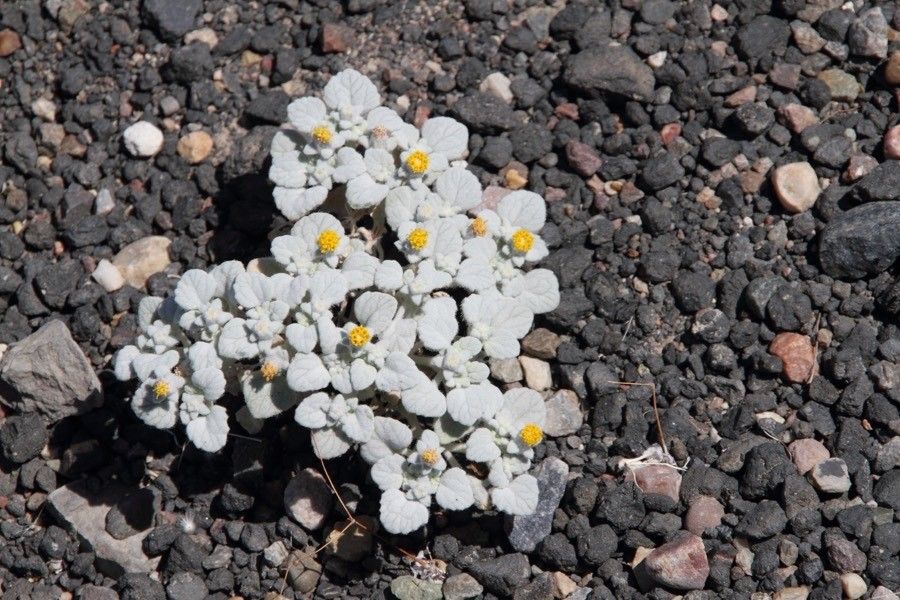
Psathyrotes ramosissima is a species of flowering plant in the aster family known by the common name velvet turtleback, or turtleback. It is native to the southwestern United States where it grows in desert scrub habitat. It is a low, neatly mounded plant producing spreading stems which are hairless to densely woolly in texture. Leaves are borne on long petioles. The leaf blade is variable in shape, generally roughly rounded, and up to 2 centimeters long. It has a wavy, bluntly toothed edge and a bumpy, velvety surface coated in woolly fibers and shiny hairs. It is brownish to gray-green to very pale green in color. The knobby inflorescence is lined with woolly gray-green phyllaries with dull points that curve outward. It contains several hairy yellow disc florets. The fruit is an achene tipped with a large pappus of over 100 long, fine bristles.
Velvet turtleback has strong disease resistance and is generally not vulnerable to illnesses. However, it can be affected by pests and diseases present in its environment. When these occur, they are typically mild. As for care, this plant requires moderate maintenance. Regular pruning is needed to preserve its appearance and support healthy growth. Applying fertilizer can also help encourage flowering. Velvet turtleback is suitable for people with outdoor spaces like a garden or patio and does not demand extensive care experience. It may require more attention when grown indoors.
How to keep Psathyrotes Ramosissima.
Light
Velvet turtleback comes from bright, open habitats and performs best in full sun. It will tolerate partial shade but prefers direct sunlight for best growth. This plant, which may be annual or biennial, is noted for its sun-loving habit.
Water
The Velvet Turtleback is well-suited to arid environments due to its impressive drought tolerance. It thrives outdoors and does best in well-draining soil that dries out completely between waterings. Though it is adapted to dry conditions, providing moderate watering during its active growing season encourages optimal growth.
Temperature
Velvet turtleback typically thrives in environments with temperatures ranging from 68 to 100 °F (20 to 38 ℃). In climates outside this range, seasonal adjustments may be necessary to replicate these conditions and support healthy growth.
Fertilizer
Velvet turtleback responds well to regular, weak applications of fertilizer to encourage healthy leaf growth. Fertilize Velvet turtleback about once a month during the summer months. Nitrogen is essential for foliage, and supplementing with nitrogen-rich sources helps Velvet turtleback thrive.
Pruning
The velvet turtleback is a low-growing perennial with velvety leaves. To keep the plant healthy and well-shaped, prune it in the spring to remove any dead branches and improve its shape. This helps to increase airflow and vigor. Regular pruning not only prevents diseases but also encourages healthy blooming by aligning with the plant's natural growth cycle.
Botanical profile.
- Plant Type
- Herb
- Life Cycle
- Annual, Perennial
- Genus
- Psathyrotes
- Family
- Asteraceae
- Hardiness Zone
- 9-11
- Mature Height
- 5 cm to 13 cm
- Mature Spread
- 46 cm
- Leaf Color
- Light Gray
- Leaf Type
- Semi-evergreen
- Flower Color
- Yellow
- Flower Size
- 2.54 cm
- Bloom Time
- Mid spring, Late spring, Early summer
- Planting Time
- Spring, Summer, Autumn
- Harvest Time
- Summer
- Native Area
- Mexico
Other names.
Reader questions.
What are the sunlight requirements for Velvet Turtleback?
Velvet Turtleback thrives in environments that offer significant sunlight exposure. It requires full sun, which is above 6 hours of sunlight daily, for optimal growth and can also tolerate partial sun, about 3-6 hours of sunlight daily. Observing the movement of sunlight through your garden and choosing locations that provide a balance of light and shade are crucial for the plant's health and happiness.
What are the ideal growing conditions for Velvet turtleback?
Velvet turtleback, or Psathyrotes ramosissima, thrives in environments with temperatures ranging from 68 to 100°F (20 to 38°C). It is extremely heat-loving, and exposure to cold temperatures can harm the plant. To ensure healthy growth in climates outside its preferred range, seasonal adjustments may be necessary. For instance, in the autumn, it's advisable to move outdoor plants indoors and place them near a bright window, yet not too close to heaters. During winter, maintaining temperatures above 20°C is beneficial, as temperatures nearing 0°C can be detrimental.
How does Velvet Turtleback grow in its natural habitat?
Originating from bright, open environments, Velvet Turtleback is an annual and biennial plant that prefers direct sunlight to flourish. Although it can tolerate partial sun, full sun is preferable for its optimal growth. This sun-loving nature is intrinsic to its thriving in its natural habitat.
How should I care for Velvet turtleback in low temperatures?
Velvet turtleback prefers warm temperatures and does not tolerate cold well, thriving best when the temperature stays above 20°C. In winter, it's crucial to keep it above 0°C. Exposure to temperatures below -5°C may cause the leaves to lighten in color and, following frost damage, turn brown or black. Symptoms such as wilting and drooping can also occur. If frost damage happens, trim off the damaged parts and move the plant indoors to a warm spot, ideally near a south-facing window for sufficient sunlight, while avoiding placing it near heaters or air conditioning vents to prevent excessive dryness.
What are the recommendations for artificial lighting with Velvet Turtleback?
For optimal growth indoors, especially when natural sunlight isn't sufficient during winter or in less sunny spaces, artificial lighting is essential. LED lights are recommended because they can be customized to provide specific wavelengths needed by your plants. Full sun plants require 30-50W/sq ft, partial sun plants need 20-30W/sq ft, and full shade plants 10-20W/sq ft of artificial light. The light source should be placed 12-36 inches above the plant, mimicking natural sunlight as closely as possible and the plant should receive 8-12 hours of light per day.
What should I do if Velvet turtleback is exposed to high temperatures?
During the summer, it's important to keep Velvet turtleback below 38°C. Exposure to temperatures above 43°C can cause the leaves to lighten and increase the risk of sunburn. If this happens, trim away the sunburned and dry parts of the plant. To protect the plant from excessive heat, move it to a spot that provides shade from the midday and afternoon sun. Watering the plant in the morning and evening can help keep the soil moist and reduce heat stress.
What are the symptoms of light deficiency in Velvet Turtleback when grown indoors?
When cultivated indoors with inadequate light, Velvet Turtleback may present symptoms such as smaller new leaves, leggy or sparse growth, faster leaf drop, slower or no new growth, lighter-colored new leaves, chlorosis (leaves turning yellow), sunscald, leaf curling, wilting, and leaf scorching. These symptoms indicate a deficiency in light exposure crucial for the plant's health.
What solutions can address light deficiency for indoor and outdoor Velvet Turtleback plants?
To combat light deficiency indoors, gradually move your plant to a sunnier location each week until it receives at least 6 hours of direct sunlight daily. Using a south-facing window helps, and in cases where the plant is large or not easily movable, consider artificial lighting such as desk or ceiling lamps, or professional plant grow lights for at least 8 hours daily. For outdoor plants, a similar gradual relocation to sunnier spots is recommended to avoid shock. If parts of your garden are too shaded, reducing obstructions like pruning trees or transplanting smaller plants to sunnier locations during their dormant period could greatly benefit the plants' exposure to sunlight.