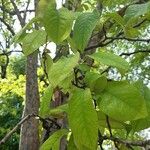
Pseudocydonia sinensis
Chinese-quince
Description
Source: leafsnapPseudocydonia sinensis or Chinese quince (Chinese: mùguā) is a deciduous or semi-evergreen tree in the family Rosaceae, native to southern and eastern China. It is the sole species in the genus Pseudocydonia. Its hard, astringent fruit is used in traditional Chinese medicine and as a food in East Asia. Trees are generally 10–18 metres (33–59 ft) tall. The tree is closely related to the east Asian genus Chaenomeles, and is sometimes placed as Chaenomeles sinensis, but lacks thorns and has single, not clustered, flowers. Chinese quince is further distinguished from quince, Cydonia oblonga, by its serrated leaves and lack of fuzz.
🌳 Beyond its visual charm, chinese quince has surprising uses: its vividly pigmented fruit can serve as a natural dye. Its leaves may also be dried and used to create distinctive herbal teas, offering a subtle, fragrant alternative outside conventional tea circles.
🎭 Safety, Affection, Joy
Care Guide
💧 Water
Chinese quince is well-suited for temperate regions and thrives with moderate moisture, showing some tolerance to drought. It needs deep watering every two weeks. Being a deciduous plant, its water requirements vary with the seasons. Adequate hydration is crucial during the growing season to support the development of its leaves and fruits.
☀️ Light Full sun
The chinese quince does best in places that receive sunlight for most of the day, though it can also grow where the sun shines only part of the day. In its native habitat it gets plenty of light, which helps its health and development. A lack of sufficient light can make a chinese quince become spindly or unproductive, while too much sun may cause stress.
What are the sunlight requirements for Chinese quince?
The Chinese quince requires a significant amount of sunlight to thrive, with ideal conditions being full sun, defined as more than 6 hours of sunlight per day. It can also grow in partial sun, which is about 3-6 hours of sunlight per day. Observing the movement of sunlight through your garden and choosing the right spots that offer a mix of light and shade will contribute to the plant's health and productivity.
Why is adequate lighting important for Chinese quince?
Adequate lighting is crucial for the health and growth of Chinese quince. In its native environment, the Chinese quince is exposed to ample sunlight which supports its development. Insufficient light can lead to a spindly or unproductive plant, while excessive sunlight may cause stress. Indoor Chinese quince plants require adequate lighting to compensate for less natural sunlight, with artificial light providing a valuable solution to ensure optimal growth during winter or in darker spaces.
How can artificial lighting be used for Chinese quince care?
When natural sunlight is insufficient, artificial lighting becomes essential for Chinese quince care, especially for indoor plants. Optimal growth can be achieved by choosing the right type of artificial light, such as LED, which can provide specific wavelengths needed by plants. Full sun plants require 30-50W per square foot, partial sun plants 20-30W per square foot, and shade plants 10-20W per square foot. The light source should be placed 12-36 inches above the plant and operated for 8-12 hours per day to mimic natural daylight.
What are the common symptoms of inadequate light in Chinese quince?
Common symptoms of light deficiency in Chinese quince include smaller new leaves, leggy or sparse growth, faster leaf drop, halted growth, lighter-colored new leaves, chlorosis, sunscald, leaf curling, wilting, and leaf scorching. These symptoms can indicate that the plant is not receiving adequate sunlight, leading to various growth and health issues.
What solutions are available for Chinese quince experiencing light-related issues?
To address light-related issues in Chinese quince, gradual adjustments to lighting conditions are recommended. For indoor plants, moving them to a sunnier spot gradually each week until receiving at least 6 hours of sunlight daily or providing artificial light can be effective. Outdoors, choosing the best sunlight spot and avoiding sudden changes in light intensity are key. Pruning obstructions or transplanting for better sunlight exposure can help improve conditions for the plant. Unfortunately, parts of the plant already affected by insufficient light may not recover, but new growth should be healthy with improved light exposure.
🌡️ Temperature 5–32.2°C
Chinese quince is native to climates with temperatures between 41 and 89.6 °F (5 to 32 ℃). It performs best within that range and may need extra shelter or warmth during colder seasons.
What is the ideal temperature range for growing Chinese quince?
Chinese quince thrives in climates where temperatures range from 41 to 89.6 °F (5 to 32 °C). It performs best within this temperature spectrum, benefiting from relatively warm temperatures to maintain healthy growth. When cultivating Chinese quince during winter, it is crucial to keep the temperature above 5°C to prevent frost damage. Extra precautions, such as bringing the plant indoors or providing added shelter, may be needed when temperatures approach -5°C (25°F) to protect the plant from freezing damage.
How does Chinese quince react to low and high temperatures, and what are the solutions to these conditions?
Chinese quince has a moderate tolerance to low temperatures but requires protection when temperatures drop below -20°C. Symptoms of cold stress include darkening leaves, water-soaked necrosis, wilting, and eventual browning of leaves if exposed to temperatures below -25°C. To mitigate cold damage, it's advisable to trim frost-damaged parts and move the plant to a warmer location indoors or set up a protective greenhouse. Ensure the plant is positioned near a south-facing window for sufficient sunlight or supplement with artificial lighting if natural light is inadequate. In contrast, high temperatures above 32°C can slow the plant's growth, lighten the color of its leaves, and increase susceptibility to sunburn. To address heat stress, trim sunburned areas, provide afternoon shade, and maintain soil moisture with morning and evening watering.
💨 Humidity
🪴 Soil 6-7
🌱 Fertilizer
The Chinese quince plant needs adequate nutrients to achieve optimal fruit production. Fertilize in early spring to encourage new growth and bloom development. Regular feeding keeps the plant healthy, yields more delicious fruit, and prevents nutrient-deficiency problems such as yellow leaves and poor fruit production.
🪴 Pot & Repot
✂️ Pruning
Chinese quince is known for its fragrant blossoms and decorative bark. To keep the plant healthy and attractive, it's important to prune it annually in early spring. During pruning, remove any dead or crowded branches to improve airflow, encourage healthy growth, and boost flower production. This practice helps the plant develop a strong structure to support its heavy fruit, thereby maintaining its vigor and visual appeal.
🌿 Propagating
🐛 Diseases & pets
☠️ Toxicity
Characteristics
- Plant Type
- Tree
- Life Cycle
- Perennial
- Genus
- Pseudocydonia
- Family
- Rosaceae
- Hardiness Zone
- 5-8
- Mature Height
- 10.06 m to 17.98 m
- Mature Spread
- 6.1 m
- Leaf Color
- Green, Yellow
- Leaf Type
- Deciduous
- Flower Color
- Pink, White
- Flower Size
- 2.54 cm to 4.06 cm
- Bloom Time
- Mid spring, Late spring
- Planting Time
- Spring, Autumn
- Harvest Time
- Mid summer, Late summer
- Native Area
- China