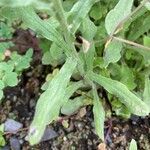
Pseudognaphalium affine
Jersey cudweed · Everlasting cudweed · 鼠麴草 (Mouse Yeast Grass)
Description
Source: leafsnapPseudognaphalium affine is a species of flowering plant belonging to the genus Pseudognaphalium. The species is widely distributed in East Asia, Southeast Asia, South Asia, Transcaucasus and Anatolia.The plant is biennial, with stems 15–40 cm long, the surface of the plant is covered with fine woolly hair and the leaves are small and rounded. The flowers appear as small florets with petal around 2 mm long.In Chinese this plant is known as shǔqúcǎo (simplified Chinese: 鼠麹草; traditional Chinese: 鼠麴草, lit. "mouse yeast grass") and used to make rice-flour pastry for the Qingming Festival; it is sometimes used to flavor the caozai guo consumed on Taiwan on Tomb Sweeping Day in the spring. In Japanese, it is known as hahakogusa or houkogousa (母子草 or ハハコグサ, lit. "mother and child grass"). G. affine is one of the herbs consumed during the Seven-Herbs Festival in the spring. In Vietnam, it is named rau khúc.
💡 Pseudognaphalium affine is a plant found throughout Asia and plays a significant role in the cuisine of China's Qingming Festival. It is used to impart flavor and a unique green color to the pastries and noodles commonly enjoyed during this celebration. Additionally, the plant is an ingredient in the Japanese dish, Kusa mochi.
Care Guide
💧 Water
Mouse yeast grass is highly drought-tolerant, thriving in conditions with balanced moisture without becoming waterlogged. To maintain its health, it requires watering once a week. This plant is well-suited to outdoor environments and can adapt to different rainfall patterns. Its minimal need for additional watering makes it an excellent choice for xeriscaping.
☀️ Light Full sun
Mouse yeast grass comes from bright, open habitats and does best in full sun. It will tolerate some partial shade but favors direct sunlight for the best growth. This species, which can be annual or biennial, is noted for its sun-loving habit.
What are the sunlight requirements for Mouse yeast grass?
Mouse yeast grass thrives in bright, open environments and prefers full sun, meaning it does best with more than 6 hours of direct sunlight daily. It can tolerate partial sun, which is about 3-6 hours of sunlight. It's important to observe your garden's sunlight exposure throughout the day to find the ideal spot for these plants, ensuring they get the right balance of light and shade for optimal growth.
How does artificial lighting support Mouse yeast grass growth indoors?
When natural sunlight is insufficient, especially during winter or in less sunny indoor locations, artificial lighting becomes essential for optimal growth of Mouse yeast grass. LED lights are recommended due to their ability to provide specific wavelengths needed by plants. Full sun plants need 30-50 watts per square foot, partial sun plants require 20-30 watts per square foot, and full shade plants need 10-20 watts per square foot. Lights should be placed 12-36 inches above the plant, mimicking natural sunlight conditions, with most plants needing 8-12 hours of light per day.
What are the symptoms of inadequate light for Mouse yeast grass?
Mouse yeast grass displays several signs when it's not receiving adequate light, including smaller new leaves, leggy or sparse growth, faster leaf drop, and slower or no new growth. Insufficient sunlight also leads to lighter-colored new leaves, chlorosis (leaves turning yellow), sunscald, leaf curling, wilting, and leaf scorching. These symptoms indicate a need for better light conditions to support the plant's growth and health.
How can I address light deficiency problems for Mouse yeast grass?
To counteract light deficiency in Mouse yeast grass, gradually introduce the plant to more sunlight, aiming for at least 6 hours of direct sun exposure daily. For indoor plants that are large or not easily movable, consider using artificial lights for at least 8 hours per day. Outdoors, adapt plants to brighter spots gradually to prevent sunburn. If parts of your garden are too shady, pruning obstructive branches or transplanting to sunnier locations can help. Note that parts of the plant damaged by insufficient light may not recover, but new growth should be healthy with increased light exposure.
🌡️ Temperature 0–32.2°C
Mouse yeast grass can tolerate a wide range of temperatures, but its distribution may still be restricted by different combinations of moisture and heat. It performs best in warm summer climates with adequate rainfall or watering. Extended periods of cloudy, rainy weather, as well as prolonged high temperatures, can raise the likelihood of Mouse yeast grass dying. In winter, proper protection from the cold can increase the plant's survival rate.
What is Mouse yeast grass?
Mouse yeast grass, scientifically known as Pseudognaphalium affine, is a species of plant. Unfortunately, the provided information does not include details about its characteristics, uses, or habitat.
💨 Humidity
🪴 Soil 5-7
🌱 Fertilizer
Mouse yeast grass are regarded as heavy feeders in terms of nutrients. They require frequent, small doses of nitrogen and potassium fertilizers and occasional applications of phosphorus, micronutrients, sulfur, and magnesium to sustain good growth and bright coloration. Continuous fertilization throughout the growing season is needed to prevent deficiency symptoms and maintain optimal growth.
🪴 Pot & Repot
✂️ Pruning
Mouse yeast grass thrives when its woolly leaves and white flower clusters are pruned from early to late spring. To promote healthier, bushier growth and improve blooming, trim away dead stems and any overgrowth. Using clean, sharp tools will ensure precise cuts, support the plant's natural growth cycle, and minimize the risk of disease.
🌿 Propagating
🐛 Diseases & pets
☠️ Toxicity
Characteristics
- Plant Type
- Herb
- Life Cycle
- Biennial, Annual
- Genus
- Pseudognaphalium
- Family
- Asteraceae
- Hardiness Zone
- 6-10
- Mature Height
- 10 cm to 40 cm
- Mature Spread
- 15 cm to 30 cm
- Leaf Color
- Gray, Green Yellow
- Leaf Type
- Evergreen
- Flower Color
- White, Yellow
- Flower Size
- 0.20 cm to 0.25 cm
- Bloom Time
- Early summer, Mid summer
- Planting Time
- Spring, Autumn
- Harvest Time
- Mid summer
- Native Area
- Nepal, Sri Lanka, Turkey, India, Pakistan, Laos, China, Afghanistan, Cambodia, Vietnam, Myanmar, Japan, Koppen, Bhutan, South Korea, Thailand