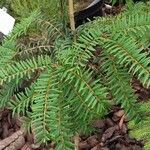
Pseudotaxus chienii
White-Berry Yew · White-berry-yew · Whiteberry Yew
Description
Source: leafsnapPseudotaxus chienii, the whiteberry yew (Chinese: 白豆杉; pinyin: báidòushān; lit. 'white bean conifer'), is a species of plant in the yew family, Taxaceae. It is the sole species in the genus Pseudotaxus, but closely related to the other yews in the genus Taxus. It is endemic to southern China, occurring in northern Guangdong, northern Guangxi, Hunan, Southwest Jiangxi and southern Zhejiang. Like other yews, it is a small coniferous shrub or small tree, reaching 2–5 m tall with reddish bark. The leaves are lanceolate, flat, 1–2.6 cm long and 2–3 mm broad, dark green above, with two white stomatal bands below; they are arranged spirally on the stem, but with the leaf bases twisted to align the leaves in two flat rows either side of the stem. The conspicuous white stomatal bands on the harder, stiffer (less soft) leaves readily distinguish it from the yews in the genus Taxus. It is dioecious, with the male and female cones on different trees. The female (seed) cones are very similar to those of Taxus species, but the aril is white when mature, not red; they are 5–7 mm long and wide. The male (pollen) cones are globose, 3–4 mm diameter. It is grown as an ornamental plant in southern China and occasionally elsewhere.
Care Guide
💧 Water
The white-berry yew, which naturally grows in forest understories, thrives with consistent moisture and can tolerate moderate drought. To imitate its natural environment, water the plant approximately every 1-2 weeks. As an evergreen, it requires regular hydration throughout the year. This is particularly important during the cooler months when indoor heating can reduce humidity levels.
☀️ Light Partial sun
White-berry yew does best in low-light settings, reflecting its origin in naturally shaded habitats. At every stage of development the plant requires very little light. Excessive sun exposure can damage it, causing leaf scorch, while too little light can inhibit its growth.
What are the sunlight requirements for White-berry yew (Pseudotaxus chienii)?
White-berry yew requires less than 3 hours of sunlight, thriving best in full shade. It's essential to monitor the sunlight movement through your garden to find the perfect balance of light and shade, ensuring the plant's happiness. In its natural habitat, the White-berry yew is accustomed to low light conditions and shadows, meaning too much sunlight can harm the plant by causing leaf burn, whereas insufficient light might stunt its growth.
How can artificial lighting support White-berry yew's growth?
White-berry yew benefits from artificial lighting, especially when natural sunlight is insufficient, like in winter or less sunny spaces. Artificial lights, such as LED, can be customized to provide specific wavelengths needed by the plant. For optimal growth, full sun plants need 30-50W/sq ft, partial sun plants 20-30W/sq ft, and full shade plants 10-20W/sq ft of artificial light. The light source should be placed 12-36 inches above the plant, mimicking natural sunlight for 8-12 hours per day.
What are the symptoms of inadequate light for White-berry yew?
Symptoms of light deficiency in White-berry yew include small, mature leaves; leggy or sparse growth; faster leaf drop; slower or no new growth; lighter-colored new leaves; chlorosis or the leaves turning yellow; sunscald; leaf curling; wilting; and leaf scorching. These symptoms indicate either too little or too much exposure to light, affecting the plant's health and growth.
What solutions exist for light-related issues in White-berry yew?
To address light-related issues, move your plants to a spot with ample filtered light, possibly near a window, ensuring they receive brief periods of direct morning sunlight. For large or immobile plants, consider using artificial light, like a desk or ceiling lamp for at least 8 hours daily or invest in professional grow lights. Outdoors, gradually acclimate plants to sunnier spots, avoiding sudden changes to prevent sunburn. Reducing obstructions and transplanting during the dormant period can improve sunlight access. Note that parts of the plant damaged by insufficient sunlight might not recover, but new growth will be healthy after adjusting light exposure.
🌡️ Temperature 15–32.2°C
White-berry yew originates from habitats with moderate temperatures of 59 to 89.6°F (15 to 32℃). The plant favors climates that remain within that range. When seasonal temperatures fluctuate, it is recommended to alter the surroundings to imitate its natural conditions.
What is the native climate for White-berry yew?
The White-berry yew is native to environments with mild temperature ranges, specifically between 59 to 89.6°F (15 to 32°C). It prefers climates that stay within these temperature bounds, making it important to adjust its surrounding conditions to mimic these natural conditions during fluctuating seasons. Its strong cold resistance indicates that special frost protection measures are usually unnecessary in winter. However, protections are advised when winter temperatures are expected to drop below -15°C by wrapping the trunk and branches with insulating materials. Additionally, watering the plant abundantly before the first freeze in autumn to ensure the soil remains moist is recommended, helping to prevent drought and water scarcity during winter and early spring.
How should White-berry yew be cared for in low temperatures?
White-berry yew is cold-tolerant and performs best in temperatures above 15°C, maintaining good health throughout the winter as long as it's kept above -10°C. However, when temperatures fall below -15°C, the plant may not show immediate distress, but by springtime, its branches might become brittle and dry, preventing the emergence of new shoots. To care for White-berry yew in low temperatures, it's advisable to prune away any dead branches that failed to produce new leaves during the spring, as a measure to encourage new growth and maintain the plant's health.
What are the best practices for White-berry yew in high temperatures?
During the summer, it is crucial to keep the White-berry yew below 32°C to avoid heat stress. High temperatures exceeding 35°C might cause lighter-colored leaves, tip dryness, withering, and increased susceptibility to sunburn. To combat these issues, the plant should be moved to a shaded location or covered with a shade cloth to protect it from the midday and afternoon sun. Trimming away the sunburned and dried parts is also recommended. Ensuring the soil stays moist by watering in the morning and evening will help the plant to cope with high temperatures and maintain its health.
💨 Humidity
🪴 Soil 6-6
🌱 Fertilizer
White-berry yew has specific nutrient needs and does not require heavy fertilization. Spring is the best time to apply fertilizer for optimal growth. Providing nutrients enhances its health, increases resistance to pests and diseases, and helps maintain its long lifespan.
🪴 Pot & Repot 2-3 years
Repot your white-berry yew every 2 to 3 years during the spring season. Use a slightly larger pot with well-draining soil to prevent root rot. Place the plant in indirect light and keep the soil moist, while being careful not to overwater. Due to its low-maintenance nature, caring for the white-berry yew is easy after repotting.
✂️ Pruning
The white-berry yew, known for its unique white berries, benefits from pruning between early and late winter. This process involves removing dead branches and shaping the plant to achieve the desired size. Pruning during the dormant season minimizes sap loss, boosts the plant's vitality, and encourages dense foliage. Additionally, it improves air circulation and reduces the risk of pests and diseases.
🌿 Propagating
🐛 Diseases & pets
☠️ Toxicity
Characteristics
- Plant Type
- Tree, Shrub
- Life Cycle
- Perennial
- Genus
- Pseudotaxus
- Family
- Taxaceae
- Hardiness Zone
- 7
- Mature Height
- 3.96 m
- Mature Spread
- 2.44 m to 3.05 m
- Leaf Color
- Dark Green
- Leaf Type
- Evergreen
- Flower Color
- White
- Flower Size
- 0.25 cm to 0.51 cm
- Bloom Time
- Mid spring, Late spring
- Planting Time
- Autumn, Spring, Summer
- Harvest Time
- Late summer, Early fall, Mid fall
- Native Area
- China