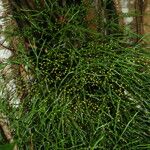
Psilotum nudum
Whisk Fern · Skeleton fork fern · Psilotum
Description
Source: leafsnapPsilotum nudum, commonly known as the whisk fern, is a primitive plant that belongs to the family Psilotaceae. This small, leafless plant typically grows up to 30 cm in height and features a slender stem with branching roots. Its green stem is photosynthetic, allowing it to produce its food through photosynthesis. Unlike many plants, the whisk fern lacks true leaves and flowers. Instead, it produces sporangia on its stems. These sporangia release spores into the air, which can then grow into new plants. Psilotum nudum is found in tropical regions around the world, thriving in moist soil conditions. It often grows on rocks or in the crevices of trees. Indigenous peoples have used the whisk fern for its medicinal properties for centuries, due to its anti-inflammatory effects. Additionally, it contains compounds with demonstrated antifungal activity. Although Psilotum nudum may not be as well-known as other plants, it plays an important role in our ecosystem and possesses potential medicinal benefits that merit further exploration.
Care Guide
💧 Water Every 7 days
Whisk ferns originate from subtropical and tropical regions, where they thrive in consistent moisture and moderate humidity. To mimic their natural environment, they should be watered weekly and misted regularly, which helps support their epiphytic growth and unique non-vascular structure. Although they prefer humid conditions, whisk ferns are moderately drought-tolerant.
How should I water my Whisk Fern?
To properly water the Whisk Fern, use filtered water at room temperature or slightly warmer. Filtering the water is important because tap water may have harmful particles. Since the Whisk Fern comes from a warm environment, avoid using cold water to prevent shocking the plant. To prevent foliage complications, don't water from overhead. Instead, water the soil directly until it is completely soaked. This helps the plant by moistening the roots and allowing them to spread through the soil to collect nutrients.
What do I do if I give my Whisk Fern too much or too little water?
Overwatering is a common problem for Whisk Ferns and can cause wilting, yellowing leaves, and diseases like root rot, mold, and mildew. Underwatering is less common but can make the leaves brittle and brown. It's important to notice signs of overwatering early to prevent irreversible damage. If you see early signs, reduce watering and check the soil's drainage. Replace poorly draining soil with a loose, well-draining mix. If your Whisk Fern shows signs of underwatering, simply water more regularly until the signs improve.
How frequently do I need to water my Whisk Fern?
If your Whisk Fern is in a pot, the best way to determine if it needs water is to check the soil. Stick your finger into the soil and if the top two to three inches feel dry, it's time to water it. If you have your Whisk Fern planted outside in the ground, you can use the same method. Once the top few inches of soil are dry, it's time to water it. Usually, during the spring and early fall, you'll need to water this plant about once a week using this method. However, during extremely hot weather, you may need to water it twice a week or even more frequently. It's important to note that mature and well-established Whisk Ferns can withstand periods of drought quite well.
How much water is needed for my Whisk Fern?
To ensure proper watering for your Whisk Fern, it's important to be generous with the amount of water you give. When the top two to three inches of soil are dry, it's time for a thorough watering. Make sure to provide enough water to completely saturate the soil. You should add enough water to cause any excess to flow out of the drainage holes at the bottom of the pot. If you don't see water draining out, it's likely that you haven't given enough water. However, be cautious not to let the water accumulate inside the soil, as this can be harmful to the plant. On the other hand, if water isn't draining properly, it could indicate that the soil doesn't have good drainage, which can negatively affect the health of the plant. If the Whisk Fern is planted outside, around 1 inch of rain per week should be enough.
How do I water my Whisk Fern at different times when it is growing?
The water needs of the Whisk Fern can vary depending on its growth stages. When the fern is in the early years of its life or has been recently transplanted, it requires more water than usual. During these stages, the fern focuses on sprouting new roots to support future growth. To ensure optimal performance, these roots require slightly more moisture. As the fern matures over a few seasons, it will require less water. Additionally, during the bloom period, the Whisk Fern may need increased watering due to the water demands of flower development.
☀️ Light Partial sun
Whisk Fern favors locations with ample sunlight, but it can also survive in complete shade. It comes from habitats where light levels vary, allowing flexibility in its growth. However, too much or too little light can hinder its development, leading to poor health and stunted growth.
What are the sunlight requirements for Whisk Fern?
Whisk Fern thrives in environments that offer flexibility in sunlight exposure, including partial sun for about 3-6 hours and full sun for more than 6 hours of sunlight daily. It can also grow in full shade areas, adapting to varying light conditions that it encounters in its natural habitat. It's essential to observe the movement of sunlight in your garden to ensure you place your plants in spots that provide an optimal balance of light and shade, fulfilling the plant's needs and promoting healthy growth.
How does artificial lighting benefit indoor Whisk Fern plants?
Artificial lighting plays a crucial role in the growth of indoor Whisk Fern plants, especially when natural sunlight is insufficient, such as during winter or in less sunny indoor spaces. Choose the right type of artificial light, like LED, which can be adjusted to emit specific wavelengths required for your plant's growth. The amount of artificial light needed varies: full sun plants require 30-50W/sq ft, partial sun plants need 20-30W/sq ft, and full shade plants require 10-20W/sq ft. Place the light source 12-36 inches above the plant to mimic natural sunlight, and ensure the plant receives 8-12 hours of light per day to promote faster, healthier growth.
What are the symptoms of light deficiency or overexposure in Whisk Ferns?
Whisk Fern shows several symptoms when exposed to insufficient light or excessive sunlight. Light deficiency can result in smaller leaves, leggy or sparse growth, faster leaf drop, slower or no new growth, and lighter-colored new leaves. On the other hand, overexposure to sunlight can cause chlorosis, sunscald, leaf curling, wilting, and leaf scorching. These symptoms indicate stress in plants due to inappropriate lighting conditions, affecting their health and growth.
How can I address lighting issues for Whisk Ferns?
To optimize Whisk Fern growth under varying light conditions, consider gradually introducing your plant to sunnier spots to adapt to changing light, ideally getting 3-6 hours of direct sunlight daily. For indoor plants that can't be easily moved, supplementing with artificial light for at least 8 hours daily or investing in professional grow lights can provide the necessary light intensity. For outdoor plants, ensure gradual exposure to sunlight to prevent sunburn. Reducing obstructions, like pruning trees, or transplanting smaller plants during their dormant period to sunnier locations can significantly improve light exposure. Remember, while parts of the plant that suffered from light deficiency may not recover, new growth will be healthier with improved lighting.
🌡️ Temperature 15–37.8°C
Whisk Fern is native to areas with mild climates and favors temperatures between 59 and 100°F (15 and 38°C). To maintain growth throughout the year, vary temperatures with the seasons and make sure they do not fall below 59°F (15°C).
What is the native climate for Whisk Fern?
Whisk Fern, or Psilotum nudum, thrives in regions with mild climates. It prefers temperatures ranging between 59 to 100°F (15 to 38°C). To ensure year-round growth, it's important to adjust temperatures seasonally, making sure they do not fall below 59°F (15°C). Even though Whisk Fern has some level of cold tolerance and generally does not require special care when temperatures are above -5°C, additional measures for cold protection are necessary if temperatures are expected to drop below this threshold.
How does Whisk Fern respond to low temperatures?
Whisk Fern has a moderate tolerance to low temperatures and performs best when the temperature stays above 15°C. During the winter months, it is vital to keep the plant above -5°C. If temperatures fall below -10°C, the fern's leaves may begin to droop. While mild cases see recovery, severe cases can lead to wilting and eventual leaf loss. To prevent damage from low temperatures, it is advisable to trim off frost-damaged parts and wrap the plant with materials like non-woven fabric or cloth, while also constructing a wind barrier to shield it from cold winds.
How does Whisk Fern react to high temperatures?
In the summer, it is crucial to maintain Whisk Fern's environment below 38°C. Temperatures exceeding 43°C can lead to lighter leaf colors, drying and withering of leaf tips, curling of leaves, and an increased risk of sunburn. To mitigate high temperature stress, remove sunburned and dried parts of the plant. Relocating the plant to a shaded area during the midday and afternoon sun, or employing a shade cloth, can provide relief. Additionally, watering the plant in the morning and evening helps keep the soil moist and supports the plant's wellbeing during hot periods.
💨 Humidity normal (40-60%)
This plant will thrive in moderate humidity, which is probably the level in your home. However, misting it a few times a week can be very beneficial. Make sure the room has good ventilation.
🪴 Soil 6-7
🌱 Fertilizer
Usually one fertilizer application in spring is enough for Whisk Fern, though repeated feedings can maximize its growth. Apply every month to a month and a half. Fertilizing improves the leaves' appearance and function, preserving even color and a healthy texture. It also encourages root development and nutrient uptake, supporting long-term plant health.
🪴 Pot & Repot 2-3 years
When repotting Whisk Fern, select a pot 1–2 inches (2.5–5.1 cm) larger with ample drainage. Use a well-draining potting mix. Repot in spring or fall, ensuring the root ball is slightly lower than the rim of the flower pot. Water thoroughly after repotting and place it in a warm spot with indirect sunlight.
✂️ Pruning
Whisk Fern benefits from light pruning between early and late spring to remove dead or damaged fronds, which promotes healthy new growth. Be sure to avoid heavy pruning, as it can stress the plant. To minimize the risk of infection and keep the plant vigorous and disease-free, use sterilized tools when pruning.
🌿 Propagating
🐛 Diseases & pets
☠️ Toxicity
Characteristics
- Plant Type
- Herb
- Life Cycle
- Perennial
- Genus
- Psilotum
- Family
- Psilotaceae
- Hardiness Zone
- 8-11
- Mature Height
- 30 cm
- Mature Spread
- 46 cm to 61 cm
- Leaf Color
- Green
- Leaf Type
- Evergreen
- Flower Color
- Yellow
- Planting Time
- Autumn
- Native Area
- Sri Lanka, Lesotho, Belize, India, Malaysia, Angola, Mexico, Guatemala, Madagascar, Pakistan, Nigeria, Yemen, Kenya, Uganda, Tanzania, Zimbabwe, Jamaica, Fiji, Benin, Cuba, Indonesia, Equatorial Guinea, Cameroon, Liberia, Mozambique, Venezuela, Brazil, Ghana, South Korea, Congo, Nepal, Saudi Arabia, Malawi, Honduras, Peru, South Africa, Zambia, Philippines, Bangladesh, Laos, Guinea, Panama, New Zealand, China, Colombia, Bahamas, Spain, Bolivia, Vietnam, Myanmar, Japan, El Salvador, Senegal, Eswatini, Singapore, Nicaragua, Ecuador, Costa Rica, Congo (DRC), Thailand, Gabon