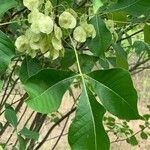
Ptelea trifoliata
Wafer-ash · Hoptree · Shrub trefoil · Common Hoptree · Stinking ash
Description
Source: leafsnapPtelea trifoliata, commonly known as common hoptree, wafer ash, stinking ash, and skunk bush, is a species of flowering plant in the citrus family (Rutaceae). It is native to North America, where it is found in Canada, Mexico, and the United States. It is a deciduous shrub or tree, with alternate, trifoliate leaves.
🌳 Although modest in appearance, the common Hoptree holds a humble yet intriguing place in culinary traditions, particularly among native North American communities. Because of its bitter flavor, parts of the plant have historically been used as a substitute for hops in brewing beer. The potential for the common Hoptree to serve as an aromatic in the craft brewing industry remains largely untapped, offering a novel opportunity for local brewers seeking to produce uniquely flavored beverages.
Care Guide
💧 Water Every 2 weeks
The Common Hoptree is well-suited to dry conditions and adapts effectively to drought. During its growth phase, water the plant every two weeks, but decrease the frequency of watering during its dormant period. When grown indoors, it's easier to manage moisture levels, which helps prevent overwatering and ensures the plant's resilience.
How should I water my Common Hoptree effectively?
To ensure excellent root development, place a garden hose at the base of the plant instead of directly spraying the leaves. If the plant is outdoors and in direct sunlight, the leaves will need more water. You can use bubblers for each plant to moisten the roots, or soaker hoses to cover the entire garden or bed when adding or removing plants. After watering, drain any excess water and allow the soil to dry before watering again. To prevent diseases, water at ground level instead of spraying the leaves. On a sunny day, it may be beneficial to spray the entire bush with water. Whether the Common Hoptree is potted or in the ground, deep watering is preferred over light sprinkling.
What do I need to do if I give the Common Hoptree too much or too little water?
An overwatered Common Hoptree may show signs such as yellowing, dropping leaves and wilting. Its appearance may be dull and unhealthy, with mushy stems. When these signs appear, it's best to adjust your watering schedule if possible. Wilting can also indicate under watering, characterized by crispy and dry leaves. If the soil is dry and simply watering is not enough, give it a thorough watering in a timely manner. Sufficient water will help the Common Hoptree recover, although the damaged root system may cause the plant to still appear dry with yellow leaves for a few days. Once it returns to normal, the yellowing of leaves will stop. Always check the moisture levels when keeping the Common Hoptree indoors. Avoid overwatering and look for signs of black spots. If present, allow the soil to dry out in the pot by refraining from watering for a few days. Overwatering can lead to root rot, so if you notice discolored and slimy roots, consider transferring the plant to a different pot. It is important to prevent root rot by keeping the soil from becoming too soggy. When planting the Common Hoptree outdoors, dig a little deeper. If the soil feels too dry when you check with your fingers, it may be a sign of underwatering. Providing adequate watering is necessary to help the plant recover.
How frequently should I water my Common Hoptree?
The Common Hoptree prefers deep and infrequent watering, especially when planted in pots. Pots have limited water storage, so it's important to soak them with a gallon of water each time. In colder regions, watering every 3 to 5 days is necessary. Water the plants early in the morning when the soil is dry, whether they are indoors or outdoors. Check the soil inside to determine if watering is needed - if the top 2-3 inches of soil is dry, it's time for a full watering. During hot days, check the moisture daily as the heat can quickly dry out the soil in the pots. If you have a garden, irrigation of the soil is necessary too. In a hot climate, watering once a week is advisable. Only water when the soil is 2 to 3 inches too dry, and consider the amount of rainfall to prevent root rot. If there is abundant rainfall, additional watering may not be needed. Common Hoptrees generally grow during spring and fall. When planted outdoors, adding mulch 3 to 4 inches deep helps conserve water. Sandy soil tends to drain faster, so more frequent watering is required. On the other hand, clay soil requires less frequent watering to avoid root rot. To keep track of watering frequency, mark the dates on a calendar and pay attention to drooping leaves as a sign of potential delay in watering.
How much water does my Common Hoptree need?
The Common Hoptree typically requires about a gallon of water on a regular basis. For potted plants, water them deeply until you see water dripping at the bottom of the pot. Then, wait for the soil to dry before watering again. You can use a water calculator or moisture meter to track how much water you've given your plant in a week. During the flowering period, provide plenty of water but allow the moisture to evaporate to prevent root rot. If the Common Hoptree is planted outdoors with sufficient rainfall, additional watering may not be necessary. However, when the Common Hoptree is young or newly planted, make sure it receives 1-2 inches of rain per week. As it grows, it can rely solely on rainfall. Only in extremely hot weather or during extended periods without rain for 2-3 weeks, consider watering the Common Hoptree during cooler moments of the day to prevent damage from high heat. Additional watering will be needed during prolonged dry spells.
Should I change how often I water my Common Hoptree based on the different seasons or climates?
The Common Hoptree thrives outdoors with regular rain but may need watering during prolonged dry spells. In spring and fall, keep the soil moist but not overly wet. Alternating between dry and moist conditions will promote growth. During hot summers or when rainfall is scarce, increase watering to prevent the soil from drying out too quickly. In winter, water less since the tree will be dormant. Use well-draining soil like terracotta to help water evaporate. Once the tree leafs out, rely on rainfall rather than watering. Cultivate and encourage growth in the spring and provide good drainage to avoid ponding or drought. When in pots, water frequently, especially in the summer, but ensure there is adequate drainage. Deeply water the root system once or twice a week, avoiding shallow sprinkles that reach only the leaves. Don't let the plants dry out completely in the fall or winter. Avoid overwatering or waterlogged soil, which can be harmful during winter. Apply mulch to reduce stress, preserve water, and promote healthy blooming.
☀️ Light Partial sun
A balanced amount of sunlight is essential for the common Hoptree, which shows reasonable adaptability and does best with moderate sun. It tolerates a range of light conditions, from light shade to stronger sunlight. Exposure to sunlight that is too intense or too weak can impede its optimum growth and overall health.
What are the sunlight requirements for the Common Hoptree?
The Common Hoptree requires a balance of sun exposure to thrive, showing adaptability to both gentle shade and intense sunlight. It ideally needs about 3-6 hours of sunlight daily, classified as partial sun but can also tolerate full sun or full shade, which means above 6 hours of sunlight. Observing how sunlight moves through your garden and choosing locations that offer a mix of light and shade will ensure the plant's happiness and optimum growth.
How can I use artificial lighting for Common Hoptree indoors?
When natural sunlight is insufficient for the Common Hoptree, especially during winter or in less sunny spaces, artificial lighting can be a crucial solution for optimal growth. To use artificial lighting effectively: 1. Choose LED lights, which can be adjusted to provide specific wavelengths needed by the plant. 2. The intensity of light should vary depending on plant type - 30-50W/sq ft for full sun plants, 20-30W/sq ft for partial sun plants, and 10-20W/sq ft for full shade plants. 3. Position the light source 12-36 inches above the plant, mimicking natural sunlight. 4. Ensure the plant receives 8-12 hours of artificial light daily to simulate the natural duration of sunlight.
What are the signs of inappropriate light exposure in Common Hoptree?
Common Hoptree may exhibit several symptoms when experiencing inappropriate light exposure. In low light, you might notice smaller new leaves, leggy or sparse growth, faster leaf drop, and slower or no new growth, indicating inadequate sunlight. New leaves may appear lighter in color or with irregular color patterns due to insufficient sunlight. Conversely, excessive sunlight can cause chlorosis (yellowing leaves), sunscald (pale, bleached areas on leaves), leaf curling, wilting, and leaf scorching (brown, dry edges on leaves). These symptoms reveal the plant's struggle with either too much or too little sunlight.
How can I address light exposure issues for Common Hoptree?
To optimize light exposure for Common Hoptree, gradually increase sunlight by moving the plant to sunnier spots each week until it receives 3-6 hours of direct sunlight daily, for both indoor and outdoor plants. Avoid abrupt changes to prevent sunburn. Use artificial lighting if the plant is large or not easy to move, keeping lights on for at least 8 hours a day. For outdoor and ground plants, reduce obstructions like tree branches that block sunlight or consider transplanting smaller plants during their dormant period to a location with better sunlight and drainage. Remember, parts of the plant damaged by insufficient sunlight might not recover, but new growth should be healthy with proper light exposure.
🌡️ Temperature 5–32.2°C
Common Hoptree is native to regions with a moderate temperature range of 41 to 89.6 °F (5 to 32 ℃), which is ideal for its growth. In different seasons, gradual temperature adjustments are recommended to help it acclimate to the changing environment.
What is the native temperature range for Common Hoptree?
The Common Hoptree thrives in moderate temperature ranges, ideally between 41 to 89.6 °F (5 to 32 °C). This range is native to its growth and indicates that the plant prefers environments that don't experience extreme temperatures. To ensure its health throughout the changing seasons, gradually adjusting its environment to mimic these conditions can be beneficial. This helps the Common Hoptree to acclimate smoothly to seasonal changes, maintaining its vitality and growth.
How should Common Hoptree be protected in winter?
Common Hoptree exhibits strong cold resistance, meaning special frost protection measures are often not required. However, in regions where winter temperatures are expected to drop below -30°C, it's crucial to offer additional protection to prevent damage. Wrapping the trunk and branches with non-woven fabric or cloth can shield the plant from severe cold. Moreover, abundantly watering the plant before the season's first freeze is recommended. This ensures the soil remains moist and enters a frozen state prepared, which is important to prevent drought and water scarcity for the plant during the colder months and into early spring.
What are the symptoms of low temperature impact on Common Hoptree?
Common Hoptree is known for its cold tolerance, flourishing best when temperatures stay above 5°C. It generally withstands winters well, provided temperatures remain above -25°C. However, if the thermometer drops below -30°C, there may not be immediately visible damage during winter, but come spring, the branches can become brittle, dry, and may fail to produce new shoots. This indicates that the plant suffered from the intense cold, necessitating proactive measures such as pruning all dead branches to encourage new growth and the plant's recovery.
How does high temperature affect Common Hoptree and what are the solutions?
During the hot summer months, it's crucial to ensure the temperature around Common Hoptree does not exceed 32°C. If it does, and particularly when temperatures rise above 35°C, the plant might show signs of stress such as leaves becoming lighter, tips drying out, and increased susceptibility to sunburn. To mitigate these effects, affected areas of the plant should be pruned to remove sunburned and dried parts. Moving the plant to a shadier spot or using a shade cloth can also protect it from direct sunlight during the peak hours. Additionally, watering the tree in the morning and evening can help keep the soil consistently moist, aiding in cooling and stabilizing the plant's environment.
💨 Humidity
🪴 Soil 6-7
🌱 Fertilizer
Timing is important when fertilizing the Common Hoptree. Apply fertilizer in early spring and continue monthly until early summer. Fertilizer encourages attractive blooms and supplies energy during both dormant and active growth periods.
Why should I put fertilizer on my Common Hoptree?
No matter what type of Common Hoptree you have, regular fertilization is important for its overall health. Providing the right nutrients will promote strong growth and make the tree more resilient to tough growing conditions, while also helping it fight off diseases and pests. Keeping the foliage intact is crucial for the tree's attractiveness. To achieve this, it's important to establish and stick to a regular fertilization schedule that suits your specific Common Hoptree. By doing so, you can expect the tree to develop deep-colored, lush leaves.
When should I fertilize my Common Hoptree?
To ensure the healthy growth of your Common Hoptree, it is recommended to fertilize it in late winter or early spring. This provides the necessary nutrients for the tree to thrive once the weather warms up. If you live in a warm climate region, it is also beneficial to give it an extra fertilizer feeding in early fall. This not only adds nutrients for the following growing season but also strengthens the tree to withstand the winter cold without foliage damage. Fertilizing earlier ensures that the new branches have sufficient time to grow and withstand the winter conditions.
When is the best time to not fertilize my Common Hoptree?
There are a few times of the year when you shouldn't fertilize your Common Hoptree. First, avoid fertilizing during the early and mid-winter months when the plant is dormant and doesn't require nutrients. It's also not recommended to fertilize during late spring and summer when the weather is hotter and drier. These conditions can negatively affect the plant's response to fertilization. To avoid problems, stick to a fertilization schedule that only involves feeding in early spring and early fall.
What kind of fertilizer should I use for my Common Hoptree?
The most important nutrient for a Common Hoptree is usually nitrogen, but that doesn't mean phosphorus and potassium are not important. In fact, all three main nutrients are needed, which is why a balanced fertilizer like 10-10-10 can be effective. However, a more specific nutrient ratio can lead to better growth. Fertilizers with a slightly higher nitrogen content, like 10-6-4, often work well. You can choose between granular or liquid-based fertilizers for application.
How should I fertilize my Common Hoptree?
To fertilize your Common Hoptree, you have two options. One is to use a granular fertilizer, which is easy to apply by simply sprinkling it on the soil at the right time. The slow-release nature of this fertilizer will gradually release nutrients into the soil over time. It's recommended to lightly water the Hoptree before applying the fertilizer. Another option is a liquid fertilizer, although this is not as commonly used. If you choose this method, you'll need to mix the fertilizer with water and then pour it onto the soil around the base of the Hoptree. Sometimes, it's a good idea to perform a soil test before fertilizing to check if the pH needs any adjustments.
🪴 Pot & Repot
✂️ Pruning
The Common Hoptree is a deciduous shrub known for its trifoliate leaves and aromatic properties. For best results, prune the shrub in early spring to remove any dead wood and thin out branches to improve air circulation. This will also help shape the plant. Regular, light pruning encourages healthy growth, but be careful not to cut the old wood, as the Common Hoptree blooms on new growth.
🌿 Propagating
🐛 Diseases & pets
☠️ Toxicity
Characteristics
- Plant Type
- Tree
- Life Cycle
- Perennial
- Genus
- Ptelea
- Family
- Rutaceae
- Hardiness Zone
- 4-8
- Mature Height
- 6.1 m to 7.92 m
- Mature Spread
- 4.57 m to 6.1 m
- Leaf Color
- Green
- Leaf Type
- Deciduous
- Flower Color
- White, Green, Yellow
- Flower Size
- 1.02 cm to 2.03 cm
- Bloom Time
- Late spring, Early summer
- Planting Time
- Spring, Summer, Autumn
- Harvest Time
- Mid summer
- Native Area
- North America