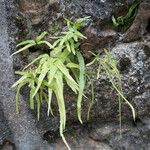
Pteris multifida
Chinese brake · Spider brake · Spider fern · Spider brake fern
Description
Source: wikipedia (CC BY-SA)Pteris multifida, the spider brake, is a species of fern in the family Pteridaceae. It is native to central and southern China, Korea, Japan, the Ryukyus, Taiwan, and Vietnam. A shade-loving lithophyte with fronds reaching at most 60 cm (24 in), it is typically found growing on old walls, and is a rare example of a fern synanthrope. Consequently it has been introduced to many locales around the world, including many of the United States, some of the Caribbean islands, Bolivia, Uruguay, the United Kingdom, central Europe, Italy, Romania, Uganda, the Indian Subcontinent, Thailand, and the Philippines, and is known by many local common names, including Chinese brake, spider fern, Huguenot fern, ribbon fern, and saw-leaved bracken.
Care Guide
💧 Water
The spider brake, which originates from forest understories, prefers consistent moisture and indirect light. It thrives in environments with higher humidity and evenly moist soil, needing to be watered once a week. Regular misting can further improve its indoor growth, making it an excellent choice for bathrooms, where the humidity is naturally higher.
☀️ Light Full shade
The fern does well in well-lit areas and does not require complete exposure. In its natural setting it prospers where light and shade alternate. Too much exposure can be damaging, and too little light will impede its healthy growth.
What are the sunlight requirements for Spider brake?
Spider brake thrives most ideally in an environment with moderate exposure to sun, preferring about 3-6 hours of sunlight daily. It's important to observe the movement of sunlight through your garden to choose spots that offer a perfect balance of light and shade, ensuring the plant's happiness. In its natural habitat, Spider brake is accustomed to slight shade, but too little or too much sunlight may lead to weak growth or scorched leaves, respectively.
How can I use artificial lighting for Spider brake indoors?
Indoor Spider brake plants require adequate lighting for optimal growth, especially when natural sunlight is insufficient. LED lights are popular for indoor plant lighting as they can be customized to provide specific wavelengths of light needed by plants. Full sun plants need 30-50W/sq ft, partial sun plants need 20-30W/sq ft, and full shade plants need 10-20W/sq ft of artificial light. The light source should be placed 12-36 inches above the plant, mimicking natural sunlight for 8-12 hours per day.
What are the symptoms of light deficiency in Spider brake?
When grown indoors with insufficient light, Spider brake may exhibit symptoms such as smaller new leaves, leggy or sparse growth, faster leaf drop, slower or no new growth, lighter-colored new leaves, and conditions like chlorosis, sunscald, leaf curling, wilting, and leaf scorching. These symptoms indicate a lack of adequate sunlight affecting the plant's health and growth.
How can I address Spider brake's light deficiency symptoms?
To optimize Spider brake's growth with insufficient light, incrementally move it to sunnier spots each week until it receives the desired 3-6 hours of direct sunlight daily. For plants that are large or not easily movable, consider using artificial light sources such as desk lamps or professional plant grow lights for at least 8 hours daily. If the plant is outdoors, gradually transition it to sunnier locations to avoid sudden changes that may cause sunburn. Reducing obstructions like pruning obstructive tree branches can help, and transplanting smaller plants during their dormant period to areas with better sunlight and drainage can also be beneficial. Note that parts of the plant affected by insufficient sunlight may not recover, but new growth should be healthy with increased light exposure.
🌡️ Temperature 20–37.8°C
The fern comes from tropical areas where the climate is generally warm and humid. Consequently, it is well adapted to high heat and moisture. It is sensitive to abrupt temperature shifts and prefers a steady thermal environment, so avoiding temperature fluctuations indoors is important. It typically cannot tolerate cold conditions and needs warmer temperatures to grow. If the surrounding temperature falls too low, the plant’s growth may stop or it may die.
What is the ideal temperature range for Spider brake?
Spider brake thrives best in temperate climate regions where the temperature averages between 59 to 95°F (15 to 35°C), showing a preference towards the higher end of this spectrum. Adjustments to maintain this preferred temperature range should be made seasonally as necessary. Despite its strong cold resistance, special measures for frost protection are not usually needed. However, if winter temperatures are expected to drop below -15°C, it's important to provide protection by covering the plant with soil or straw.
How does cold temperature affect Spider brake, and what are the solutions?
Spider brake is quite cold-tolerant, thriving best when temperatures are above 15°C. During winter, it should be kept above -10°C. When temperatures fall below -15°C, there may be a decrease in sprouting or even a complete lack of sprouting in spring, although there might not be noticeable changes during winter. The solution in spring is to remove any parts that have failed to sprout.
How does high temperature affect Spider brake, and what are the solutions?
During summer, it is recommended to keep Spider brake below 35°C. Exceeding 41°C, the leaves may become lighter in color, curl, become prone to sunburn, and, in severe cases, the entire plant may wilt and dry up. To mitigate this, trim away sunburned and dried-up parts. Moving the plant to a shaded location or using a shade cloth to protect it from midday and afternoon sun is beneficial. Additionally, watering the plant in the morning and evening to keep the soil moist can also help.
What are some key facts about Spider brake?
Spider brake, with its botanical name Pteris multifida, is native to regions with a temperate climate. This plant has strong cold resistance, requiring specific temperature ranges (between 59 to 95°F or 15 to 35°C) to thrive optimally, especially preferring the higher end of this spectrum. For winter protection, when temperatures drop below -15°C, covering the plant is advised. It also has certain temperature thresholds that, if exceeded or not met, could affect its sprouting and overall health negatively.
💨 Humidity
🪴 Soil 6-7
🌱 Fertilizer
🪴 Pot & Repot
✂️ Pruning
The spider brake plant benefits greatly from careful pruning, especially from early to late spring. By removing dead fronds and thinning out crowded areas, you can improve air circulation and light exposure. Making clean cuts helps prevent disease, promotes healing, and maintains the plant's structure and aesthetic appeal throughout the growing season.
🌿 Propagating
🐛 Diseases & pets
☠️ Toxicity
Characteristics
- Plant Type
- Fern
- Life Cycle
- Perennial
- Genus
- Pteris
- Family
- Pteridaceae
- Hardiness Zone
- 10-12
- Mature Height
- 20 cm to 61 cm
- Mature Spread
- 20 cm to 40 cm
- Leaf Color
- Green
- Leaf Type
- Evergreen
- Planting Time
- Spring, Summer, Autumn
- Native Area
- Nepal, India, Malaysia, Cambodia, Vietnam, Myanmar, Philippines, Bangladesh, Laos, Thailand, China