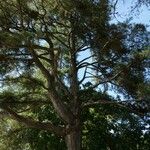
Pterocarpus angolensis
Transvaal-teak · Muninga · Bleedwoodtree · Kiaat · Bloodwood
Description
Source: leafsnapPterocarpus angolensis, commonly known as the bloodwood tree, is a flowering plant species in the family Fabaceae. Native to southern Africa, it is found in countries such as Angola, Botswana, Namibia, South Africa, and Zimbabwe. The tree can grow up to 20 meters tall, with a trunk diameter reaching up to 1 meter. Its bark is dark brown or reddish-brown and exudes a red sap when cut or damaged. The leaves of the bloodwood tree are compound, consisting of 5 to 9 oval-shaped leaflets with serrated edges. The small, yellowish-green flowers have five petals and form clusters at the ends of branches. The tree produces fruit pods containing one or two seeds each. These mature pods have a woody texture, making them difficult for animals to eat. The wood of Pterocarpus angolensis is highly valued for its durability and resistance to termites, making it ideal for use in construction projects such as flooring and furniture making, as well as carving. In traditional medicine practices across southern Africa, various parts of Pterocarpus angolensis, such as bark extracts, are used to treat ailments including diarrhea. Its red sap has antiseptic properties and is applied topically to wounds. Despite being classified by the IUCN (International Union for Conservation) Red List as "Least Concern" due to its widespread presence across southern African countries, deforestation poses a significant threat to its survival. Logging activities aimed at harvesting its valuable wood resources are a major concern.
Care Guide
💧 Water Every 7 days
Transvaal teak, native to arid savannas, grows well with minimal water due to its drought tolerance. Watering it twice a week simulates its natural environment and is sufficient for its needs. This plant prefers well-draining soil, which helps prevent root rot while supporting its growth and maintaining an optimal moisture balance.
☀️ Light Full sun
Transvaal teak comes from open habitats, for example sunlit meadows and forest margins, which supply abundant light. It performs best in full sun but can tolerate partial sun, adapting well to different light conditions.
What are the sunlight requirements for Transvaal teak (Pterocarpus angolensis)?
Transvaal teak (Pterocarpus angolensis) thrives in various sunlight conditions. For 'Full sun,' it requires more than 6 hours of sunlight daily, making it ideal for areas that receive ample daylight. For 'Partial sun,' about 3-6 hours of sunlight per day is sufficient, catering to spots in your garden that enjoy a mix of sun and shade. It's important to observe how sunlight moves through your garden to find the best locations that offer the right balance of light and shade, ensuring the plants' well-being.
🌡️ Temperature 20–37.8°C
Transvaal teak is native to areas with temperatures between 68 and 100.4°F (20 to 38 ℃). Preferring these relatively warm conditions, the plant should be monitored during cooler seasons to ensure best growth and preservation.
What is the botanic name of Transvaal teak?
The botanic name of Transvaal teak is Pterocarpus angolensis. This species is known for its preference for warm conditions which enhance its growth and preservation.
What are the ideal temperature conditions for Transvaal teak?
Transvaal teak thrives in regions where the temperature ranges between 68 to 100.4°F (20 to 38°C). Given its preference for warmer climates, it is essential to monitor the plant closely during the cooler seasons to ensure optimal growth and health.
💨 Humidity
🪴 Soil 6-7
🌱 Fertilizer
The ideal time to fertilize a Transvaal teak is in early spring, when it emerges from dormancy. This encourages overall growth and flower development. Fertilization improves the foliage, stems, and branches, and promotes large, vibrant, long-lasting flowers. It helps transfer nutrients from the roots to the flowers and enhances the plant’s health and resistance to disease.
🪴 Pot & Repot
✂️ Pruning
Transvaal teak is valued for its durable wood and ornamental beauty. To encourage growth and maintain its shape, prune the tree in early spring. This involves removing dead branches and excess growth to improve air circulation. Always use sterilized tools to ensure clean cuts, which promote the tree's health and appearance. For more detailed guidance, refer to horticultural resources on best practices.
🌿 Propagating
🐛 Diseases & pets
☠️ Toxicity
Characteristics
- Plant Type
- Tree
- Life Cycle
- Perennial
- Genus
- Pterocarpus
- Family
- Fabaceae
- Hardiness Zone
- 10-12
- Mature Height
- 15.85 m to 18.9 m
- Mature Spread
- 10.06 m to 14.94 m
- Leaf Color
- Green
- Leaf Type
- Deciduous
- Flower Color
- Yellow
- Flower Size
- 10.16 cm to 20.32 cm
- Bloom Time
- Mid spring, Late spring
- Planting Time
- Spring, Summer, Autumn
- Harvest Time
- Mid summer, Late summer, Early fall
- Native Area
- Angola, Mozambique, South Africa, Zambia, Eswatini, Namibia, Congo (DRC), Tanzania, Congo