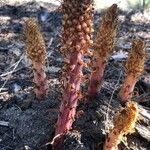
Pterospora andromedea
Pine-drops · Woodland pinedrops · Giant Bird's Nest · Giant Pinedrops
Description
Source: leafsnapPterospora, commonly known as pinedrops, woodland pinedrops, Albany beechdrops, or giant bird's nest is a North American genus in the subfamily Monotropoideae of the heath family, and includes only the species Pterospora andromedea. It grows as a mycoheterotroph in coniferous or mixed forests. It is widespread across much of Canada as well as the western and northeastern United States to and northern Mexico (Sonora, Coahuila, Durango, Nuevo León and Baja California). Along with Monotropa it is one of the more frequently encountered genera of the Monotropoideae. The genus name is derived from the morphology of the seeds which have narrow flaps of tissue on the side and therefore appear winged: pteron (Gr.) = wing, spora (Gr.) = seed. The specific name andromedea derives from the resemblance of the flowers to those of another genus in the Ericaceae, Andromeda.The visible portion of Pterospora andromedea is a fleshy, unbranched, reddish to yellowish flower spike (raceme) 30–100 cm (12–39.5 in) in height, though it has been reported to occasionally attain a height of 2 meters (6.6 feet). The above-ground stalks (inflorescences) are usually found in small clusters between June and August. The inflorescences are hairy and noticeably sticky to the touch. This is caused by the presence of hairs which exude a sticky substance (glandular hairs). The inflorescences are covered by scale-like structures known as bracts. The upper portion of the inflorescence has a series of yellowish, urn-shaped flowers that face downward. The fruit is a capsule. Plants exist for most of their life as a mass of brittle, but fleshy, roots. Pterospora has consistently been shown to be more closely related to Sarcodes than any other member of the Monotropoideae.
Care Guide
💧 Water
Woodland pinedrop thrives in cool, damp environments, which reflects its origins in the forest understory. It prefers moderate humidity and requires weekly watering. Although it benefits from natural rainfall when grown outdoors, additional watering is necessary during dry spells to support its growth and maintain a healthy ecosystem.
How should I water my Woodland pinedrop plant?
To care for the Woodland pinedrop plant, here are some guidelines to follow. Firstly, use filtered water that is at room temperature. Tap water can contain harmful particles, so filtering it is better for the plant's health. Additionally, the water should be at room temperature or slightly warmer because the Woodland pinedrop is used to a warm environment, and cold water can be a shock to its system. Avoid overhead watering, as it can cause issues with the foliage. Instead, thoroughly soak the soil with your filtered, room temperature water. This practice is beneficial because it moisturizes the roots and helps them spread and gather the necessary nutrients from the soil.
What do I need to do if I give my Woodland pinedrop plant too much or too little water?
Both overwatering and underwatering can harm the health of your Woodland pinedrop, but overwatering is more common. Too much water can cause wilting and yellowing of the stems and leaves. It can also lead to diseases like root rot, mold, and mildew, which can kill the plant. Underwatering is less common because this plant can tolerate drought. However, if it happens, the leaves may become brittle and brown. To care for your Woodland pinedrop, it's important to notice signs of overwatering early. Some diseases caused by overwatering, like root rot, may not be fixable if you wait too long. If you see early signs of overwatering, reduce your watering schedule and check the soil quality. If the soil drains poorly, replace it with a loose, well-draining potting mix. If you notice signs of underwatering, simply water more regularly until the signs subside.
How frequently should I give water to my Woodland pinedrop plant?
If your Woodland pinedrop is in a pot, the most precise way to determine if it needs water is to stick your finger into the soil. If the top two to three inches of soil feel dry, it's time to water it. If you're growing your Woodland pinedrop outdoors in the ground, you can use the same method. When the top few inches of soil dry out, it's time to water. Typically, during spring and early fall, watering once a week is sufficient. However, in extremely hot weather, you may need to water twice a week or even more. It's worth noting that mature, well-established Woodland pinedrops have an impressive ability to tolerate drought.
How much water does my Woodland pinedrop plant require?
When watering your Woodland pinedrop, don't be afraid to give it a generous amount of water. Make sure the top few inches of soil are dry before watering. Give enough water to saturate the soil completely, allowing excess water to drain through the pot's drainage holes. If you don't see any excess water draining, you may be underwatering. However, be cautious not to let water accumulate in the soil, as this can harm the plant. Poorly draining soils should also be avoided since they can negatively affect the plant's health. If the plant is outdoors, receiving about 1 inch of rain per week should be enough.
How do I water my Woodland pinedrop as it grows?
The water needs of the Woodland pinedrop can vary based on growth stages. In the first few years of its life or after transplanting, it requires more water than usual. This is because it focuses on developing new roots to support future growth, which need extra moisture. As the plant matures, it will require less water. Additionally, during the bloom period, when the plant is developing flowers, it may need additional water due to increased moisture usage.
☀️ Light Full sun
Woodland pinedrop thrives in full, unobstructed sunlight but also tolerates moderate shade. Native to habitats where sun is plentiful, its growth is aided by abundant light. Both excessive and insufficient exposure to that light can harm the plant's health.
What are the sunlight requirements for Woodland pinedrop?
Woodland pinedrop thrives under the full sun, requiring above 6 hours of sunlight daily to flourish, but it can also tolerate partial sun, which amounts to about 3-6 hours of sunlight. Observing the way sunlight moves through your garden is crucial, allowing you to pick spots that ensure plants get the ideal mix of light and shade. This approach is key to keeping your Woodland pinedrop happy and healthy.
How does artificial lighting benefit indoor plants, and what are the guidelines for using it?
Indoor plants, including Woodland pinedrop, benefit greatly from artificial lighting, especially when natural sunlight is insufficient. This is common in winter or less sunny locations. Artificial lights, like LED, can be customized to supply specific light wavelengths necessary for your plants. For full sun plants, 30-50W/sq ft is recommended; partial sun plants need 20-30W/sq ft, and full shade plants require 10-20W/sq ft. The light source should be placed 12-36 inches above the plant, simulating natural sunlight, and kept on for 8-12 hours a day to mimic natural daylight hours, promoting healthier, faster growth.
What are the symptoms of light deficiency in Woodland pinedrop?
In rooms with inadequate lighting, Woodland pinedrop may not show immediate signs of light deficiency. However, symptoms can include smaller new leaves, leggy or sparse growth, faster leaf drop, slower or halted growth, lighter-colored new leaves, and conditions like chlorosis, sunscald, leaf curling, wilting, and leaf scorching. These signs indicate either too much or too little exposure to sunlight, affecting the plant's health negatively.
What solutions can help improve the health of a Woodland pinedrop with light deficiency?
To counter light deficiency in both indoor and outdoor Woodland pinedrops, consider gradually moving the plants to sunnier locations, ensuring they receive at least 6 hours of direct sunlight daily. For indoor plants, using artificial light like grow lights or keeping a lamp on for at least 8 hours a day can supplement sunlight. Outdoors, gradual relocation helps the plant adjust without the risk of sunburn. If necessary, reduce obstructions by pruning or transplanting to a spot with better sunlight. Remember, while damaged parts might not recover, new growth should be healthy with improved light conditions.
🌡️ Temperature 5–32.2°C
Woodland pinedrop can adjust to a wide range of temperatures, but its distribution may still be restricted by different combinations of moisture and heat. It performs best in warm summers with adequate rainfall or watering. Extended stretches of cloudy, rainy weather or prolonged high temperatures can increase the chance of Woodland pinedrop dying. In winter, proper protection from the cold can improve the plant's survival.
💨 Humidity
🪴 Soil 4-5
🌱 Fertilizer
A single fertilizing in spring is typically adequate for Woodland pinedrop, though repeated feedings can increase growth. Apply fertilizer every month to every month and a half. Fertilization improves the leaves’ appearance and function, helping to maintain uniform color and a healthy texture. It also promotes root growth and nutrient uptake, supporting the plant’s long-term health.
🪴 Pot & Repot
✂️ Pruning
The woodland pinedrop is a tall, unbranched, parasitic plant that requires minimal pruning. To promote healthy growth and reduce the risk of disease, remove dead stems from early to late spring. Be cautious with pruning, as this plant has limited foliage. Always use clean tools to prevent the spread of disease.
🌿 Propagating
🐛 Diseases & pets
☠️ Toxicity
Characteristics
- Plant Type
- Herb
- Life Cycle
- Perennial
- Genus
- Pterospora
- Family
- Ericaceae
- Hardiness Zone
- 4-8
- Mature Height
- 0.3 m to 2.13 m
- Mature Spread
- 10 cm to 30 cm
- Leaf Color
- Dark Green
- Leaf Type
- Semi-evergreen
- Flower Color
- Pink, White
- Flower Size
- 0.51 cm to 0.76 cm
- Bloom Time
- Early summer, Mid summer
- Planting Time
- Spring
- Harvest Time
- Late summer, Early fall, Mid fall
- Native Area
- Mexico