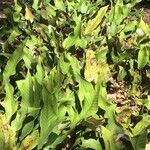
Pyrrosia lingua
Felt fern · Tongue fern · Pyrrosia
Description
Source: leafsnapPyrrosia lingua is a species of epiphytic fern in the family Polypodiaceae. It occurs through China, Southeast Asia and into Japan and Taiwan, China. Pyrrosia lingua is grown as a cultivated plant, and multiple named cultivars have been developed.
Care Guide
💧 Water Twice per week
The felt fern, native to East Asia, flourishes in environments that are rich in humidity and moisture. It requires regular watering twice a week to maintain its health. As an epiphytic plant, it relies on frequent misting to keep its fronds vibrant and to replicate the conditions of its tropical rainforest home.
☀️ Light Full shade
The felt fern grows well under a canopy that filters sunlight and can tolerate direct, unobstructed sun. Originating from habitats with fluctuating light levels, it is adapted to a wide range of light exposure. However, prolonged exposure to either excessively strong or too little sunlight can impair its growth.
What are the sunlight requirements for Felt fern?
Felt fern requires specific amounts of sunlight to thrive, categorized into partial sun, with about 3-6 hours of sunlight daily, and full sun, needing more than 6 hours of sunlight each day. It's crucial to observe how sunlight moves through your garden to pick the ideal locations that provide the right balance of light and shade for Felt fern, enhancing its growth and wellbeing.
What are the essentials for growing Felt fern?
The Felt fern prospers under conditions where sunlight is filtered, yet it can also tolerate direct sun exposure. Originating from environments with fluctuating light levels, this fern has an inherent flexibility to adapt to various degrees of light exposure. However, growth can be adversely affected under conditions of extreme or insufficient sunlight. In scenarios where natural sunlight is not enough, especially during the winter or in darker indoor areas, employing artificial lighting can significantly benefit the plants' growth, with LED lights being an efficient choice due to their ability to offer customizable light wavelengths. Correctly adjusting the artificial light's intensity, distance, and duration is essential for mimicking natural sunlight conditions and promoting optimal plant health.
What are the symptoms of inadequate light exposure in Felt fern?
Symptoms of insufficient light in Felt fern can manifest as smaller new leaves, signs of leggy or sparse growth, premature leaf drop, halted growth or a complete stop in new leaf production, lighter-colored new leaves indicating a lack of chlorophyll, chlorosis which leads to leaves losing their green color, sunscald causing damage to leaves or stems from intense sunlight, leaf curling as a defense against excessive sunlight exposure, wilting due to increased water loss, and leaf scorching, characterized by brown, dry patches on leaves because of too much sunlight. These symptoms show the fern's struggle with improper light conditions and underline the need for proper light management.
How can I ensure optimal light conditions for my Felt fern?
To optimize light conditions for your Felt fern and support its growth, consider gradually moving it to spots with more sunshine each week, aiming for 3-6 hours of direct sunlight daily. This helps the plant adapt without experiencing shock. If natural sunlight is inadequate, especially for large or immovable plants, supplementing with artificial light for at least 8 hours daily can be beneficial. Outdoor plants should also be transitioned carefully to sunnier locations to prevent sunburn. If shadows from obstacles limit sunlight, trimming or moving plants can help. During the dormant season, you might consider transplanting smaller plants to ensure better access to sunlight and good drainage.
🌡️ Temperature 15–35°C
Felt fern thrives in temperatures between 59 and 95 °F (15 to 35 ℃). Native to moderate climates, it prefers warm conditions. Through the seasons, take care to keep the plant within its preferred temperature range.
What is the ideal temperature range for Felt fern?
Felt fern, also known by its botanical name Pyrrosia lingua, thrives in environments with a temperature range of 59 to 95 °F (15 to 35 °C). Originating from moderate climates, it enjoys warm environments. It's crucial to maintain the plant within this preferred temperature range throughout different seasons. Felt fern exhibits some cold tolerance, typically not requiring additional cold protection measures when temperatures are above -5°C. However, if temperatures are expected to drop below -5°C, temporary cold protection measures are advisable, such as wrapping the plant in plastic film, fabric, or other suitable materials, which should be removed once temperatures rise again.
What should I do if my Felt fern is exposed to low temperatures?
Felt fern has a moderate tolerance to low temperatures, thriving best when the temperature is above 15°C and should be kept above -5°C during the winter. If the temperature falls below -10°C, the leaves may begin to droop; they can recover in mild cases, but severe cold can cause leaves to wilt and fall off. If frost damage occurs, trim off the frost-damaged parts. To prevent future cold damage, wrap the plant with non-woven fabric or cloth, and set up a wind barrier to protect it from cold winds.
How should I care for my Felt fern during high temperatures?
During the summer, it's critical to keep Felt fern below 35°C. Exposure to temperatures above 41°C can cause the leaves to lighten in color, dry and wither at the tips, curl, and increase the plant's susceptibility to sunburn. To manage sunburn or dryness, trim away the sunburned and dried areas. Relocate the plant to a shaded area during the peak midday and afternoon sun, or use a shade cloth to provide necessary shade. Also, water the plant in the morning and evening to maintain soil moisture.
💨 Humidity
🪴 Soil 6-7
🌱 Fertilizer
🪴 Pot & Repot 2-3 years
The felt fern is perfect for minimalists. It needs to be repotted every 2 to 3 years, ideally in the spring. Choose a shallow pot to accommodate its rhizomatous growth. After repotting, place it in a spot with bright, indirect light and maintain moderate moisture to encourage healthy, lush fronds.
✂️ Pruning
Prune your felt fern in early spring to remove damaged fronds and encourage new growth. Be careful not to over-prune, as this can stress the plant. Pruning improves airflow, helps prevent disease, and enhances the plant's appearance. Make sure to use clean tools to prevent infections, which will promote vigorous and resilient growth.
🌿 Propagating
🐛 Diseases & pets
☠️ Toxicity
Characteristics
- Plant Type
- Fern
- Life Cycle
- Perennial
- Genus
- Pyrrosia
- Family
- Polypodiaceae
- Hardiness Zone
- 8-10
- Mature Height
- 20 cm to 30 cm
- Mature Spread
- 30 cm to 91 cm
- Leaf Color
- Green, White, Gray, Silver, Brown
- Leaf Type
- Evergreen
- Planting Time
- Autumn, Spring
- Native Area
- Nepal, India, Cambodia, Vietnam, Myanmar, Japan, Bhutan, Laos, South Korea, Thailand, China