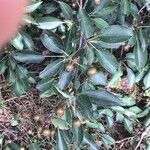
Pyrus pashia
Himalayan pear
Description
Source: leafsnapPyrus pashia, the wild Himalayan pear, is a small to medium size deciduous tree of the small and oval shaped crown with ovate, finely toothed leaves, attractive white flowers with red anthers and small pear-like fruits. It is a fruit bearing tree that is native to southern Asia. Locally, it is known by many names such as batangi (Urdu), tangi (Kashmiri), mahal mol (Hindi) and passi (Nepal).
💡 According to legend, a beautiful woman inspired an entire village to plant pear trees across a mountain to sustain their livelihoods. Enchanted by her beauty, a god attempted to seduce her, but she refused his advances. In retaliation, the god caused a drought, and the pear trees began to wither. Desperate and with no other options, the woman chose to end her life beneath the pear trees. To everyone's astonishment, the moment she died, the pear trees blossomed in the wind.
Care Guide
💧 Water
The Himalayan pear is a drought-resistant plant that needs very little watering, mainly during extended dry periods. For young plants, it's best to water them once a week with about 2.5 cm (1 inch) of water. Make sure to let the topsoil dry out slightly between waterings to avoid root rot.
☀️ Light Full sun
The Himalayan pear comes from open habitats, like sunny meadows and forest edges, which offer abundant light. It performs best in Full Sun but can also tolerate Partial Sun, adapting well to different sunlight levels.
🌡️ Temperature 5–32.2°C
The Himalayan pear is highly adaptable to a variety of climatic conditions, from very hot summers to cold winters. Nevertheless, it requires a specific temperature range for optimal growth. If temperatures become too high, the plant is vulnerable to heat and humidity stress, which can cause it to die. In areas where temperatures approach the lower limit of its cold tolerance, it's necessary to use insulation measures to protect the plant.
💨 Humidity high (>60%)
This plant needs special care because it loves high humidity levels of 60-80% or more. The best way to achieve this is by placing a humidifier near the plant. Daily misting is also essential! Make sure the room has good ventilation.
🪴 Soil 6-7
🌱 Fertilizer
The Himalayan pear plant needs adequate nutrients to achieve optimal fruit production. Fertilize in early spring to support new growth and flower development. Regular feeding keeps the plant healthy, promotes more delicious fruit, and prevents nutrient-deficiency problems like yellowing leaves and poor fruit yield.
🪴 Pot & Repot
✂️ Pruning
The Himalayan pear benefits greatly from pruning in early spring. Focus on removing dead branches and thinning out overcrowded areas to improve air circulation and sunlight exposure. Shaping the plant each year not only enhances its form but also boosts fruit production. Pruning at the right time during its growth period reduces stress on the plant. With regular care, your Himalayan pear will stay healthy, resist diseases, and remain an attractive addition to your garden.
🌿 Propagating
🐛 Diseases & pets
☠️ Toxicity
Characteristics
- Plant Type
- Tree
- Life Cycle
- Perennial
- Genus
- Pyrus
- Family
- Rosaceae
- Hardiness Zone
- 5-8
- Mature Height
- 7.92 m to 11.89 m
- Mature Spread
- 4.88 m to 7.92 m
- Leaf Color
- Red, Green, Brown
- Leaf Type
- Deciduous
- Flower Color
- White
- Flower Size
- 2.03 cm to 3.05 cm
- Bloom Time
- Early spring, Mid spring
- Planting Time
- Spring, Summer
- Harvest Time
- Late summer, Early fall, Mid fall
- Native Area
- Nepal, Afghanistan, India, Vietnam, Myanmar, Bhutan, Pakistan, Laos, Thailand, China