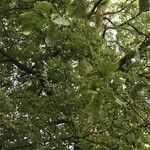
Quercus arkansana
Arkansas oak
Description
Source: leafsnapQuercus arkansana, commonly known as the Arkansas oak, is a deciduous tree native to the central and southern regions of the United States. Belonging to the Fagaceae family, this species can grow up to 30 meters tall with a trunk diameter of up to 1 meter. The tree's grayish-brown bark is characterized by deep vertical furrows. The leaves of Quercus arkansana are simple, alternate, and lobed, measuring between 7 to 15 cm in length. They are dark green on the top with lighter green undersides. The tree produces oval-shaped acorns, with a cap covering about one-third of their surface. Quercus arkansana prefers well-drained soils but can tolerate various soil types, including sandy or clay soils, provided they have adequate moisture levels. It thrives in environments with full sun or partial shade. This oak species provides crucial habitat for various wildlife. Birds such as woodpeckers and nuthatches feed on its acorns, while deer browse on its leaves during the winter months when other food sources are scarce. Overall, Quercus arkansana is an important tree species for both ecological diversity and aesthetic value. Its attractive foliage turns vibrant shades of yellow, orange, red, and brown in the fall before shedding leaves for the winter dormancy period, until spring arrives with new growth.
Care Guide
💧 Water Every 7 days
The Arkansas oak thrives in well-drained soils and is tolerant of drought once it is established. It requires moderate watering every 2-3 weeks. However, it's important to consider seasonal rain patterns, as heavy rainfall can reduce the need for additional watering.
☀️ Light Full sun
Arkansas oak comes from open habitats, like sunny meadows and the edges of forests, which supply abundant light. It performs best in full sun but can tolerate partial sun, showing good adaptability to a range of sunlight conditions.
What are the sunlight requirements for Arkansas Oak?
Arkansas Oak thrives best in environments that mimic its natural habitat, which includes sunny meadows and forest edges. It requires full sun, meaning it needs above 6 hours of direct sunlight daily, but it can also tolerate partial sun, with about 3-6 hours of sunlight. It's important to observe the movement of sunlight through your garden to ensure that you're providing the ideal balance of light and shade for your plants, securing their growth and happiness.
How does artificial lighting support plant growth indoors?
Indoor plants, including Arkansas Oak, may require artificial lighting to complement natural sunlight, especially in less sunny spaces or during winter. Optimal growth is facilitated by adequate lighting, with LED lights being a popular choice due to their capability to mimic specific wavelengths needed by plants. For full sun plants, 30-50W/sq ft of artificial light is recommended, 20-30W/sq ft for partial sun plants, and 10-20W/sq ft for full shade plants. The artificial light source should be placed 12-36 inches above the plant, and plants most often require 8-12 hours of light per day to mimic natural daylight hours effectively.
What are some common symptoms of insufficient sunlight in Arkansas Oak?
Arkansas Oak may show several symptoms when experiencing insufficient sunlight, including smaller new leaves, leggy or sparse growth, faster leaf drop, and halted growth, indicating that the plant is in survival mode. Inadequate sunlight can also lead to lighter-colored new leaves, chlorosis (loss of leaf greenness), sunscald, leaf curling, wilting, and leaf scorching. These symptoms showcase the plant's struggle under suboptimal lighting conditions and highlight the importance of proper light exposure for healthy growth.
What solutions can improve sunlight exposure for Arkansas Oak?
To optimize sunlight exposure for your Arkansas Oak, gradually relocate the plant to ensure it receives at least 6 hours of direct sunlight daily, particularly using a south-facing window for indoor plants. If moving the plant isn't feasible, consider artificial lighting options, such as desk lamps or professional grow lights, for at least 8 hours daily. For outdoor plants, it's crucial to avoid sudden changes in light intensity to prevent sunburn. Assess and adjust your garden's environment to minimize obstructions, which might involve pruning trees or relocating the plant to a sunnier spot with adequate drainage during its dormant period. It's important to note that while affected parts of the plant may not recover, new growth should be healthy following improved light exposure.
🌡️ Temperature 10–35°C
The Arkansas oak is highly adaptable to a wide range of climate conditions, from hot summers to cold winters. Nevertheless, it does have a preferred temperature range for healthy growth. If temperatures climb too high, the plant can experience stress from heat and humidity that may lead to its death. In areas where temperatures near the lower limit of its cold tolerance, taking steps to insulate the plant is important for its protection.
What is the botanical name of Arkansas oak?
The botanical name of Arkansas oak is Quercus arkansana.
💨 Humidity
🪴 Soil 6-7
🌱 Fertilizer
To encourage healthy growth, fertilize your Arkansas oak in early spring. Regular feeding improves its overall health, producing vigorous growth, greater tolerance of difficult conditions, and enhanced resistance to pests and diseases. Keep to a specific fertilization schedule for your Arkansas oak to maintain foliage that is vibrant, deeply colored, and lush in appearance.
🪴 Pot & Repot
✂️ Pruning
Pruning an Arkansas oak is important for maintaining its shape and health. This process involves removing dead branches and thinning the tree to improve airflow. The best time to prune is in early spring when the tree experiences minimal stress. Proper pruning helps prevent diseases and pests. However, be careful not to cut too much, as this can weaken the tree.
🌿 Propagating
🐛 Diseases & pets
☠️ Toxicity
Characteristics
- Plant Type
- Tree
- Life Cycle
- Perennial
- Genus
- Quercus
- Family
- Fagaceae
- Hardiness Zone
- 6-9
- Mature Height
- 21.95 m to 30.48 m
- Mature Spread
- 6.1 m to 10.06 m
- Leaf Color
- Dark Green, Olive Drab
- Leaf Type
- Deciduous
- Bloom Time
- Mid spring, Late spring
- Planting Time
- Spring, Summer
- Harvest Time
- Late summer, Early fall, Mid fall