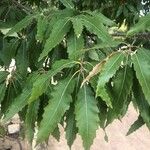
Quercus castaneifolia
شاه بلوط · Chestnut-leaved Oak · Chestnut-leaf oak · Chinquampin Oak
Description
Source: leafsnapQuercus castaneifolia, commonly known as the chestnut-leaved oak, is a deciduous tree species in the Fagaceae family. It is native to the Caucasus region and northern Iran. This tree can reach heights of up to 25 meters and has a broad crown with a diameter of up to 20 meters. The leaves of Quercus castaneifolia are large, typically measuring 15-20 cm in length and 10-15 cm in width. They have a dark green color and serrated edges that resemble chestnut leaves, hence the common name. The tree produces acorns that are about 2-3 cm long, with a cup-like structure at their base. These acorns mature in late summer or early autumn. Quercus castaneifolia is valued as a timber species due to its strong wood, which is suitable for construction purposes such as flooring, furniture making, and shipbuilding. It also has medicinal properties; its bark can be used to treat diarrhea, and its leaves have been traditionally used for treating wounds. Ecologically, Quercus castaneifolia provides habitat for various wildlife, including birds and insects, and contributes significantly to soil conservation due to its deep root system, which helps prevent soil erosion. Overall, Quercus castaneifolia is important both ecologically and economically. It plays a significant role in conservation efforts aimed at preserving biodiversity within its native ecosystems, as well as in regions where it is cultivated under suitable growth conditions.
Care Guide
💧 Water Every 7 days
Originally from moist forests, the chestnut-leaved oak thrives in evenly moist soil and needs to be watered twice a week. It also benefits from higher humidity when grown indoors. As a deciduous plant, its water requirements increase during the active growing season, before its leaves shed.
☀️ Light Full sun
The chestnut-leaved oak grows best in full sun, which promotes vigorous growth and good health. It can also tolerate semi-shaded conditions. In its original habitat it received abundant sunlight, yet it adapted to somewhat reduced light. Excessive exposure may cause leaf damage, while insufficient sun can result in stunted growth.
🌡️ Temperature 15–32.2°C
Chestnut-leaved oak is native to regions where the average temperature falls between 59 and 89.6 °F (15 to 32 ℃). It favors a moderately warm climate. Seasonal temperature adjustments might be required to mimic its natural habitat.
💨 Humidity normal (40-60%)
This plant will thrive in moderate humidity, which is probably the level in your home. However, misting it a few times a week can be very beneficial. Make sure the room has good ventilation.
🪴 Soil 5-6
🌱 Fertilizer
To encourage healthy growth, fertilize your Chestnut-leaved oak in early spring. Regular feeding boosts its overall health, leading to vigorous growth, increased tolerance of harsh conditions, and improved resistance to diseases and pests. Stick to a specific fertilization schedule for your Chestnut-leaved oak to ensure bright, deeply colored foliage and a lush appearance.
🪴 Pot & Repot
✂️ Pruning
The Chestnut-leaved Oak is a deciduous tree with leaves that resemble those of a chestnut. To maintain its health, it is advisable to prune the tree in early spring. Focus on removing any dead branches and thinning out densely crowded areas to improve air circulation. Be careful to avoid heavy pruning, as it can cause undue stress to the tree. Instead, aim for regular, moderate pruning to promote strong structural growth and healthier foliage.
🌿 Propagating
🐛 Diseases & pets
☠️ Toxicity
Characteristics
- Plant Type
- Tree
- Life Cycle
- Perennial
- Genus
- Quercus
- Family
- Fagaceae
- Hardiness Zone
- 7
- Mature Height
- 20.12 m to 29.87 m
- Mature Spread
- 14.94 m to 20.12 m
- Leaf Color
- Dark Green, Forest Green
- Leaf Type
- Deciduous
- Flower Size
- 6.35 cm to 10.16 cm
- Bloom Time
- Mid spring, Late spring
- Planting Time
- Autumn
- Harvest Time
- Late summer, Early fall, Mid fall
- Native Area
- Iran, Tajikistan, Azerbaijan, Turkmenistan