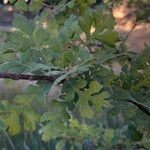
Quercus lobata
Valley oak · California white oak · Roble · Black oak
Description
Source: leafsnapQuercus lobata, commonly called the valley oak or roble, grows into the largest of California oaks. It is endemic to California, growing in interior valleys and foothills from Siskiyou County to San Diego County. Mature specimens may attain an age of up to 600 years. This deciduous oak requires year-round access to groundwater.Its thick, ridged bark is characteristic and resembles alligator hide. The valley oak's deeply lobed leaves assist in identification.
🌳 Valley oak has been an important resource for indigenous communities. Traditionally, the valley oak’s acorns were ground into a meal that functioned as a staple food and was rich in nutrients and energy. Surprisingly, the acorns were also soaked in water to remove tannins, making them an uncommon example of an edible oak nut.
🎭 Security, Wellness, Finances
Care Guide
💧 Water
The valley oak is a deciduous tree native to the Mediterranean climate of California. It thrives in deep, well-drained soils and exhibits a high tolerance to drought. When young, it requires watering about once every three weeks. However, once established, it benefits from seasonal rainfall, which significantly reduces the need for additional irrigation.
☀️ Light Full sun
Valley oak does best with abundant light but can tolerate moderate light levels. Its early years require plenty of illumination for robust growth, a characteristic derived from its native open-landscape habitat. Too much or too little light can negatively affect its health, demonstrating its reliance on light.
What are the sunlight requirements for Valley Oak?
Valley Oak thrives under conditions of abundant light, requiring more than 6 hours of direct sunlight daily for optimal growth, known as full sun exposure. It can also endure moderate light conditions, described as partial sun, with about 3-6 hours of sunlight. Notably, its formative years demand ample luminosity for vigorous growth, inherited from its origin in open landscapes. An appropriate balance of light and shade is essential for ensuring the plant's health and happiness, as both excessive and inadequate exposure to light might adversely affect its well-being.
How does artificial lighting support Valley Oak growth indoors?
When natural sunlight is insufficient, especially during winter or in less sunny spaces, artificial lighting becomes an essential solution for supporting Valley Oak's growth indoors. LED lights are often chosen for indoor plant lighting as they can provide specific wavelengths of light required by plants. Full sun plants need 30-50 watts per square foot of artificial light, partial sun plants require 20-30 watts per square foot, and full shade plants need 10-20 watts per square foot. The light source should be placed 12-36 inches above the plant to mimic natural sunlight, and most plants benefit from 8-12 hours of light per day to simulate natural daylight hours effectively.
What are the symptoms of inadequate sunlight exposure in Valley Oak?
Valley Oak displays several symptoms when exposed to inadequate sunlight, indicating a light deficiency. These include new leaves growing smaller in size compared to previous ones, leggy or sparse growth with longer spaces between leaves or stems, faster leaf drop to conserve resources, slower or no new growth as the plant enters survival mode, leaves developing paler colors or irregular patterns due to a lack of chlorophyll, and conditions like chlorosis, sunscald, leaf curling, wilting, and leaf scorching. Each symptom reflects the plant's struggle with suboptimal lighting conditions.
What solutions can be applied to address Valley Oak's light deficiency indoors and outdoors?
For indoor Valley Oaks, improving light conditions involves gradually moving the plant to sunnier locations each week until it receives at least 6 hours of direct sunlight daily, utilizing south-facing windows for maximum exposure. If the plant is large or not easily movable, artificial lighting such as desk or ceiling lamps, or professional grow lights can be used for at least 8 hours daily. Outdoors, plants should be moved gradually to sunnier spots to avoid sunburn, emphasizing the importance of avoiding sudden light intensity changes. Additionally, reducing obstructions like pruning trees to allow more sunlight and transplanting smaller plants during their dormant period to locations with better sunlight and drainage are effective strategies. Note that parts of the plant affected by insufficient sunlight may not recover, but new growth will be healthy with increased light exposure.
🌡️ Temperature 10–35°C
Native to California, the valley oak prefers temperatures from 50 to 95 ℉ (10 to 35 ℃). It copes with seasonal temperature changes by dropping its leaves in winter to conserve water and reduce heat loss.
What are the essential care instructions for a Valley Oak?
The Valley Oak, native to California, thrives in temperatures between 50 to 95°F (10 to 35°C), adjusting to seasonal temperature changes by shedding leaves in winter to conserve water and reduce heat loss. It possesses strong cold resistance, and special frost protection measures are usually not necessary. However, if winter temperatures are expected to drop significantly, protection by wrapping the trunk and branches with non-woven fabric or cloth is advisable. To prevent drought and water scarcity, watering the plant abundantly before the first freeze of autumn to keep the soil moist is recommended.
How do I protect my Valley Oak from low temperatures?
Valley Oak is cold-tolerant, doing well in temperatures above its minimum growth range. If temperatures are expected to fall below its growth limit, although immediate damage may not be visible in winter, the branches can become brittle and dry by spring, failing to produce new shoots. To counteract this, prune away any dead branches that didn't produce new leaves in the spring. Ensuring the soil remains moist before winter can help prevent issues.
What should I do if my Valley Oak is exposed to high temperatures?
During the summer, keeping the Valley Oak below the maximum suitable growth temperature is crucial. Exceeding this can result in lighter leaf colors, dry and withered leaf tips, and increased susceptibility to sunburn. To mitigate these effects, trim away the sunburned and dried parts of the plant, move it to a shaded location during the midday and afternoon sun, or use a shade cloth to provide protection. It's also important to water the plant in the morning and evening to maintain soil moisture.
💨 Humidity
🪴 Soil 6-7
🌱 Fertilizer
Fertilize your Valley oak in early spring to encourage healthy growth. Regular fertilization improves overall health, producing vigorous growth, greater tolerance of challenging conditions, and increased resistance to pests and diseases. Keep to a consistent fertilization schedule to maintain foliage that is vivid in color and lush in appearance.
🪴 Pot & Repot Every 12 months
✂️ Pruning
The Valley Oak is a deciduous tree known for its wide canopy and resilience. To keep it healthy, prune it in early spring by removing any dead or crossing branches to enhance air circulation. Crown thinning can help with light access, but be careful not to prune too aggressively to preserve the tree's health and vitality. With regular care, the Valley Oak will remain attractive and robust.
🌿 Propagating
🐛 Diseases & pets
☠️ Toxicity
Characteristics
- Plant Type
- Tree
- Life Cycle
- Perennial
- Genus
- Quercus
- Family
- Fagaceae
- Hardiness Zone
- 6-9
- Mature Height
- 15.24 m to 21.34 m
- Mature Spread
- 9.14 m to 14.94 m
- Leaf Color
- Green
- Leaf Type
- Deciduous
- Flower Color
- Yellow, Green
- Flower Size
- 2.54 cm
- Bloom Time
- Mid spring, Late spring
- Planting Time
- Autumn
- Harvest Time
- Mid summer, Late summer