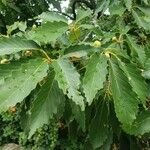
Quercus muehlenbergii
Chinkapin oak · Chinquapin oak · Yellow chestnut oak · Yellow Oak
Description
Source: leafsnapQuercus muehlenbergii, commonly known as the chinkapin oak, is a deciduous tree native to North America. As a member of the Fagaceae family, it can grow up to 60 feet tall with a spread of about 40 feet. The tree features a pleasing rounded crown and mature bark that becomes deeply furrowed and scaly over time. The leaves of Quercus muehlenbergii are simple, alternate, and feature toothed margins. During the summer, they are dark green, turning yellow-brown in autumn before falling off for winter dormancy. Chinkapin oaks produce acorns which serve as a crucial food source for wildlife, including squirrels and deer. The acorns are notably sweeter than those of other oak species, though they are smaller in size. This tree prefers well-drained soils but can tolerate drought conditions once established. It is often found on rocky slopes or ridges throughout its native range, which extends from Texas to Minnesota. Historically, Quercus muehlenbergii has been utilized for various purposes. Its wood is sought after for furniture and flooring due to its durability and attractive grain pattern. Additionally, Native American tribes used parts of the tree medicinally to treat ailments such as diarrhea and fever. Overall, Quercus muehlenbergii is an ecologically important species, providing essential food sources for wildlife. It is also valued by humans both aesthetically and functionally for its wood products.
🌳 The chinquapin oak, often viewed as a typical oak, is remarkably versatile. Its wood is particularly strong, durable, and resistant to decay, making it well suited for fine furniture and construction materials. Native Americans ingeniously ground the tree's acorns into flour, offering a distinctive food option in their diet. The tree also helps sustain ecosystems by providing habitat for insects, which in turn are important food sources for various birds and other wildlife, demonstrating its multiple benefits.
🎭 Security, Wellness, Finances
Care Guide
💧 Water Every 7 days
Chinquapin oak is well-adapted to different moisture levels and demonstrates moderate drought tolerance, thriving in well-drained soil. For optimal growth, water the tree every 1 to 2 weeks to mimic its natural habitat. Typically grown outdoors, the chinquapin oak conserves water during dry periods by shedding its leaves.
☀️ Light Full sun
Chinquapin oak does best when it gets a plentiful amount of light each day. It can also tolerate spots where sunlight is occasionally blocked, though that may slightly affect its health and growth. In its native range it naturally receives abundant light. Both too much and too little light can hinder its health and development.
What are the sunlight requirements for Chinquapin oak?
Chinquapin oak requires a generous amount of sunlight to thrive, ideally in conditions that mirror its native habitat, where it absorbs abundant light. It is best exposed to full sun, defined as above 6 hours of sunlight daily, but it can also tolerate partial sun, which is about 3-6 hours of sunlight. However, it's crucial to watch how sunlight moves through your garden and choose spots that provide the right balance of light and shade, as both overexposure or deficiency of light can negatively impact the plant's health and development.
How does artificial lighting support plant growth indoors?
Artificial lighting is essential for indoor plants, especially when natural sunlight is insufficient, such as in winter or in less sunny spaces. LED lights are a popular choice, offering the ability to customize the light to the specific needs of the plant. Full sun plants need 30-50 watts per square foot of artificial light, partial sun plants require 20-30 watts, and full shade plants need 10-20 watts. The light source should be placed 12-36 inches above the plant to mimic natural sunlight, with most plants benefiting from 8-12 hours of light per day. This promotes faster, healthier growth by providing optimal lighting conditions.
What symptoms indicate insufficient sunlight in Chinquapin oak?
Symptoms of insufficient sunlight in Chinquapin oak include new leaves growing smaller in size, leggy or sparse growth with longer spaces between leaves or stems, faster leaf drop, slower or no new growth, and lighter-colored new leaves due to lack of chlorophyll. There's also chlorosis, where leaves lose their green color and turn yellow, sunscald with damaged areas on leaves or stems from intense sunlight, leaf curling as a defense against overexposure, wilting due to excessive water loss, and leaf scorching where edges become brown and dry.
What solutions can improve light exposure for Chinquapin oak?
To ensure optimal growth for Chinquapin oak with insufficient light exposure, gradually acclimate plants to more sunlight by moving them to a sunnier location each week until they receive at least 6 hours of direct sunlight daily. Indoors, use south-facing windows and keep curtains open or supplement with artificial light for large plants. Outdoors, avoid sudden changes in light intensity to prevent sunburn. Additionally, reduce obstructions like overhanging branches, or transplant smaller plants during their dormant period to spots with more sunlight and good drainage. It's important to note that while parts of the plant affected by insufficient sunlight may not recover, new growth after increasing light exposure will be healthy.
🌡️ Temperature 5–32.2°C
The chinquapin oak is native to the midwestern United States and occurs in temperate habitats. For optimal growth it prefers temperatures between 41 and 90 ℉ (5 to 32 ℃). In winter it can tolerate lows down to -4 ℉ (-20 ℃), and in summer it can withstand highs up to 95 ℉ (35 ℃). In locations with extreme temperature swings, planting it in a sheltered spot can help the chinquapin oak cope with the variations.
What is the native habitat and optimal temperature range for Chinquapin oak?
Chinquapin oak, botanically known as Quercus muehlenbergii, is native to the mid-western United States and thrives in temperate environments. It prefers a temperature range from 41 to 90°F (5 to 32°C) for optimal growth. During winter, it can endure temperatures as low as -4°F (-20°C), and in summer, it can withstand up to 95°F (35°C). For areas experiencing extreme temperature fluctuations, planting Chinquapin oak in a sheltered location is advisable to help it adjust to varying temperatures. This species is highly cold-tolerant and doesn't necessitate additional frost protection measures in winter.
How should Chinquapin oak be cared for before the first freeze of autumn?
Before the first freeze in autumn, it is crucial to water Chinquapin oak generously. Ensuring the soil remains moist and enters a frozen state is important for preventing drought and water scarcity for the plant during the winter and early spring. This step is beneficial for maintaining the health and resilience of Chinquapin oak through colder months.
What are the symptoms and solutions for Chinquapin oak when experiencing low temperatures?
Chinquapin oak is extremely cold-tolerant, yet it is recommended to maintain winter temperatures above -4°F (-20°C). If temperatures fall below this threshold, there may not be noticeable changes during winter. However, branches may become brittle and dry by spring, with no new shoots emerging. The solution to this issue is to prune away any dead branches that have failed to produce new leaves come spring, thereby encouraging the growth of healthy new shoots.
How does Chinquapin oak react to high temperatures and what are the solutions?
Chinquapin oak is not tolerant of high temperatures. Exceeding the temperature of 95°F (35°C) can result in significant leaf drop, and in severe cases, the plant may wither and die. To mitigate this, it is advisable to trim away any sunburned and dried-up parts of the plant. Moving the plant to a shaded location or using a shade cloth to provide protection from the midday and afternoon sun can be beneficial. Watering the plant in the morning and evening to keep the soil moist is also effective in helping the plant cope with the heat.
💨 Humidity
🪴 Soil 6-7
🌱 Fertilizer
Fertilize your Chinquapin oak in early spring to encourage healthy growth. Regular feeding boosts overall health, producing vigorous growth, better tolerance of challenging conditions, and stronger resistance to diseases and pests. Keep to a consistent fertilization routine for your Chinquapin oak to maintain foliage that is vibrant, deeply colored, and lush in appearance.
🪴 Pot & Repot
✂️ Pruning
The Chinquapin oak stands out with its distinct lobed leaves and wide canopy. To promote good health and air circulation, prune the tree in early spring by removing any dead or crossing branches. While pruning, aim to maintain the tree's natural shape and encourage strong structure. Be sure to sterilize your tools to prevent infection and enhance the tree's appearance.
🌿 Propagating
🐛 Diseases & pets
☠️ Toxicity
Characteristics
- Plant Type
- Tree
- Life Cycle
- Perennial
- Genus
- Quercus
- Family
- Fagaceae
- Hardiness Zone
- 5-7
- Mature Height
- 29.87 m
- Mature Spread
- 17.98 m to 24.08 m
- Leaf Color
- Green, Yellow, Red, Gold, Brown
- Leaf Type
- Deciduous
- Flower Color
- Yellow, Green, Gold
- Flower Size
- 0.25 cm
- Bloom Time
- Mid spring, Late spring
- Planting Time
- Autumn
- Harvest Time
- Mid summer, Late summer
- Native Area
- Mexico