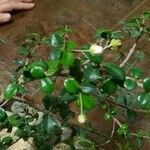
Randia aculeata
Inkberry · Box brier · Goat-horn · Five-fingers · White Indigo-Berry
Description
Source: leafsnapRandia aculeata, commonly known as white indigoberry or white indigo berry, is a species in the Rubiaceae. It is a shrub or small tree that grows from 2 to 6 m tall. R. aculeata is native to Florida, Bermuda, the Bahamas, elsewhere among the Caribbean islands, and also from Mexico south through Central and South America to Colombia.
Care Guide
💧 Water
The white indigo berry, native to arid regions, is highly drought-tolerant and thrives in low humidity. It requires minimal watering, approximately once every 2-3 weeks. When you do water, ensure a deep soak in well-draining soil to encourage strong root development.
☀️ Light Full sun
For optimal growth, white indigo berry performs best when exposed to sunlight for most of the day. It can, however, tolerate conditions with less light. Its native habitat, generally sun-drenched, accounts for this. Excessive exposure can stress the plant, while inadequate light may impede its growth.
What are the sunlight requirements for White indigo berry?
White indigo berry thrives in conditions where it can receive constant exposure to the sun for the majority of the day, as it originates from typically sun-drenched habitats. It requires full sun, which means above 6 hours of sunlight, but can also tolerate partial sun, with about 3-6 hours of sunlight. However, it's important to note that overexposure can cause the plant stress, while insufficient light might stunt its growth. Observing how sunlight moves through your garden will help in choosing spots that provide the perfect balance of light and shade, ensuring the plant's well-being.
How can artificial lighting be used for White indigo berry?
Artificial lighting is crucial for indoor White indigo berry plants, especially when natural sunlight is insufficient, like in winter or in spaces that do not get enough sun. LED lights are a popular choice because they can provide the specific wavelengths needed by the plant. For optimum growth, full sun plants require 30-50W/sq ft of artificial light, partial sun plants require 20-30W/sq ft, and full shade plants need 10-20W/sq ft. The light source should be placed 12-36 inches above the plant to mimic natural sunlight, and most plants need 8-12 hours of light per day.
What symptoms indicate insufficient light for White indigo berry?
When White indigo berry is subjected to insufficient light, particularly indoors during winter, several symptoms can emerge. These include smaller new leaves compared to mature ones, leggy or sparse growth with longer spaces between leaves or stems, faster leaf drop, slower or halted growth, and lighter-colored new leaves, indicating a lack of chlorophyll and essential nutrients. Chlorosis, or the yellowing of leaves due to breaking down of chlorophyll, sunscald, leaf curling, wilting, and leaf scorching are additional signs of light-related stress, whether from insufficient or excessive exposure.
What are the solutions for White indigo berry struggling due to insufficient or excessive sunlight?
To help White indigo berry plants struggling due to insufficient or excessive sunlight, gradual adaptation is key. For example, indoor plants should ideally be moved to a sunnier location each week, aiming for at least 6 hours of direct sunlight daily, using a south-facing window for natural light or artificial lights if necessary. Outdoor plants also need cautious relocation to sunnier spots without causing sunburn. If obstructions like trees block sunlight, consider pruning to allow more light through. For affected plants that are small enough, transplanting during their dormant period (late winter or early spring) into a sunnier location with good drainage might be vital. Note, while parts of the plant damaged by insufficient sunlight may not recover, new growth should be healthy following these adjustments.
🌡️ Temperature 20–37.8°C
White indigo berry is a species originating from temperate regions. It grows best at temperatures between 68 and 100°F (20 to 38℃). In colder weather, it may need protection or insulation to survive.
What is the ideal temperature for growing White Indigo Berry?
White Indigo Berry thrives in temperatures ranging from 68 to 100°F (20 to 38°C). This plant is native to temperate climates and loves heat, but it is crucial to protect it from cold temperatures. During autumn and winter, it is recommended to bring the plant indoors and place it near a bright window while keeping it away from direct heat sources to ensure temperatures stay above 20°C. Temperatures nearing 0°C or colder can be detrimental to the plant's health.
How does low temperature affect White Indigo Berry and what are the solutions?
White Indigo Berry is sensitive to low temperatures and performs best when the temperature is above 20°C. In winter, it's critical to keep temperatures above 0°C to avoid damage. Exposure to temperatures below -5°C may cause the leaves to lighten in color, and after frost, they may turn brown or black with symptoms like wilting and drooping appearing. The solution includes trimming off the frost-damaged portions and moving the plant indoors to a warm spot, preferably near a south-facing window to ensure it gets enough sunlight. It's also important to avoid placing the plant too close to heaters or air conditioning vents to prevent excessive dryness.
How should White Indigo Berry be cared for in high temperatures?
During the hot summer months, it is essential to ensure that White Indigo Berry's environment stays below 38°C to prevent heat stress. Exposure to temperatures above 43°C can lighten the leaves' color and increase susceptibility to sunburn. To manage this, trim away sunburned and dried parts of the plant, move it to a shaded location during the most intense midday and afternoon sun, and water the plant in the morning and evening to maintain soil moisture.
💨 Humidity
🪴 Soil 5-7
🌱 Fertilizer
Early spring, as the White indigo berry breaks dormancy, is the best time to apply fertilizer. This supports overall growth and flower development. Fertilization improves the foliage, stems, and branches, while encouraging larger, more vibrant, and longer-lasting blooms. It helps transport nutrients from the roots to the flowers and enhances the plant's health and resistance to disease.
🪴 Pot & Repot
✂️ Pruning
The white indigo berry is an evergreen shrub known for its spiny branches and fragrant white flowers that produce white berries. To maintain its health and appearance, prune the shrub between early and late winter. Focus on removing dead branches and thinning out the plant to allow more light to penetrate. This process encourages healthy growth, denser foliage, and more abundant flowering, thereby enhancing its ornamental beauty.
🌿 Propagating
🐛 Diseases & pets
☠️ Toxicity
Characteristics
- Plant Type
- Tree, Shrub
- Life Cycle
- Perennial
- Genus
- Randia
- Family
- Rubiaceae
- Hardiness Zone
- 9-11
- Mature Height
- 1.83 m to 3.05 m
- Mature Spread
- 1.52 m to 2.44 m
- Leaf Color
- Green, Blue
- Leaf Type
- Evergreen
- Flower Color
- White
- Flower Size
- 2.54 cm
- Bloom Time
- Late spring, Summer, Early fall
- Planting Time
- Spring, Summer, Autumn
- Harvest Time
- Late summer, Fall, Early winter
- Native Area
- Belize, Honduras, Mexico, Guatemala, Peru, Panama, Jamaica, Colombia, Bahamas, Cuba, Venezuela, El Salvador, Nicaragua, Ecuador, Costa Rica