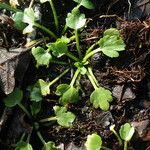
Ranunculus sceleratus
Celery buttercup · Celery-leaf buttercup · Celery-leaf crowfoot · Cursed crowfoot · Marsh crowfoot
Description
Source: leafsnapRanunculus sceleratus, commonly known as the cursed buttercup or celery-leaved buttercup, is a perennial herbaceous plant in the Ranunculaceae family. Native to Europe and Asia, it has also been introduced and naturalized in various parts of North America. The plant can grow up to 60 cm tall and features hollow stems with leaves that are deeply divided and resemble celery leaves. Its small, yellow flowers have five petals and a diameter of about 1 cm. The fruit is an achene that contains numerous seeds. Ranunculus sceleratus thrives in wet habitats such as marshes, ditches, wet meadows, or along streams, but it can also grow in other moist areas, including gardens and disturbed sites. This plant contains toxic compounds like protoanemonin, which can cause skin irritation upon contact with humans or animals. Despite its toxicity, some indigenous cultures have used it medicinally to treat various ailments, including rheumatism. In summary, Ranunculus sceleratus is an interesting yet potentially dangerous plant due to its toxicity. It should be handled with care when encountered in the wild or in garden settings.
Care Guide
💧 Water Every 3 days
The celery-leaved buttercup originates from marshy environments and thrives in consistently moist soil, needing weekly watering. While it can tolerate short periods of dryness, it is best grown outdoors in well-draining soil that holds moisture without becoming waterlogged.
How should I water my Celery-leaved buttercup plant to keep it healthy?
To water Celery-leaved buttercup, you have several options. You can use a garden hose with a spray nozzle, a watering can, or any other common watering tool. This plant isn't too particular about the type of water it receives. It can survive on rainwater, tap water, or filtered water. However, it's best to avoid watering it from above as this can harm the leaves and flowers and potentially cause disease. Using a drip irrigation system is often the most effective method for watering Celery-leaved buttercup. These systems deliver water evenly and directly to the soil. If you have a container-grown Celery-leaved buttercup, you should use a different approach. You can water it by pouring water using a cup, watering can, or directly from the tap, aiming for the soil.
What should I do if I give my Celery-leaved buttercup too much or too little water?
To remedy underwatering Celery-leaved buttercup, simply start watering it regularly when you notice it lacks moisture. Overwatering, on the other hand, can have more severe consequences if not addressed promptly. Overwatered plants may fall prey to diseases that cause decline and death. To prevent this, select a suitable location with ample sunlight to dry the soil and good drainage to prevent water from pooling. If you overwater a potted Celery-leaved buttercup, consider transferring it to a new pot with better soil drainage and more drainage holes. Use loose soil and an efficient draining pot when repotting the overwatered plant.
How often do I need to water my Celery-leaved buttercup?
Celery-leaved buttercup needs regular watering throughout the growing season. In the spring, water once a week. As it gets warmer, increase watering to two to three times per week. However, watering more than that can harm the plant. Regardless of watering frequency, make sure the soil remains relatively moist but not wet. For potted celery-leaved buttercup, you'll need to water more often since pot soil can dry out faster than ground soil. Generally, water container-grown plants a few times per week compared to once per week for in-ground plants.
How much water does my Celery-leaved buttercup plant require?
Determining the amount of water to give to your Celery-leaved buttercup can be done in a few different ways. Some gardeners prefer to rely on their sense of touch by feeling the soil for moisture. This method suggests that you water until the first six inches of soil feel moist. Alternatively, you can use a specific measurement to determine how much water your Celery-leaved buttercup needs. Generally, two gallons of water per week is recommended, although this may vary depending on the temperature and how quickly the soil dries out. However, it is important to be cautious with rigid guidelines, as overwatering can occur if your plant requires less water for any reason. When growing Celery-leaved buttercup in a container, a different approach is necessary. In this case, you should aim to moisten all of the dry layers of soil. To check if the soil is dry, simply stick your finger in it to feel for moisture. Another indication is if you see a small amount of excess water draining out of the pot's drainage holes when watering.
How can I know if I am giving enough water to my Celery-leaved buttercup plant?
Avoiding overwatering your Celery-leaved buttercup can be challenging due to conflicting needs. While these plants have deep roots that require weekly watering, they are also highly prone to root rot and browning from excess moisture. Underwatering is less of a concern as these plants can survive without supplemental watering for a while. However, if you wait too long, the plant may wilt and develop dry leaves.
☀️ Light Full sun
The celery-leaved buttercup does best with abundant sunlight but can also tolerate moderate light, which supports healthy growth. It is native to places with considerable sun exposure, a factor that enhances its hardiness. Too little light can weaken the plant, while too much may cause damage.
What are the sunlight requirements for Celery-leaved buttercup?
Celery-leaved buttercup thrives in full sun, requiring above 6 hours of sunlight daily, but can also grow in partial sun, with about 3-6 hours of sunlight. It's crucial to observe how sunlight moves through your garden, aiming for a suitable balance of light and shade to ensure optimal plant health. The plant's origins in sunny habitats contribute to its resilience, allowing it to handle various light conditions, though too little light may weaken it, and too much can be harmful.
How can artificial lighting be used for Celery-leaved buttercup indoors?
When natural sunlight is insufficient for Celery-leaved buttercup, especially in winter or less sunny spaces, artificial lighting is beneficial for growth. LED lights are recommended due to their customizable wavelengths suitable for different plant needs. Full sun plants require 30-50W/sq ft, partial sun plants 20-30W/sq ft, and full shade plants 10-20W/sq ft of artificial light. The light should be placed 12-36 inches above the plant to mimic natural sunlight and turned on for 8-12 hours daily.
What are the symptoms of inadequate light for Celery-leaved buttercup?
Celery-leaved buttercup shows several symptoms when it doesn't receive enough light, including smaller new leaves, leggy or sparse growth, faster leaf drop, slower or halted new growth, lighter-colored new leaves, and symptoms of too much light such as chlorosis, sunscald, leaf curling, wilting, and leaf scorching. These symptoms indicate the plant's struggle with the light conditions, affecting its health and growth.
What solutions can help Celery-leaved buttercup receive adequate sunlight?
To ensure Celery-leaved buttercup receives enough sunlight, gradually move the plant to sunnier locations until it gets at least 6 hours of direct sunlight daily. For indoor plants needing more light, utilize a south-facing window or artificial light sources, like desk or ceiling lamps, for at least 8 hours daily. Outdoor plants should be moved gradually to prevent sunburn. Pruning obstructions or transplanting to sunnier spots can also help. Remember, parts of the plant damaged by insufficient light may not recover, but new growth should be healthy with better light exposure.
🌡️ Temperature 20–35°C
The celery-leaved buttercup is native to moderate-temperature environments and prefers temperatures between 68 and 95 °F (20 to 35 ℃). Temperature adjustments should be made between seasons.
What is the ideal temperature range for Celery-leaved buttercup?
Celery-leaved buttercup thrives in moderate temperature environments, with an ideal temperature range between 68 to 95°F (20 to 35°C). It is a heat-loving plant, and it's important to adjust the temperature settings between seasons to cater to its needs. During winter, it is beneficial for the plant's growth to maintain temperatures above the minimum suitable growth temperature, while ensuring that temperatures do not approach the minimum tolerable growing temperature, as this could be detrimental to the plant's health.
How do you care for Celery-leaved buttercup during cold temperatures?
Celery-leaved buttercup is not tolerant of low temperatures and thrives best in warm conditions. During winter, it is crucial to keep the plant above the tolerable growing temperature minimum. If the temperature falls below the growth limit temperature, the leaves may lighten in color, and frost damage can lead to browning or blackening of leaves, along with wilting and drooping symptoms. To care for the plant, trim off the frost-damaged parts and immediately move it indoors to a warm environment. Place the plant near a south-facing window to ensure it receives enough sunlight, but avoid placing it near heaters or air conditioning vents to prevent air dryness.
What steps should be taken if Celery-leaved buttercup experiences high temperatures?
During summer, it's essential to keep Celery-leaved buttercup below the suitable growth temperature maximum. Exceeding the tolerable growing temperature max can cause the leaves to lighten and increase susceptibility to sunburn. To mitigate these issues, trim away sunburned and dried-up parts of the plant. Move the plant to an area that provides shade during the midday and afternoon sun to protect it. Additionally, water the plant in the morning and evening to maintain soil moisture, helping the plant endure the high temperatures.
💨 Humidity
🪴 Soil 6-7
🌱 Fertilizer
Celery-leaved buttercup benefits from regular, dilute applications of fertilizer to encourage healthy foliage. You should feed Celery-leaved buttercup about once a month over the summer. Nitrogen is essential for leaf development, and adding nitrogen-rich sources helps Celery-leaved buttercup thrive.
🪴 Pot & Repot
✂️ Pruning
To promote blooming, deadhead the faded flowers of the celery-leaved buttercup. When the leaves start to yellow, stop watering the plant. Cut the top parts off and remove the corms for cool storage, treating them with a fungicide. Hardy corms can be left undisturbed as long as the soil is dry. If you have potted celery-leaved buttercup, keep 3-5 strong buds and remove the others.
🌿 Propagating
🐛 Diseases & pets
☠️ Toxicity
Characteristics
- Plant Type
- Herb
- Life Cycle
- Annual, Perennial, Biennial
- Genus
- Ranunculus
- Family
- Ranunculaceae
- Hardiness Zone
- 10
- Mature Height
- 15 cm to 52 cm
- Mature Spread
- 20 cm to 40 cm
- Leaf Color
- Green
- Leaf Type
- Semi-evergreen
- Flower Color
- Yellow
- Flower Size
- 0.51 cm to 1.02 cm
- Bloom Time
- Late spring, Early summer, Mid summer
- Planting Time
- Spring, Summer
- Harvest Time
- Mid summer