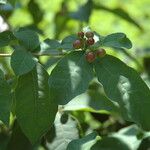
Rauvolfia tetraphylla
Four-leaf devil-pepper · Milkbush · Devil-pepper · Be still tree · Devil's-pepper
Description
Source: leafsnapRauvolfia tetraphylla, commonly known as Four-Leaved Snake Root, is a medicinal plant from the Apocynaceae family. Native to India, this plant can also be found in other parts of Asia. It grows up to 2 meters tall and features a woody stem with branches that bear leaves in whorls of four. The leaves are dark green, glossy, and oval-shaped with pointed tips. The plant produces small flowers that are either white or pinkish, with five petals forming a star shape. Its fruit is a small capsule containing numerous seeds. Rauvolfia tetraphylla has been used for centuries in traditional medicine due to its various medicinal properties, including anti-inflammatory, anti-diabetic, and anti-cancer effects. It contains alkaloids such as reserpine, which have been employed to treat hypertension (high blood pressure) by reducing the heart rate. Additionally, the plant has sedative properties, making it useful for treating anxiety disorders, insomnia, and depression by calming the nervous system. In conclusion, Rauvolfia tetraphylla is an important medicinal plant with numerous health benefits, which makes it a vital component of traditional medicine practices across Asia today.
Care Guide
💧 Water Every 7 days
The Be Still tree flourishes in tropical conditions with high humidity and consistent moisture. It should be watered every 2-3 weeks, allowing the soil to dry out slightly between waterings. During its dormancy period, the tree is sensitive to overwatering, so careful management is crucial to prevent root rot.
How should I water my Be Still tree?
Your Be still tree is not picky about how you water it, so you can use any common watering tool you have. Watering cans, hoses, or even cups will do the job. It's important to water the soil directly and make sure all areas are evenly moistened to provide enough water to the entire root system. Using filtered water is recommended to avoid harmful particles from tap water. It's also best to use water at room temperature or slightly warmer, as extremely cold or hot water can be a bit shocking to the Be still tree. However, the tree generally responds well to any kind of water you give it.
If I give too much or too little water to my Be still tree, what should I do?
Outdoor plants, especially newly planted ones or seedlings, are susceptible to lack of watering. It's important to water them enough for a few months while they are small or newly planted. Once the roots are established, these plants can rely on rainfall. When caring for potted plants, overwatering is a common issue. If you accidentally overwater your plant, quickly stop watering to minimize the effect. Take the plant out of its pot and check the roots for signs of root rot. If there is no root rot, you can return the plant to its pot. However, if there is root rot, trim affected roots and apply fungicide. Repot the plant in well-draining soil. On the other hand, if your plant is underwatered, simply water it more frequently. Underwatering can be easily corrected as the leaves will droop and dry out, but they will regain fullness after sufficient watering. Adjust your watering frequency promptly when you notice underwatering.
How much water does my Be still tree need?
Most outdoor plants can grow naturally with rainfall, but if your area lacks rainfall, you should water them adequately every 2 weeks in the spring and fall. In the summer, they will need more frequent watering. However, in the winter, when growth slows down and plants require less water, you should water them sparingly or not at all. If your Be still tree is young or newly planted, it will need more frequent watering to help it establish and become more adaptable and drought tolerant. For potted plants, there are two main ways to determine watering frequency for your Be still tree. The first method is to follow a predetermined watering schedule, such as watering once a week or every other week. However, this approach may not always be suitable as it does not consider the specific growing conditions of your Be still tree. Watering frequency can also vary depending on the season. During summer, when the plant's water needs are highest, a predetermined watering schedule may not be enough. An alternative method is to base your watering frequency on soil moisture. Ideally, you should wait until the top two to four inches of soil (around ⅓ to ½ depth of the pots) have completely dried out before watering again.
How much water does my Be still tree require?
When watering your Be still tree, you don't always need to use a lot of water. If only a few inches of soil have dried since the last watering, giving the tree about five to ten ounces of water is enough for healthy growth. You can also determine the water volume based on the moisture of the soil. Take note of how many inches of soil have dried out between waterings. To ensure your tree gets enough moisture, water until all the layers of dry soil are moistened. If more than half of the soil is dry, consider giving more water and continue until you see excess water draining from the pot's holes. If your Be still tree is planted in an area with abundant rain, it may not need extra watering. For young or newly established trees, make sure they receive 1-2 inches of rain each week. As they grow, they can rely on rainwater, only needing full watering during hot weather and extended periods without rainfall (2-3 weeks) to prevent stress.
How can I know if I'm giving enough water to my Be still tree?
The Be still tree is often affected by overwatering, which has distinct signs to look out for. Yellowing leaves and leaf drop are common indications of overwatering. Additionally, overwatering may cause the plant to shrink and can lead to root rot. On the contrary, an underwatered Be still tree will start to wilt and may have brown or brittle leaves. Whether you notice signs of overwatering or underwatering, it is important to act promptly and restore your Be still tree's health.
☀️ Light Full sun
The be still tree does best when it gets a generous amount of sunlight each day. Its native habitat has conditioned it to do well under those circumstances. Too little light can weaken its health, while too much may cause a stress response.
What are the sunlight requirements for a Be still tree?
The Be still tree requires full sun, meaning it needs above 6 hours of sunlight daily to thrive. It's vital to observe how sunlight moves through your garden to ensure your Be still tree gets a perfect balance of light and shade. This balance is crucial for its health and happiness. The tree has evolved in its native habitat to flourish under abundant solar light, and both too little and too much light can adversely affect its health.
How can artificial lighting be used for Be still trees?
Indoor Be still trees require adequate lighting to ensure optimal growth, especially when natural sunlight is insufficient, such as in winter or in less sunny spaces. Artificial lights, such as LED lights that provide specific wavelengths of light needed by plants, are a vital solution. For full sun plants, 30-50W/sq ft of artificial light is recommended, 20-30W/sq ft for partial sun plants, and 10-20W/sq ft for full shade plants. The light source should be placed 12-36 inches above the plant to mimic natural sunlight, and most plants need 8-12 hours of light per day.
What are the symptoms of light deficiency in Be still trees?
Be still trees show several symptoms when exposed to insufficient lighting, including smaller new leaves, leggy or sparse growth, faster leaf drop, slower or no new growth, lighter-colored new leaves, and chlorosis. Excessive sunlight can cause sunscald, leaf curling, wilting, leaf scorching, indicating too much exposure. These symptoms help in identifying whether the plant is receiving too little or too much light.
What solutions can be applied to solve light-related issues in Be still trees?
To address light-related issues in Be still trees, gradually increase sunlight exposure to ensure the plant receives at least 6 hours of direct sunlight daily. For indoor plants, using a south-facing window or artificial light like a desk or ceiling lamp for at least 8 hours daily can help. For outdoor plants, moving them gradually to sunnier spots can prevent sunburn. If sunlight is obstructed by elements like trees, consider pruning to allow sunlight to reach the plants. For smaller plants, transplantation during the dormant period to a location with ample sunlight and good drainage could be beneficial.
🌡️ Temperature 20–35°C
Be still tree is native to temperate environments where temperatures range from 68 to 95 °F (20 to 35 ℃). Adjustments may be necessary during cooler seasons to maintain the optimal temperature for be still tree.
What is the optimal temperature for the Be Still Tree?
The Be Still Tree, botanically known as Rauvolfia tetraphylla, thrives in temperate climates where the temperature ranges from 68 to 95°F (20 to 35°C). During the cooler seasons, it may be necessary to make adjustments to maintain this optimal temperature range. The tree is notably heat-loving, and exposure to cold temperatures can be detrimental. In autumn, for those growing the tree outdoors, it is advisable to bring it indoors and place it near a bright window, albeit not too close to heaters. Ensuring that temperatures remain above 20°C during winter is beneficial for the plant's growth, as temperatures nearing 5°C can harm it.
How to care for the Be Still Tree during low temperatures?
In conditions of low temperature, the Be Still Tree, which prefers warm environments and thrives at temperatures above 20°C, requires special care to prevent damage. During winter, it's crucial to keep the temperature above 5°C, as falling below this threshold can cause the leaves to lighten in color, and possibly lead to wilting and drooping after frost damage. The frost-damaged parts should be trimmed off, and the tree should be moved indoors to a warmer location immediately for cold protection. It's ideal to place the tree near a south-facing window to ensure it receives ample sunlight while avoiding proximity to heaters or air conditioning vents to prevent air from becoming excessively dry.
What should be done if the Be Still Tree is exposed to high temperatures?
During the summer, the Be Still Tree should be kept at temperatures below 35°C to prevent heat stress. Exposure to temperatures above 41°C can cause the leaves to lighten and increase susceptibility to sunburn. If sunburn occurs, it's important to trim away the sunburned and dried-up parts of the plant. To protect the tree from excessive heat, it should be relocated to a shaded area, especially from the intense midday and afternoon sun. Watering the plant in the morning and evening can help keep the soil moist and further reduce the risk of temperature-related stress.
💨 Humidity high (>60%)
This plant needs special care because it loves high humidity levels of 60-80% or more. The best way to achieve this is by placing a humidifier near the plant. Daily misting is also essential! Make sure the room has good ventilation.
🪴 Soil 6-7
🌱 Fertilizer
The best time to fertilize a Be still tree is in early spring as it comes out of dormancy. This encourages overall growth and flower development. Fertilizing improves the foliage, stems, and branches, and promotes large, vibrant, long-lasting flowers. It helps transfer nutrients from the roots to the flowers and boosts the plant's health and disease resistance.
🪴 Pot & Repot
✂️ Pruning
The "Be Still" tree has spirally arranged leaves and flowers that are white to greenish-yellow. To encourage healthy growth, it's best to prune the tree during its dormant period, from early to late winter. Regularly remove dead branches and thin out dense areas to improve air circulation. This not only enhances flowering but also helps prevent pests, resulting in a healthier plant.
🌿 Propagating
🐛 Diseases & pets
☠️ Toxicity
Characteristics
- Plant Type
- Shrub
- Life Cycle
- Perennial
- Genus
- Rauvolfia
- Family
- Apocynaceae
- Hardiness Zone
- 10
- Mature Height
- 1.52 m
- Mature Spread
- 49 cm to 91 cm
- Leaf Color
- Dark Green
- Leaf Type
- Evergreen
- Flower Color
- White
- Flower Size
- 0.25 cm
- Bloom Time
- Late spring, Summer, Early fall, Mid fall
- Planting Time
- Spring, Summer, Autumn
- Harvest Time
- Mid summer, Late summer, Fall, Early winter
- Native Area
- Colombia, Belize, Honduras, Mexico, Guatemala, Bolivia, Venezuela, Peru, El Salvador, Nicaragua, Ecuador, Costa Rica, Panama, Jamaica