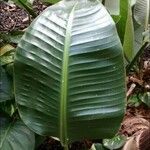
Ravenala madagascariensis
Traveler's-palm · Traveler's-tree · Traveller's tree · Traveller's palm · Madagascar traveller's tree
Description
Source: leafsnapRavenala madagascariensis, commonly known as the Traveler's Tree or the Madagascar Tree, is a unique and iconic plant native to Madagascar. Although it belongs to the Strelitziaceae family, it is not a true tree but rather a giant herbaceous plant that can grow up to 30 feet tall. The Traveler's Tree features large, fan-like leaves that grow in an alternating pattern along its trunk. These leaves are cleverly arranged to collect rainwater at their base, which can serve as an emergency water source for travelers in arid regions. From May to July, the plant produces large white flowers with blue or purple accents, followed by green fruit pods containing black seeds. In Madagascar, Ravenala madagascariensis holds cultural significance and is often used for medicinal purposes by locals. Its leaves are also utilized for weaving baskets and mats. This distinctive plant has gained worldwide popularity as an ornamental garden feature due to its striking appearance and its unique ability to collect water at the base of its leaves. Overall, Ravenala madagascariensis is not only visually stunning but also culturally significant and practically useful, making it a truly remarkable species worth admiring!
🌳 The Traveller's palm provides more than just visual charm; it also serves as a survival resource. The bases of its leaf stalks act as rain collectors, each capable of holding a quart of water, effectively making the plant a wilderness water source. Known as the 'Traveller's palm', it truly assists travelers. Additionally, its hard seeds can be crafted into distinctive pieces of jewelry, while its vibrant white flowers yield nectar that can be fermented into tropical drinks.
🎭 Eternal life
Care Guide
💧 Water Every 7 days
The Traveller's Palm, native to the tropical climate of Madagascar, thrives in high humidity and consistent moisture. Although it can withstand drought once fully established, watering it weekly ensures optimal growth. This evergreen plant flourishes outdoors, gaining the most from rainfall that closely mimics its natural habitat.
How should I water my Traveller's palm properly?
To properly water the Traveller's palm, it is best to use filtered water at room temperature. Tap water may contain harmful particles, so filtered water is preferred. The water should be at room temperature or slightly warmer because the Traveller's palm is accustomed to a warm climate and cold water can be detrimental. Avoid spraying water from above as it can cause issues with the foliage. Instead, pour your filtered room temperature water directly onto the soil until it is completely soaked. This helps moisten the roots and encourages their growth and nutrient absorption.
What should I do if I give too much or too little water to my Traveller's palm?
Overwatering your Traveller's palm can cause wilting and yellowing of the stems and leaves, as well as diseases like root rot, mold, and mildew. This is a common issue, so it's important to notice the signs early to prevent irreversible damage. To address overwatering, reduce your watering schedule and ensure the soil drains well. Underwatering is less likely, but if you notice brittle and brown leaves, increase your watering frequency until the signs improve.
How often should I water my Traveller's palm plant?
If your Traveller's palm is in a pot, the easiest way to know when it needs water is by checking the soil. Stick your finger in and if the top two to three inches are dry, it's time to water. If you're growing it outdoors in the ground, you can use the same method. When the top few inches of soil are dry, it's time to water. In the spring and early fall, this usually means watering once a week. In extremely hot weather, you may need to water twice or more per week. However, mature Traveller's palms can handle drought well.
How much water should I give to my Traveller's palm tree?
When watering your Traveller's palm, don't be hesitant to give it plenty of water. Make sure the top two to three inches of soil are dry before watering. It's best to thoroughly soak the soil, allowing excess water to drain through the bottom of the pot. If you don't see water draining, you may have underwatered the plant or the soil may not be draining properly. Avoid letting water accumulate inside the soil, as this can harm the plant. If the palm is outside, about an inch of rain per week should be enough.
How do I water my Traveller's palm as it grows?
The watering needs of the Traveller's palm can vary depending on its growth stages. In the first few years or after transplanting, it requires more water because it focuses on developing new roots for future growth. These roots need additional moisture. However, as the palm matures, it will require less water. Another stage that may require increased watering is during the bloom period, as flower development uses up more moisture.
☀️ Light Full sun
Traveller's palm prefers locations with abundant sunlight, yet, surprisingly, it can also tolerate conditions with less light. If its light needs aren't met, it may grow less vibrantly. In its natural habitat, that illumination supports robust growth, but too much exposure can cause scorching.
What are the sunlight requirements for a Traveller's palm?
Traveller's palm (Ravenala madagascariensis) thrives in various sunlight conditions. It loves areas where sunlight is abundantly available and can endure conditions where light isn't as abundant. However, not meeting its need for light may result in less vibrant growth. For optimal health, the Traveller's palm should receive above 6 hours of sunlight for 'Full sun' and about 3-6 hours of sunlight for 'Partial sun'. It's important to observe how sunlight moves through your garden to find a spot that offers the right balance of light and shade, ensuring the plant's happiness.
What solutions are recommended for handling insufficient sunlight for indoor, outdoor, and ground Traveller's palms?
For Traveller's palms facing insufficient sunlight, several solutions are recommended based on their setting. Indoors, if the plant is too large or not easily movable, consider using artificial light, keeping a desk or ceiling lamp on for at least 8 hours daily, or investing in professional plant grow lights. Outdoors, gradually move plants each week to sunnier spots, avoiding sudden changes in light intensity to prevent sunburn. For plants in the ground, reduce obstructions like pruning branches that block sunlight, and consider transplanting smaller plants during their dormant period to a location with ample sunlight and good drainage. Note that parts of the plant affected by low light may not recover, but increased light exposure encourages healthy new growth.
What symptoms indicate a Traveller's palm is receiving inadequate light?
Symptoms of inadequate light in Traveller's palm include smaller new leaves, leggy or sparse growth, faster leaf drop, slower or halted growth, lighter-colored new leaves, chlorosis (leaves turning yellow), sunscald (damaged leaves or stems from intense light exposure), leaf curling, wilting, and leaf scorching. These symptoms suggest the plant is struggling with either too little or too much sunlight, affecting its overall health and ability to photosynthesize properly.
How can artificial lighting benefit indoor Traveller's palms, and what are the key considerations?
Indoor Traveller's palms benefit from artificial lighting when natural sunlight is insufficient, especially during winter or in less sunny spaces. Artificial lights, such as LED lights, can provide the specific wavelengths of light that plants need. Key considerations when using artificial lighting include choosing the right type of light, determining the appropriate distance from the plant (12-36 inches), and mimicking natural daylight hours, typically 8-12 hours of light per day. For full sun plants, 30-50W/sq ft of artificial light is needed, partial sun plants require 20-30W/sq ft, and full shade plants should have 10-20W/sq ft.
🌡️ Temperature 20–41.1°C
The traveller's palm, native to Madagascar, thrives in warm temperatures between 68 to 105 ℉ (20 to 41 ℃), though it can tolerate cooler conditions if they are not prolonged. During colder seasons, it is recommended to maintain a warmer environment of around 75 to 80 ℉ (24 to 27 ℃) to help the plant adjust.
What is the native habitat and ideal temperature range for Traveller's palm?
The Traveller's palm is native to Madagascar and thrives in warm temperatures, ideally between 68 to 105°F (20 to 41°C). However, it can tolerate slightly lower temperatures as long as they are not prolonged. To facilitate its adjustment in colder seasons, it's suggested to provide a warmer environment of approximately 75 to 80°F (24 to 27°C).
How should Traveller's palm be cared for in autumn and winter?
During autumn, it is recommended to bring outdoor-grown Traveller's palm indoors to protect it from the cold. It should be placed near a bright window but kept at a certain distance from heaters to avoid harm. Throughout winter, maintaining temperatures above 20°C is beneficial for the plant's growth, and it's crucial to ensure that temperatures do not approach 5°C, as this can be detrimental to the plant.
What are the effects of low temperature on Traveller's palm and how can they be mitigated?
Traveller's palm prefers warm temperatures and does not tolerate low temperatures well. When temperature falls below 20°C, the plant can begin to show signs of distress, and exposure to temperatures below 1°C can cause the leaves to lighten in color. Following frost damage, leaves might turn brown or black, and wilting and drooping may occur. To mitigate this, frost-damaged parts should be trimmed off and the plant moved indoors to a warm environment, placed near a south-facing window for ample sunlight, and kept away from heaters or air conditioning vents to prevent air dryness.
How does high temperature affect Traveller's palm and what measures should be taken?
Traveller's palm should ideally be kept below 41°C during summer to avoid heat stress. Exposure to temperatures above 45°C can result in lighter leaf color and increased susceptibility to sunburn. To address these issues, trim away sunburned and dried parts of the plant, move it to a shaded location, especially from the midday and afternoon sun, and ensure the soil is kept moist by watering in the morning and evening.
💨 Humidity high (>60%)
This plant needs special care because it loves high humidity levels of 60-80% or more. The best way to achieve this is by placing a humidifier near the plant. Daily misting is also essential! Make sure the room has good ventilation.
🪴 Soil 5-7
🌱 Fertilizer
The traveller's palm requires the most fertilizer during its active growth period, which takes place mainly in spring, summer, and early fall. Fertilization is needed to supply essential nutrients that the soil may be missing, encouraging healthy root and stem growth as well as attractive foliage, which is a defining feature of this plant.
Why should I use fertilizer on my Traveller's palm?
Plants, including the Traveller's palm, require soil nutrients for growth. However, it is not always guaranteed that the soil where your plants grow will provide all the necessary nutrients. To address this, fertilization and soil amendments are used to ensure that your garden plants not only receive basic nutrients but also the specific nutrients they require. For the Traveller's palm, fertilization is needed to support healthy root and stem development throughout the growing season. Additionally, it will enhance the appearance of its foliage, which is the main ornamental feature of this plant.
When should I fertilize my Traveller's palm?
The Traveller's palm requires the most fertilizer during its active growth phase, which generally occurs in spring, summer, and early fall. After winter, you should feed the palm every two to four weeks until fall. During fall, gradually reduce the amount of fertilizer until you stop completely in preparation for the less active growth period in winter.
When is not a good time to add fertilizer to my Traveller's palm?
From spring to the end of fall, it is generally recommended to regularly feed your Traveller's palm. However, if you notice any signs of over-fertilization or incorrect fertilization causing issues like fertilizer burn, you should address these problems before resuming regular feeding. The only exception is during winter, especially if you keep the plant indoors in a cold area. During this dormant phase, feeding the Traveller's palm is unnecessary and can even lead to fertilizer burn.
What kind of fertilizer should I use for my Traveller's palm?
To properly fertilize a Traveller's palm, it is important to use a specific blend of nutrients, each in relatively low amounts. An ideal fertilizer will have an N-P-K ratio of 3-1-2. However, a general-purpose fertilizer with even nutrient levels can still work in some cases. When using any fertilizer, it is crucial that the ratio number representing the volume of each nutrient is 10 or lower. You have the option of using either a granular or liquid-based fertilizer. If you choose a liquid-based fertilizer, it is recommended to dilute its strength by half. Granular fertilizer does not have many downsides, but it is generally more sensible to use liquid fertilizer, especially if you provide water to your Traveller's palm while feeding it.
How can I add fertilizer to my Traveller's palm?
When buying fertilizer for your Traveller's palm, there will be instructions on how to apply it. In most cases, you should follow these instructions. However, for this particular plant, it is best to fertilize just before or during watering to avoid damaging the roots. If you are using a slow-release granular fertilizer, sprinkle it on the soil and then water immediately. If you are using a liquid-based fertilizer, dilute it with water, apply it to the soil, and then add a bit more water. It is especially important to dilute the fertilizer by at least half in the spring and fall when the plant's growth is increasing or decreasing.
🪴 Pot & Repot 2-3 years
When repotting Traveller's palm, choose a pot 1–2 inches (2.5–5.1 cm) larger with ample drainage. Use a well-draining potting mix. Repot in spring or fall, ensuring that the root ball is slightly lower than the rim of the flower pot. Water thoroughly after repotting and place the plant in a warm spot with indirect sunlight.
✂️ Pruning
To promote growth, it's important to regularly prune dead or damaged leaves from the traveler's palm during early to late spring. Removing suckers is also beneficial as it helps maintain the plant's structure, improves air circulation, and reduces the risk of disease. Pruning at the right time minimizes stress and enhances the overall health of the plant.
🌿 Propagating
🐛 Diseases & pets
☠️ Toxicity
Parts of the plant are said to be mildly toxic to humans and common pets if ingested.
Characteristics
- Plant Type
- Herb
- Life Cycle
- Perennial
- Genus
- Ravenala
- Family
- Strelitziaceae
- Hardiness Zone
- 10-13
- Mature Height
- 9.14 m to 15.24 m
- Mature Spread
- 4.57 m to 5.49 m
- Leaf Color
- Green, Blue
- Leaf Type
- Evergreen
- Flower Color
- White
- Flower Size
- 15.24 cm to 30.48 cm
- Bloom Time
- Mid summer, Late summer, Early fall
- Planting Time
- Spring
- Harvest Time
- Early spring, Mid spring, Late summer, Fall, Winter
- Native Area
- Madagascar