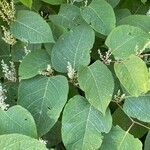
Reynoutria japonica
Japanese knotweed · Impossible to kill invasive demon plant · Mexican-bamboo · Flowering bamboo · Asian Knotweed
Description
Source: leafsnapReynoutria japonica, synonyms Fallopia japonica and Polygonum cuspidatum, is a species of herbaceous perennial plant in the knotweed and buckwheat family Polygonaceae. Common names include Japanese knotweed and Asian knotweed. It is native to East Asia in Japan, China and Korea. In North America and Europe, the species has successfully established itself in numerous habitats, and is classified as a pest and invasive species in several countries.Japanese knotweed has hollow stems with distinct raised nodes that give it the appearance of bamboo, though it is not related. While stems may reach a maximum height of 3–4 m (10–13 ft) each growing season, it is typical to see much smaller plants in places where they sprout through cracks in the pavement or are repeatedly cut down. The leaves are broad oval with a truncated base, 7–14 cm (3–5+1⁄2 in) long and 5–12 cm (2–4+1⁄2 in) broad, with an entire margin. The flowers are small, cream or white, produced in erect racemes 6–15 cm (2+1⁄2–6 in) long in late summer and early autumn. Related species include giant knotweed (Reynoutria sachalinensis, syns. Fallopia sachalinensis, Polygonum sachalinense) and Russian vine (Fallopia baldschuanica, syn. Polygonum baldschuanicum).
💡 Japanese knotweed is regarded as a highly invasive species that has significantly impacted the real estate market in the United Kingdom. In 2012, certain mortgage lenders were reported to have denied mortgage applications if Japanese knotweed was found on the property or nearby. Since then, many institutions have advocated for easing lending restrictions related to the presence of Japanese knotweed, contending that it can be effectively treated and managed.
🌳 In Japan, where Japanese knotweed is native, locals enjoy its young shoots as a tangy substitute for rhubarb in various recipes. These shoots are edible while under a foot tall; once they exceed that height they become tough and less palatable. Besides its culinary uses, Japanese knotweed benefits beekeepers by supplying late-season nectar, so placing hives nearby is ideal. Moreover, extracts of Japanese knotweed, rich in resveratrol, are used to produce natural anti-aging cosmetics.
🎭 Bonding, well-being, stamina, optimism
Care Guide
💧 Water
Japanese knotweed thrives in humid environments by effectively balancing moisture retention with drought resilience. It requires moderate hydration and ideally should be watered weekly, preferring consistent soil moisture without becoming waterlogged. As a perennial herb, it's important to consider natural rainfall when planning its watering routine, especially during the vigorous growing season.
When Should I Water My Japanese Knotweed?
Watering Japanese Knotweed requires attention to soil moisture levels, leaf and stem conditions, and timing. The key indicators to water include dry soil at a depth of 1 to 2 inches, wilted or dull leaves, drooping stems, and curled leaves. Watering is most effective in the early morning or late afternoon to avoid water loss through evaporation and reduce the risk of diseases. However, watering too early can lead to root diseases, and late watering when the plant is excessively dry can stress the plant. Properly scheduling watering based on these signs contributes to the plant's health, growth, and disease resistance.
How Should I Water My Japanese Knotweed?
Watering Japanese Knotweed effectively involves using the right technique and tools to meet its specific needs. Bottom-watering is recommended to ensure the roots receive adequate moisture without over-saturating the soil's surface, preventing fungal diseases. A watering can with a narrow spout helps direct water to the base of the plant. Using a moisture meter can accurately determine when the plant needs water. It's important to avoid wetting the foliage to reduce the risk of fungal diseases and to monitor the soil's moisture level to prevent overwatering and root rot.
How Much Water Does Japanese Knotweed Really Need?
Japanese Knotweed requires a generous amount of water due to its deep root system, although the exact quantity varies with factors such as pot size, weather, and plant size. Signs of appropriate watering are lush, vibrant leaves and moist, but not soggy, soil. Under-watering can stunt growth, while over-watering can cause root rot. For container plants measuring 12-24 inches, 1-2 gallons per session is sufficient. It's crucial to ensure the water reaches the root level and drains properly to prevent waterlogging.
What Kind of Water is Best for Japanese Knotweed?
Japanese Knotweed thrives with rainwater due to its balanced pH and mineral content, though it is tolerant towards chlorine and fluoride in tap water. However, lower levels of these chemicals can enhance growth. Avoid water with high salinity to prevent root and nutrient absorption issues. While special water treatments like dechlorination are not necessary, using water conditioned with liquid plant fertilizer can be beneficial. The plant prefers lukewarm water to avoid stress impacting its growth.
How Do Japanese Knotweed's Watering Needs Change with the Seasons?
The watering needs of Japanese Knotweed vary with the seasons. In spring, consistent soil moisture is crucial for its active growth phase. Summer may require reduced watering frequency due to natural dormancy. Autumn calls for gradually decreasing water as the plant prepares for dormancy, maintaining lightly moist soil. Winter watering should be minimal, allowing the topsoil to dry out between sessions, as the plant's moisture requirement is low during dormancy.
☀️ Light Full sun
Despite its ability to survive in less light, Japanese knotweed prefers a habitat where sunlight is plentiful for optimal growth. This plant originated from regions with ample sunlight and flourishes more in those conditions. Both excessive and inadequate sunlight can hinder its development. The requirement for sunlight by this vegetation remains consistent throughout all stages of its growth.
What are the sunlight requirements for Japanese knotweed?
Japanese knotweed, botanically known as Reynoutria japonica, thrives best in an environment that receives generous sunlight, ideally above 6 hours of direct sunlight daily, which is considered full sun. However, it can still grow in partial sun, which is about 3-6 hours of sunlight. Despite its adaptability to lesser light conditions, its healthiest growth is observed in habitats where sunlight is abundant. The plant's necessity for sunlight remains consistent throughout its growth phases, and adjusting its exposure to light is crucial for its well-being.
How can artificial lighting be used for Japanese knotweed indoors?
For Japanese knotweed grown indoors where natural sunlight is insufficient, artificial lighting serves as an essential solution. It promotes faster, healthier growth by providing adequate light. Opting for LED lights is beneficial as they can be tailored to offer specific light wavelengths needed by the plant. Full sun plants require 30-50W/sq ft, partial sun plants need 20-30W/sq ft, and full shade plants need 10-20W/sq ft of artificial light. The appropriate placement of the light source should be 12-36 inches above the plant, simulating natural sunlight. Furthermore, mimicking the natural daylight duration, most plants will require 8-12 hours of artificial light daily.
What are the symptoms of light deficiency in Japanese knotweed?
Japanese knotweed displays several symptoms when experiencing light deficiency. New leaves may grow smaller, and the plant may exhibit leggy or sparse growth, showcasing a stretched-out appearance due to longer spaces between leaves or stems. There might be faster leaf drop as the plant tries to conserve resources, leading to slower or no new growth. Leaves can develop irregular color patterns or appear paler, indicating a lack of chlorophyll and essential nutrients. These symptoms suggest the plant is not receiving adequate sunlight for optimal growth.
How can you provide optimal sunlight for Japanese knotweed when growing it indoors?
To optimize sunlight for Japanese knotweed grown indoors, gradually move the plant to sunnier locations each week until it receives at least 6 hours of direct sunlight daily. Utilizing a south-facing window and keeping curtains open during the day maximizes sunlight exposure. If the plant is too large or not easily movable, or if natural light is insufficient, consider supplementing with artificial light. Keeping a desk or ceiling lamp on for at least 8 hours daily, or investing in professional plant grow lights, can ensure the plant receives ample light for healthy growth.
What are effective outdoor light adjustment strategies for Japanese knotweed?
For outdoor cultivation of Japanese knotweed, it's important to gradually adapt the plant to the optimal sunlight exposure. This can be achieved by progressively moving the plant to sunnier spots each week, avoiding sudden changes in light intensity to prevent sunburn. Notably, parts of the plant already affected by insufficient sunlight may not recover, but new growth will be healthy following the adjustment to increased light exposure.
🌡️ Temperature 5–35°C
Originating from Japan, where the yearly average temperature ranges from 59 to 64 ℉ (15 to 18 ℃), Japanese knotweed adjusts its growth and energy conservation according to the temperature. It thrives best in a temperature spectrum of 41 to 95 ℉ (5 to 35 ℃). During summer, the plant can adapt to temperatures that surpass its preferred range by slowing down its growth and preserving energy.
What is the native climate of Japanese knotweed?
Japanese knotweed is native to Japan, thriving in an area where the average annual temperature ranges between 59 to 64°F (15 to 18°C). It is well-suited to a temperature range of 41 to 95°F (5 to 35°C) for optimal growth and development. Despite its preference, Japanese knotweed has developed mechanisms to adjust during summer months when temperatures often exceed its optimal range, by slowing down its growth and conserving energy. Its strong cold resistance indicates that special frost protection is not usually required, although precautions should be taken if winter temperatures are expected to fall below -30°C.
How does low temperature affect Japanese knotweed, and what are the solutions?
Japanese knotweed is notably cold-tolerant, ideally surviving temperatures above 5°C but should be protected if temperatures drop below -25°C. Exposure to temperatures below -30°C may not show immediate damage, but it could lead to decreased sprouting or even a failure to sprout in the following spring. To mitigate these effects, it is recommended to remove any parts of the plant that fail to sprout in the spring.
How does high temperature affect Japanese knotweed, and how can you protect the plant?
During the summer months, Japanese knotweed thrives best when temperature remains below 35°C. Temperatures exceeding 41°C might cause the leaves to lighten in color, curl, become susceptible to sunburn, and, in severe cases, lead the entire plant to wilt and dry. To protect the plant from high temperatures, trim away sunburned and dried-up parts, provide shade during the midday and afternoon sun either by relocating the plant or using a shade cloth, and ensure the soil remains moist by watering the plant in the morning and evening.
💨 Humidity high (>60%)
This plant needs special care because it loves high humidity levels of 60-80% or more. The best way to achieve this is by placing a humidifier near the plant. Daily misting is also essential! Make sure the room has good ventilation.
🪴 Soil 5-7
🌱 Fertilizer
For Japanese knotweed, one application of fertilizer in the spring is commonly adequate, though monthly or every one and a half month feedings could boost its growth. Fertilizing improves the look and performance of the leaves, fostering uniform color and ideal texture. Moreover, it encourages the development of roots and the absorption of nutrients, ensuring the plant's health in the long run.
🪴 Pot & Repot Every 12 months
✂️ Pruning
This plant does not require pruning. As it is an invasive plant, it is more commonly removed and destroyed than pruned to encourage growth.
🌿 Propagating
🐛 Diseases & pets
☠️ Toxicity
Japanese Knotweed is not considered a toxic plant.
Characteristics
- Plant Type
- Herb
- Life Cycle
- Perennial
- Genus
- Reynoutria
- Family
- Polygonaceae
- Hardiness Zone
- 4-10
- Mature Height
- 0.91 m to 2.13 m
- Mature Spread
- 0.91 m to 6.1 m
- Leaf Color
- Green, Blue, Red
- Leaf Type
- Deciduous
- Flower Color
- White
- Flower Size
- 2.54 cm
- Bloom Time
- Mid spring, Late spring, Early summer, Mid summer
- Planting Time
- Spring, Autumn
- Harvest Time
- Mid summer
- Native Area
- Russia, Vietnam, Japan, Koppen, South Korea, China