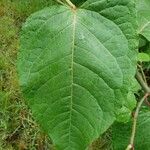
Reynoutria sachalinensis
Giant Knotweed · Sacaline · Sakhalin Knotweed · Elephant-ear · Sachaline Knotweed
Description
Source: leafsnapReynoutria sachalinensis (giant knotweed or Sakhalin knotweed Japanese オオイタドリ ooitadori, Russian Горец сахалинский, Гречиха сахалинская; syns. Polygonum sachalinense, Fallopia sachalinensis) is a species of Fallopia native to northeastern Asia in northern Japan (Hokkaidō, Honshū) and the far east of Russia (Sakhalin and the southern Kurile Islands). Reynoutria sachalinensis is a herbaceous perennial plant growing to 2–4 m (79–157 in) tall, with strong, extensively spreading rhizomes forming large clonal colonies. The leaves are some of the largest in the family, up to 15–40 cm (6–15.5 in) long and 10–28 cm (4–11 in) broad, nearly heart-shaped, with a somewhat wavy, crenate margin. The flowers are small, produced on short, dense panicles up to 10 cm (4 in) long in late summer or early autumn; it is gynodioecious, with male and female (male sterile) flowers on separate plants. The species is closely related to the Japanese knotweed, Reynoutria japonica, and can be distinguished from it by its larger size, and in its leaves having a heart-shaped (not straight) base and a crenate margin. Reynoutria sachalinensis has a chromosome count of 2n=44.
🌳 Aside from its reputation as an invasive species, giant knotweed has been recognized as a potential bioenergy crop because of its rapid growth and substantial biomass yield. These characteristics could be used to produce bioethanol, offering a renewable energy alternative. Research into using giant knotweed in this way is interesting because it could turn a problematic species into a valuable resource, effectively converting an ecological challenge into a sustainable solution.
Care Guide
💧 Water
Giant knotweed thrives in humid environments, preferring soil that remains consistently moist. While it can tolerate short periods of drought, it requires weekly watering to maintain healthy, lush growth. Commonly found in riparian zones, giant knotweed benefits from natural rainfall, which supports its robust size and vigorous growth cycle.
What is the most effective way to water my Giant knotweed plant?
To properly water the Giant knotweed, follow these steps for optimal results. First, use filtered water at room temperature. Tap water may contain harmful particles. Next, consider the plant's natural habitat and use water that is at room temperature or slightly warmer to avoid shocking the system. Avoid overhead watering to prevent foliage complications. Instead, focus on applying the filtered room temperature water directly to the soil until it is thoroughly soaked. This helps moisten the roots and aids in their spread through the soil, ensuring they can absorb the necessary nutrients.
What should I do if I give too much or too little water to my Giant knotweed?
When taking care of your Giant knotweed, both overwatering and underwatering can cause harm. However, overwatering is a more common problem. Too much water can make the stems and leaves wilt and turn yellow. It can also lead to diseases like root rot, mold, and mildew, which can be fatal for your plant. Underwatering is less likely since this plant can withstand drought to some extent. However, it can still happen, resulting in brittle, brown leaves. So, it's important to watch for signs of overwatering and take action quickly. If you notice these signs, reduce your watering immediately, and check the soil's drainage. If it's not good, replace it with a well-draining potting mix. On the other hand, if you see signs of underwatering, simply water your plant more regularly until the signs improve.
How frequently should I water my Giant knotweed?
If your Giant knotweed is in a pot, the most accurate way to determine whether it needs water is to stick your finger into the soil. If the top two to three inches of soil are dry, it's time to water. The same method can be used if you're growing your Giant knotweed outdoors in the ground. Once the first few inches of soil have dried out, it's time to water. Typically, during the spring and early fall, watering once a week is sufficient. However, during extremely hot weather, you may need to water twice or more per week. It's worth noting that mature, well-established Giant knotweed has a remarkable ability to withstand drought.
How much water does my Giant knotweed plant need?
When watering your Giant knotweed, don't be afraid to give it plenty of water. Make sure the top few inches of soil are dry, then give it a good, deep watering. Add enough water to completely saturate the soil, so that excess water flows out of the drainage holes at the bottom of the pot. If you don't see this excess water draining, you probably haven't watered enough. However, be careful not to let water accumulate in the soil, as this can harm the plant. On the other hand, if water doesn't drain out of the pot, it could mean that the soil doesn't drain well, which is bad for the plant's health. If the plant is outside, one inch of rain per week should be enough.
How do I water my Giant knotweed at different stages of growth?
The water needs of Giant knotweed vary depending on its growth stages. In the first few years or after transplanting, it requires more water due to the energy it puts into growing new roots. These new roots need extra moisture to support future growth. However, after a few seasons, the water requirements decrease. Another stage that may require more water is the blooming period, as flower development uses a significant amount of moisture.
☀️ Light Partial sun
Giant knotweed grows best when it receives abundant but filtered sunlight. Native to areas where light levels change over the course of the day, it can tolerate fairly low light. Too little light leads to stunted growth, while too much light can potentially injure the plant.
What are the sunlight requirements for Giant Knotweed?
Giant knotweed (Reynoutria sachalinensis) thrives best with substantial, yet filtered sunlight, but can adapt to a range of light conditions. It prefers about 3-6 hours of sunlight for partial sun and less than 3 hours of sunlight for full shade. Lack of sufficient light can hinder growth, while too much sunlight may cause harm. Remember to observe how sunlight moves through your garden to find spots that offer the right balance of light and shade, ensuring the plant's well-being.
How do you provide adequate lighting for indoor Giant Knotweed plants?
For Giant Knotweed plants grown indoors, adequate lighting is crucial, especially when natural sunlight is insufficient. Artificial lighting can be an effective solution, with LED lights being a popular choice due to their ability to mimic specific wavelengths needed by the plants. Full sun plants need 30-50W/sq ft, partial sun plants require 20-30W/sq ft, and full shade plants should have 10-20W/sq ft of artificial light. The light source should be placed 12-36 inches above the plant and turned on for 8-12 hours a day, mimicking natural daylight hours.
What are the symptoms of inadequate lighting for Giant Knotweed?
Giant knotweed shows various symptoms when it suffers from inadequate lighting. These include smaller new leaves, leggy or sparse growth, quicker leaf drop, slower or no new growth, lighter-colored new leaves, chlorosis (yellowing leaves due to lack of chlorophyll), sunscald, leaf curling, wilting, and leaf scorching. Each symptom indicates either too little or too much light exposure, affecting the plant's overall health and ability to photosynthesize properly.
What solutions can help Giant Knotweed receive adequate sunlight?
To ensure your Giant Knotweed receives adequate sunlight, gradually acclimate it to sunnier spots if it’s been under low light. Indoors, shift the plant weekly to sunnier locations until it gets 3-6 hours of sunlight, or use artificial light sources like desk or ceiling lamps for at least 8 hours daily, or invest in professional grow lights. Outdoors, gradually move plants to sunnier locations to prevent sunburn. Removing obstructions and careful transplanting during the dormant period can also improve light exposure. Note that damages from insufficient light might not be reversible, but new growth will be healthy with better light.
🌡️ Temperature 5–32.2°C
Giant knotweed is indigenous to areas with a temperate climate where temperatures range from 41 to 89.6 °F (5 to 32℃). It favors sites that remain within this range year-round. Seasonal temperature variations should reproduce these conditions.
What is the native climate for Giant knotweed?
Giant knotweed, botanically known as Reynoutria sachalinensis, thrives in environments with a temperate climate, where temperatures range between 41 to 89.6 °F (5 to 32°C). It is adapted to areas that consistently stay within this temperature range throughout the year. The plant possesses strong cold resistance, making it usually unnecessary to take special frost protection measures during winter. However, in conditions where winter temperatures are expected to drop below -30°C, it's crucial to provide additional cold protection to prevent damage.
How should Giant knotweed be cared for during winter?
Caring for Giant knotweed during winter involves ensuring the plant has adequate protection if temperatures are expected to fall below -30°C. Cold protection can be achieved by covering the plant with insulating materials such as soil or straw. Additionally, it's recommended to water the plant abundantly before the first freeze in autumn to maintain moist soil conditions. This preparation helps the plant to prevent drought and water scarcity during winter and early spring, supporting its health and vigour.
What are the important symptoms to look out for in Giant knotweed related to temperature changes?
Symptoms to watch for in Giant knotweed due to temperature changes include: For low temperatures, the plant is cold-tolerant and prefers temperatures above 5°C but should be protected if temperatures dip below -25°C. Below -30°C, there might not be noticeable changes during winter, but a decrease in sprouting, or absence thereof, might occur in spring. High temperatures pose a risk as well; during summer, temperatures should stay below 32°C. Exceeding 35°C can lead to the leaves becoming lighter, curling, susceptible to sunburn, and, in severe cases, the plant may wilt and dry up.
What solutions are available for Giant knotweed affected by extreme temperatures?
For Giant knotweed affected by extreme temperatures, there are several solutions: If the plant fails to sprout in spring likely due to low winter temperatures, remove any parts that have not sprouted. In case of high temperatures leading to sunburned or dried parts during summer, it's advisable to trim these damaged parts. Relocating the plant to a shaded area or using a shade cloth can protect it from intense midday and afternoon sun. To counteract the effects of high temperatures, watering the plant in the morning and evening can help keep the soil moist and support the health of the plant.
💨 Humidity
🪴 Soil 6-7
🌱 Fertilizer
The best time to fertilize a Giant knotweed is in early spring, when it comes out of dormancy and starts active growth. Fertilization supplies essential nutrients for healthy development. Although Giant knotweed has fairly low fertilizer requirements, applying fertilizer annually can improve its survival and encourage better, longer-lasting flowers.
🪴 Pot & Repot
✂️ Pruning
🌿 Propagating
🐛 Diseases & pets
☠️ Toxicity
Characteristics
- Plant Type
- Herb
- Life Cycle
- Perennial
- Genus
- Reynoutria
- Family
- Polygonaceae
- Hardiness Zone
- 4-8
- Mature Height
- 2.13 m to 3.96 m
- Mature Spread
- 3.05 m
- Leaf Color
- Green, Blue
- Leaf Type
- Deciduous
- Flower Color
- White, Pink
- Flower Size
- 10.16 cm
- Bloom Time
- Early summer, Mid summer
- Planting Time
- Spring, Summer, Autumn
- Harvest Time
- Mid summer
- Native Area
- Russia, Japan, South Korea