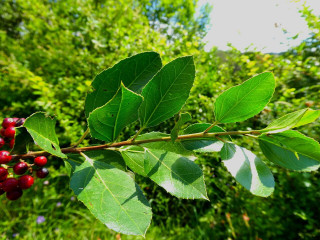
Rhamnus alaternus
Mediterranean buckthorn · Alaternus · Italian buckthorn · Blow-fly-bush · Evergreen Buckthorn
Description
Source: leafsnapRhamnus alaternus, commonly known as the Italian buckthorn or Mediterranean buckthorn, is a species of flowering plant in the family Rhamnaceae. Native to the Mediterranean region, it thrives in various habitats, including woodlands, scrublands, and rocky areas. This plant can reach heights of up to 5 meters and features a dense crown of glossy, oval-shaped green leaves with serrated edges. The small, inconspicuous flowers have greenish-yellow petals and bloom from April to June. Rhamnus alaternus produces small black drupes containing one or two seeds. Historically, Rhamnus alaternus has been used for its medicinal properties, particularly as a laxative. However, it should be used with caution, as large quantities can cause severe gastrointestinal irritation. In landscaping, Rhamnus alaternus is popular as an ornamental shrub due to its attractive foliage and ability to tolerate drought conditions once established. Its dense growth habit also makes it ideal for hedging purposes. Overall, Rhamnus alaternus is an appealing shrub species native to the Mediterranean region. With its medicinal properties and ornamental value, it is a popular choice among gardeners worldwide.
🌳 Italian buckthorn is noted for a variety of uses beyond its ornamental appeal. A hardy, evergreen shrub, Italian buckthorn makes an excellent landscape hedge and is used to control soil erosion because of its robust root system. Additionally, the durable wood of Italian buckthorn is sometimes employed in carpentry for small, intricate pieces.
Care Guide
💧 Water Every 7 days
Italian buckthorn flourishes in Mediterranean-like climates, where summers are dry and winters are mild and wet. This plant is highly drought-tolerant and typically needs watering every 2 to 3 weeks. For optimal growth, it should be planted outdoors in full sun and in well-draining soil, which helps prevent root rot.
How should I water my Italian buckthorn plant?
Your Italian buckthorn is not particular about how you water it. You can use any common watering tool like watering cans, hoses, or even cups. It's best to water directly into the soil, making sure to evenly moisten all areas to support the entire root system. Filtering the water is a good idea to remove any harmful particles, as tap water can contain them. Using water at or slightly above room temperature is also recommended, as very cold or hot water can be a bit shocking to the plant. However, the Italian buckthorn generally responds well to any type of water you provide.
What do I do if I give too much or too little water to my Italian buckthorn plant?
When planting outdoor plants, especially new plants or seedlings, it's important to make sure they are well-watered. This is particularly crucial in the first few months after planting, as the roots are still getting established. Italian buckthorn typically relies on rainfall once the roots are developed. If you have an Italian buckthorn in a pot, overwatering is more likely. If you accidentally overwater, you should act quickly to fix the situation. Stop watering the plant immediately to minimize the negative effects. Remove the Italian buckthorn from its pot to check the roots. If there is no sign of root rot, you can return the plant to its container. However, if you find signs of root rot, trim away the affected roots and consider using a fungicide to prevent further damage. Repot the Italian buckthorn in well-draining soil. On the other hand, if you underwater the Italian buckthorn, simply water it more frequently. Underwatering is a relatively easy problem to fix. When underwatered, the plant's leaves may droop, dry out, and fall off. However, they will quickly regain their fullness after sufficient watering. Make sure to adjust your watering frequency as soon as you notice signs of underwatering.
How frequently do I need to water my Italian buckthorn?
Most outdoor plants can grow naturally with rainfall. If you live in an area with limited rainfall, you should water your plants every 2 weeks in the spring and fall. In the summer, you need to water more often. In the winter, when plants grow slower and require less water, water sparingly or not at all. For Italian buckthorn plants that are young or newly planted, they need more frequent watering to establish and grow. Mature plants are more adaptable and drought tolerant. For potted Italian buckthorn plants, there are two main ways to determine watering frequency. The first way is to set a predetermined schedule, like once a week or every other week. However, this may not consider the specific conditions of your growing environment. Watering frequency can also change depending on the season. For example, a set schedule may not be enough during the summer when plants need more water. An alternative approach is to check the soil moisture before watering. Wait until the top two to four inches of soil have dried out completely before watering again.
How much water does my Italian buckthorn plant need?
Watering your Italian buckthorn can be surprising because it doesn't always need a lot of water. If only a few inches of soil have dried since the last watering, you can give it about five to ten ounces of water. You can also determine the watering volume by checking the soil moisture. Note how many inches of soil have dried out between waterings. To ensure your Italian buckthorn gets enough moisture, water until all dry soil layers from the previous watering are moistened. If more than half of the soil is dry, give more water until you see excess water draining from the pot's holes. If your Italian buckthorn is in a rainy outdoor area, it may not need extra watering. For young or newly established plants, ensure they receive 1-2 inches of rain per week. As they grow and establish, they can rely solely on rainwater. Only when the weather is hot and there is no rainfall for 2-3 weeks, consider giving a full watering to prevent stress.
How can I know if I'm giving enough water to my Italian buckthorn plant?
The Italian buckthorn is more commonly affected by overwatering. If this happens, there are some signs to look out for. Typically, an overwatered Italian buckthorn will have yellowing leaves and may lose some leaves. Overwatering can also cause the plant's structure to shrink and can lead to root rot. On the other hand, an underwatered Italian buckthorn will start to droop and may have brown or brittle leaves. Regardless of whether you see signs of overwatering or underwatering, it's important to take action and restore your Italian buckthorn's health.
☀️ Light Full sun
The Italian buckthorn needs a generous amount of daylight to grow well, flourishing where sunlight is plentiful while also tolerating moderately lit settings. Originating from a sun-rich habitat, it is prone to decline in low-light situations and can be damaged by excessive shade.
What are the sunlight requirements for Italian Buckthorn?
Italian Buckthorn (Rhamnus alaternus) thrives in environments with generous daylight. It requires full sun, which is above 6 hours of sunlight daily, but can also grow in partial sun, receiving about 3-6 hours of sunlight. Observing the movement of sunlight through your garden helps in choosing locations that offer a healthy balance of light and shade, ensuring the plant's well-being. However, too little light can lead to the plant's deterioration, signaling the importance of sufficient sunlight for its growth.
How do artificial lighting conditions affect Italian Buckthorn indoors?
In scenarios where natural sunlight is insufficient, especially during winter or in less sunny spaces, artificial lighting serves as an essential solution for Italian Buckthorn's growth indoors. Optimal growth is achieved with adequate lighting, necessitating the use of artificial lights such as LED, which can be adjusted to meet the plant's specific light wavelength needs. For plants requiring full sun, 30-50W/sq ft of artificial light is advisable; for partial sun plants, 20-30W/sq ft is suitable, and for full shade plants, 10-20W/sq ft is recommended. The light source should be placed 12-36 inches above the plant to simulate natural sunlight, ensuring the plant receives 8-12 hours of light per day.
What are the common symptoms of improper sunlight exposure in Italian Buckthorn?
Italian Buckthorn displays several symptoms when it does not receive adequate sunlight. These include small and lighter-colored new leaves, indicating insufficient chlorophyll and nutrient acquisition. The plant may experience leggy or sparse growth, with increased spacing between leaves or stems, leading to a weakened structure. Other symptoms include faster leaf drop as a resource-conservation measure, slower or halted growth, chlorosis, sunscald, leaf curling, wilting, and leaf scorching. Each symptom reflects the plant's struggle to adapt to suboptimal lighting conditions, highlighting the importance of proper sunlight exposure for its health.
How can I address sunlight-related issues for Italian Buckthorn?
To resolve sunlight-related issues for Italian Buckthorn, consider gradually moving the plants to sunnier locations, ensuring they receive at least 6 hours of sunlight daily. For indoor plants, using artificial lights like desk or ceiling lamps for at least 8 hours a day can help, with professional plant grow lights being a more comprehensive solution. Outdoors, it is crucial to adapt plants gradually to prevent sunburn. Pruning obstructing branches or transplanting to areas with better sunlight can also be effective. Remember, while parts of the plant affected by insufficient light may not recover, new growth will be healthy with improved light exposure.
🌡️ Temperature 10–35°C
Italian buckthorn originates from habitats where temperatures usually range from 50 to 95 °F (10 to 35 ℃) and performs best within that temperate span. If temperatures fall significantly, winter protection may be needed. Occasional adjustments to mimic natural climate changes can help achieve optimal growth.
What is the native temperature range for Italian buckthorn?
Italian buckthorn is native to environments that typically experience temperatures between 50 to 95 °F (10 to 35 °C), thriving best within this temperate range. It has strong cold resistance, making special frost protection measures usually unnecessary during winter. However, significant temperature drops, especially below -25°C, require taking steps to ensure the plant's survival, such as wrapping the trunk and branches with insulating materials.
How can you protect Italian buckthorn during very cold winters?
To protect Italian buckthorn during winters with temperatures expected to drop below -25°C, you should wrap the plant's trunk and branches with non-woven fabric or cloth. Additionally, it's advised to water the plant abundantly before the first freeze in autumn to keep the soil moist. This helps prevent drought and ensures the plant has enough water during the winter and early spring.
What are the symptoms and solutions for Italian buckthorn in low temperatures?
Italian buckthorn is cold-tolerant and performs best when temperatures stay above 10°C, but it should be kept above -15°C during winter to avoid damage. Exposure to temperatures below -25°C won't show immediate issues during winter, but by spring, branches may become brittle, dry, and fail to produce new shoots. The solution for this damage is to prune away any dead branches in spring.
How should you care for Italian buckthorn in high temperatures?
In high temperatures, specifically above 35°C, care should be taken to protect Italian buckthorn from heat stress. Symptoms of stress include lighter leaf color, dry and withered leaf tips, and increased susceptibility to sunburn. Address these symptoms by trimming sunburned or dried parts, moving the plant to a shaded area during intense sunlight, or using a shade cloth. It's also important to water the plant in the morning and evening to keep the soil moist and cool.
💨 Humidity normal (40-60%)
This plant will thrive in moderate humidity, which is probably the level in your home. However, misting it a few times a week can be very beneficial. Make sure the room has good ventilation.
🪴 Soil 5-7
🌱 Fertilizer
Fertilize your Italian buckthorn in early spring to encourage healthy growth. Consistent feeding improves overall health, producing vigorous growth, greater tolerance of harsh conditions, and better resistance to diseases and pests. Follow a set fertilization schedule for your Italian buckthorn to maintain lush foliage with rich color and a full appearance.
🪴 Pot & Repot
✂️ Pruning
Italian buckthorn has glossy evergreen leaves and thrives with proper care. To keep the plant healthy and well-shaped, prune it in late winter. This helps control its size and improve air circulation, which can prevent diseases. Regular pruning also encourages bushier growth. Since pruning aligns with the plant's dormancy period, it supports optimal development in the spring.
🌿 Propagating
🐛 Diseases & pets
☠️ Toxicity
Rhamnus alaternus can be toxic when used in an abusive way beside its strong antibacterial, antioxidant, and antidiabetic activities. Rhamnus alaternus berries, bark and roots are toxic. The berries cause severe cramping and diarrhea in humans.
Characteristics
- Plant Type
- Shrub
- Life Cycle
- Perennial
- Genus
- Rhamnus
- Family
- Rhamnaceae
- Hardiness Zone
- 6-9
- Mature Height
- 0.91 m to 4.88 m
- Mature Spread
- 3.05 m
- Leaf Color
- Green, White, Silver
- Leaf Type
- Evergreen
- Flower Color
- Yellow, Green, White
- Flower Size
- 2.54 cm
- Bloom Time
- Mid spring, Late spring, Early summer
- Planting Time
- Spring, Autumn
- Harvest Time
- Mid summer, Late summer
- Native Area
- Saudi Arabia, Libya, Turkey, Tunisia, Italy, Portugal, Spain, Cyprus, Albania, Algeria, Greece, Morocco, France