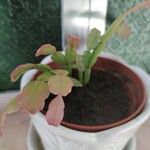
Rhipsalidopsis gaertneri
Easter Cactus · Christmas Cactus
Description
Source: leafsnapThe Easter Cactus (Hatiora gaertneri, Schumbergera gaertneri, Rhipsalidopsis gaertneri), also known as the Spring Cactus, is an epiphyte native to the Brazilian rainforests that is cultivated for its vivid red flowers that occur around Easter time in the Northern Hemisphere. The Easter cactus is a pendulous branching plant with no spines. Flattened cladodes (leafless photosynthetic units) with notched edges make up the segmented stems. The funnel-shaped blooms are borne at the terminal cladodes and have multiple petals. This plant has a wide range of flower colors. The colors of its flowers vary from white to red, orange, peach, lavender, and pink. Even after it has bloomed, the plant's distinctive form retains an alluring appeal. New growth adds to the segments, giving them a rickety pile look. The plant lacks the spines of a desert cactus and instead has a more undulating appearance with softer pointy nodes on the margins of the leaves.
🌳 The Easter cactus’s showy flowers, which typically open in spring around Easter, are the reason it is commonly called the Easter cactus. Beyond their aesthetic appeal, those blooms have a functional use. Tribes native to the cactus’s home region in Brazil use the blossoms’ bright colors to make a purple dye. This dye is a valued element of local textile art. Although large-scale commercialization does not yet exist, there is considerable potential in the natural dye market. Additionally, studies into the Easter cactus’s suitability for pharmaceuticals and cosmetics are ongoing because of its distinctive compounds.
🎭 Lively, happiness, courteous
Care Guide
💧 Water Once a week
Allow the soil to dry between waterings, then water well until the water drains from the bottom. Because the Easter cactus can not tolerate having its roots flooded, it is essential that the container has appropriate drainage. Do not leave any water in the saucer after watering. Reduce watering from late autumn to early winter to enhance flowering.
☀️ Light Partial sun
Easter cactus grows best with moderate sunlight and can tolerate darker conditions when necessary. Its growth may falter if exposed to excessive sunlight or very low light.
🌡️ Temperature 20–37.8°C
In its native habitat, easter cactus grows in tropical forests with humid conditions and temperatures that remain between 20 and 30 ℃ (68 to 86 ℉). This indicates that it needs a warm, humid setting for proper growth. Easter cactus prefers temperatures from 20 to 38 ℃ (68 to 100 ℉), which makes it a good indoor plant. In the cooler months, however, it should be kept in a cooler but still comfortable range of 15 to 18 ℃ (59 to 64 ℉) to allow it to rest.
💨 Humidity
🪴 Soil 6-7
🌱 Fertilizer
For an Easter cactus, light applications of fertilizer once or twice a year during the growing season are enough. Do not fertilize in winter or summer when the plant is dormant. Reduce the amount of fertilizer for repotted specimens and wait a couple of months after repotting before applying fertilizer. Feeding helps maintain healthy growth and promotes flowering.
🪴 Pot & Repot 2-3 years
Repot an Easter cactus in spring or summer, selecting a pot slightly larger than the current one that provides good drainage. Use a well-draining, sandy or gritty cactus mix. Handle it carefully to avoid the spines. Allow the cactus to dry out before repotting to prevent root rot. After repotting, wait for a week before watering so the roots can heal.
✂️ Pruning
Pruning an Easter cactus is optional, but it will help it bloom again the following year. When the plant is still in active development after blooming in the spring, prune it promptly. Don't delay pruning until fall or winter. Concentrate on detaching the top leaf pad from the stem at the junction during pruning. Use your fingers or a clean garden scissor to do this. If you create an uneven break, be sure to trim it properly. Pruning promotes the growth of new stems, which results in a bushier plant with more blooms.
🌿 Propagating
🐛 Diseases & pets
☠️ Toxicity
Non-toxic to humans, cats, or dogs. Nonetheless, ingestion is not recommended and may result in stomach pains or vomiting.
Characteristics
- Plant Type
- Succulent, Shrub
- Life Cycle
- Perennial
- Genus
- Rhipsalidopsis
- Family
- Cactaceae
- Hardiness Zone
- 10-12
- Mature Height
- 61 cm
- Mature Spread
- 61 cm
- Leaf Color
- Green
- Leaf Type
- Evergreen
- Flower Color
- Red, Pink
- Flower Size
- 4.06 cm to 7.62 cm
- Bloom Time
- Mid spring, Late spring
- Planting Time
- Spring
- Harvest Time
- Late spring, Early summer
- Native Area
- Southeast Brazil