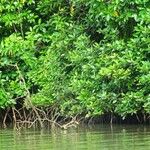
Rhizophora apiculata
Mangrove · Tall-stilt Mangrove
Description
Source: leafsnapRhizophora apiculata (R. apiculata) belongs to the Plantae kingdom under the Rhizophoraceae family. Currently R. apiculata is distributed throughout Australia (Queensland and Northern Territory), Guam, India, Indonesia, Malaysia, Micronesia, New Caledonia, Papua New Guinea, the Philippines, Singapore, the Solomon Islands, Sri Lanka, Taiwan, the Maldives, Thailand, Vanuatu, and Vietnam. Rhizophora apiculata is called ‘bakhaw lalaki,’ in the Philippines, "Thakafathi ތަކަފަތި" in the Maldives, 'Đước' in Vietnam, Garjan in India, as well as other vernacular names. R. apiculata has a C4 plant morphology that best adapts the plant for high temperature low water climates, enabling the plant to thrive in tropical environments due to the diffuse CO2 whilst limiting the amount of water transpired out of the leaves.It's located exclusively in the mangrove ecosystem due to an affinity with wet, muddy and silty sediments. Due to the high salt concentrations of the soils it has mechanisms (ultrafiltration) in place to reduce the likely impacts associated with increased salt in plant physiology (drying plant material down causing increased evapotranspiration). Rhizophora apiculata, as well as Rhizophora mucronata, is used to make charcoal in the charcoal kilns of Kuala Sepetang in Perak, Malaysia. Rhizophora apiculata is used within mangrove plantation specifically for wood, and charcoal production in many parts of Thailand; Yeesarn village of Smaut Songkram Province for instance.There are a variety of alternative uses for R. apiculata including medically (to inhibit fungal infections), and commercially to reinforce nets, ropes and fishing lines, transform into charcoal or trade for income.
Care Guide
💧 Water
Mangroves thrive in humid, saline coastal environments and are well-adapted to brackish water, exhibiting excellent drought tolerance. Water mangroves every 2 to 3 weeks, which reflects their adaptability. Primarily grown outdoors, mangroves help stabilize shorelines and provide habitats for various species. The tidal patterns of their environment influence how often they need to be watered.
☀️ Light Full sun
Mangrove thrives in locations that receive abundant sunlight. Its origin in coastal, sun-drenched habitats underscores this. There is a clear link between ample sun exposure and its healthy growth. At every stage of growth, sufficient light helps, but excessive light can cause damage, and too little light likewise harms its development.
What are the sunlight requirements for a Mangrove?
Mangroves require full sun, defined as above 6 hours of sunlight daily, to thrive. Originating from coastal areas abundant in sunlight, these plants do best when exposed to ample sun throughout their growth stages. However, both too much and too little sunlight can adversely affect their development. Observing how sunlight moves through your garden and selecting spots with a perfect balance of light and shade will ensure the plants' happiness and healthy growth.
How does artificial lighting support Mangrove plants indoors?
When natural sunlight is insufficient, especially during winter or in less sunny spaces, artificial lighting becomes crucial for the optimal growth of indoor Mangrove plants. It's recommended to choose the right type of artificial light, such as LED lights, which can provide specific wavelengths needed by the plants. Full sun plants require 30-50W per square foot, partial sun plants need 20-30W per square foot, and full shade plants need 10-20W per square foot. The light source should be placed 12-36 inches above the plant, mimicking natural sunlight, and most plants will need between 8-12 hours of light per day.
What are the symptoms of inappropriate sunlight exposure in Mangroves?
Mangroves exhibit several symptoms when they receive inappropriate sunlight, including small leaves, leggy or sparse growth, faster leaf drop, slower or no new growth, and chlorosis. Excessive sunlight can lead to sunscald, leaf curling, wilting, and leaf scorching. These symptoms typically indicate either a deficiency or excess in sunlight exposure, affecting the plant's ability to photosynthesize and overall health.
What solutions can help Mangroves with insufficient sunlight?
For indoor Mangroves, gradually moving the plant to a sunnier location each week, until it receives at least 6 hours of direct sunlight daily, can be beneficial. Using artificial light, like a desk or ceiling lamp for at least 8 hours daily or investing in professional plant grow lights, can also provide sufficient light. For outdoor plants, move them gradually to sunny spots to avoid sunburn. Reducing obstructions like pruning trees or transplanting to sunnier locations can help outdoor and ground plants receive the sunlight they need. It's crucial to acknowledge that parts of the plant affected by insufficient light may not recover, but new growth should be healthy with improved light exposure.
🌡️ Temperature 20–37.8°C
Mangrove originates in tropical regions, where the climate is commonly warm and humid. As a result, it is well adapted to high temperatures and humidity. It does not tolerate sudden temperature changes and favors a stable thermal environment, so it's important to prevent temperature fluctuations indoors. It usually cannot withstand cold and requires higher temperatures for growth. If the environmental temperature falls too low, the plant may stop growing or even die.
💨 Humidity
🪴 Soil 6-8
🌱 Fertilizer
Fertilization is vital for mangrove care. Regular feeding throughout the growing season maintains the energy required for showy leaves and supports overall growth. Ignoring fertilization can cause unhealthy leaves, reduced ornamental value, and stunted or weak growth that is prone to breaking.
🪴 Pot & Repot
✂️ Pruning
Mangroves flourish in coastal areas and benefit from pruning between early and late winter. This practice helps maintain their shape and promotes new growth by removing dead or damaged branches. Regular pruning also improves air circulation, deters pests, and enhances both the ecological health and the aesthetic appeal of the area. It is important to use clean, sharp tools during pruning to prevent infections.
🌿 Propagating
🐛 Diseases & pets
☠️ Toxicity
Characteristics
- Plant Type
- Tree, Shrub
- Life Cycle
- Perennial
- Genus
- Rhizophora
- Family
- Rhizophoraceae
- Hardiness Zone
- 10-12
- Mature Height
- 6.1 m
- Mature Spread
- 10.06 m to 11.89 m
- Leaf Color
- Green
- Leaf Type
- Evergreen
- Flower Color
- Yellow, Brown
- Flower Size
- 1.02 cm to 2.03 cm
- Bloom Time
- All year round
- Planting Time
- Summer, Autumn
- Harvest Time
- All year round
- Native Area
- Sri Lanka, India, Malaysia, Indonesia, Cambodia, Vietnam, Myanmar, Philippines, Singapore, Bangladesh, Pakistan, Brunei, Thailand, China