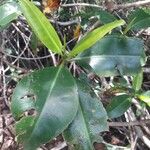
Rhizophora mangle
Red mangrove · Mangrove · American mangrove · Asiatic Mangrove
Description
Source: leafsnapRhizophora mangle, the red mangrove, is distributed in estuarine ecosystems throughout the tropics. Its viviparous "seeds", in actuality called propagules, become fully mature plants before dropping off the parent tree. These are dispersed by water until eventually embedding in the shallows. Rhizophora mangle grows on aerial prop roots, which arch above the water level, giving stands of this tree the characteristic "mangrove" appearance. It is a valuable plant in Florida, Louisiana, and Texas coastal ecosystems. In its native habitat it is threatened by invasive species such as the Brazilian pepper tree (Schinus terebinthifolius). The red mangrove itself is considered an invasive species in some locations, such as Hawaii, where it forms dense, monospecific thickets. R. mangle thickets, however, provide nesting and hunting habitat for a diverse array of organisms, including fish, birds, and crocodiles.
🌳 The red mangrove plays a crucial role in coastal ecosystems by acting as a nursery for many types of marine life. Its complex network of prop roots, which seem to defy gravity as they hold the red mangrove above the water, creates a sheltered habitat for juvenile fish, molluscs, and crustaceans. These roots both protect young marine species from predators and provide a plentiful source of food, significantly contributing to the sustainability of local fisheries and helping to maintain biodiversity.
🎭 Not secure, unsteady
Care Guide
💧 Water
☀️ Light Full sun
The red Mangrove thrives in areas that receive plenty of sunlight throughout the day. Its native habitat comprises places where the sun's presence is ongoing, supporting healthy growth. At various growth stages, adequate light exposure is necessary. However, excessively strong or insufficient light can negatively affect the plant's health.
What are the sunlight requirements for Red Mangrove?
Red Mangrove, or Rhizophora mangle, thrives in full sun, requiring above 6 hours of sunlight daily to flourish properly. It is native to areas where sunlight is abundant, which is vital for its growth at different stages. However, both excessive and insufficient light can harm the plant. It's important to observe sunlight patterns in your garden and ensure that your Red Mangrove has the perfect balance of light and shade.
How can you use artificial lighting for Red Mangrove indoors?
When natural sunlight is insufficient, especially during winter or in less sunny spaces, artificial lighting becomes crucial for the growth of indoor Red Mangroves. LED lights are recommended for their ability to be customized to specific wavelengths needed by plants. Full sun plants require 30-50W/sq ft, partial sun plants need 20-30W/sq ft, and full shade plants should have 10-20W/sq ft of artificial light. The light source should be placed 12-36 inches above the plant, mimicking natural sunlight. Most plants will need 8-12 hours of light per day.
What are the symptoms of inadequate light in Red Mangrove?
Insufficient light exposure can lead to several symptoms in Red Mangrove, including small leaves, leggy or sparse growth, faster leaf drop, slower or no new growth, and lighter-colored new leaves. Other issues caused by improper lighting are chlorosis, where leaves lose their green color, sunscald from intense exposure, leaf curling as a defense mechanism, wilting due to loss of turgor pressure, and leaf scorching, characterized by dry, crispy edges on leaves.
What solutions exist for improving light exposure for Red Mangrove?
To enhance light exposure for Red Mangrove, indoors, gradually relocate your plant to sunnier spots until it receives at least 6 hours of direct sunlight daily. Using a south-facing window or artificial grow lights can help achieve the necessary light levels. Outdoors, ensure a gradual transition to sunnier locations to prevent sunburn. Minimizing obstructions like pruning trees or transplanting to sunlit areas with good drainage can also improve sunlight access. Note, parts of the plant damaged by insufficient light may not recover, but increased exposure will ensure healthy new growth.
🌡️ Temperature 20–37.8°C
The red Mangrove's natural temperature requirements for growth fall between 20 and 38 ℃ (68 to 100.4 ℉). It prefers warmer conditions and can endure temperatures as low as 5 ℃ (41 ℉), although not for extended periods. In winter, it may need protection against frost and freezing temperatures.
What are the temperature requirements for Red Mangrove?
The Red Mangrove, or Rhizophora mangle, thrives in temperatures ranging from 20 to 38°C (68 to 100.4°F), preferring warmer climates for optimal growth. It can withstand temperatures as low as 5°C (41°F) but is not frost-tolerant and requires protection from freezing temperatures during winter. To prevent cold damage, it is advisable to bring outdoor-grown Red Mangroves indoors during autumn, placing them near a bright window while ensuring they are not too close to heaters. Keeping the environment above 20°C is beneficial for the plant's growth, and exposure to temperatures near 0°C should be avoided to prevent harm.
What should I do if my Red Mangrove experiences low temperatures?
If your Red Mangrove is affected by low temperatures, which it prefers to avoid, you may notice the leaves lightening in color, eventually turning brown or black with symptoms like wilting and drooping after frost damage. The solution is to trim off the frost-damaged parts and immediately move the plant to a warm indoor environment to protect it from the cold. Placing it near a south-facing window ensures it gets ample sunlight, but it's important to avoid placing it near heaters or air conditioning vents to prevent the air around it from becoming excessively dry.
How should I care for Red Mangrove in high temperatures?
During the summer, it's essential to keep the Red Mangrove below 38°C to prevent heat stress. Temperatures exceeding 43°C may cause the leaves to lighten and increase the plant's susceptibility to sunburn. To manage this, trim away sunburned and dried parts of the plant, and relocate it to a spot where it can enjoy shade during the midday and afternoon sun. Ensuring the soil remains moist is crucial, so watering the plant in the morning and evening is recommended.
💨 Humidity high (>60%)
This plant needs special care because it loves high humidity levels of 60-80% or more. The best way to achieve this is by placing a humidifier near the plant. Daily misting is also essential! Make sure the room has good ventilation.
🪴 Soil
🌱 Fertilizer Every 30 days
🪴 Pot & Repot Every 12 months
✂️ Pruning
The Red Mangrove is notable for its dense root system and ability to thrive in saline conditions. It's best to prune these plants from early to late winter, concentrating on removing dead branches and shaping the plant to avoid overcrowding. This practice encourages healthy growth, strengthens the plant's structure, and enhances its resilience.
🌿 Propagating
🐛 Diseases & pets
☠️ Toxicity
Characteristics
- Plant Type
- Shrub
- Life Cycle
- Perennial
- Genus
- Rhizophora
- Family
- Rhizophoraceae
- Hardiness Zone
- 9-11
- Mature Height
- 6.1 m to 22.86 m
- Mature Spread
- 6.1 m to 9.14 m
- Leaf Color
- Green
- Leaf Type
- Evergreen
- Flower Color
- White
- Flower Size
- 2.54 cm
- Bloom Time
- All year round
- Planting Time
- Spring, Summer, Autumn, Winter
- Harvest Time
- All year round
- Native Area
- Belize, Angola, Mexico, Guatemala, Dominican Republic, Nigeria, Fiji, Guinea-Bissau, Jamaica, Benin, Cuba, Sierra Leone, Haiti, Cameroon, Liberia, Venezuela, Brazil, Ghana, Suriname, Honduras, Peru, Guinea, Trinidad and Tobago, Panama, Gambia, Colombia, Bahamas, Togo, El Salvador, Senegal, Nicaragua, Guyana, Ecuador, Côte d'Ivoire, Costa Rica, Gabon