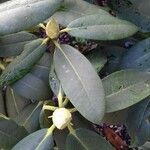
Rhododendron maximum
آزالیا · Αζαλέα (ροδόδενδρο) · American Rhododendron · Great rhododendron · Great-laurel
Description
Source: leafsnapRhododendron maximum, commonly known as the Great Laurel or Rosebay Rhododendron, is a large evergreen shrub native to the eastern United States. It typically reaches heights of 6 to 20 feet and features dark green, leathery, and glossy leaves. In late spring or early summer, the plant produces large clusters of fragrant pink or white flowers that are highly attractive to bees and other pollinators. Rhododendron maximum thrives in moist, acidic soils and prefers partial shade to full sun. It is commonly found in woodland areas along streams or on mountain slopes, ranging from Maine to Georgia. For centuries, Native Americans have used this plant for medicinal purposes. They brewed the leaves into a tea used as an expectorant for coughs and colds, and they used the bark as an astringent. However, it's important to note that Rhododendron maximum can be toxic if ingested by humans or animals due to its high levels of grayanotoxins. Consumption can lead to symptoms such as vomiting, diarrhea, dizziness, and even heart problems if ingested in large quantities. Overall, Rhododendron maximum is a beautiful plant, but it should be handled with care due to its toxicity when ingested.
💡 In regions where great laurel is frequently planted, other plant species struggle to regenerate. This inhibitory effect is not fully understood, so caution is advised when planting great laurel. It is believed that great laurel competes with other species for nutrients and light in forest environments. If planted nearby, it can significantly impact wood production.
🌳 Great laurel demonstrates a notable ability to take up air pollutants, positioning it as a natural air purifier. Researchers have found that great laurel can tolerate and accumulate heavy metals, such as lead and cadmium, from contaminated soils, showing potential for phytoremediation. This often-unexamined feature carries promising implications for sustainable agriculture and urban forestry.
🎭 Peril, power, defense, loveliness
Care Guide
💧 Water Every 7 days
Great laurel originates from moist habitats and thrives best when provided with consistent moisture and humidity. It should be watered every 1-2 weeks. Although it is moderately drought-tolerant, it flourishes in temperate climates. Using mulch can help retain soil moisture during its active growing season, enhancing its growth.
When Should I Water My Great Laurel?
Watering your great laurel is essential to maintain its health, encouraging vibrant flower production and disease resistance. To determine when to water, check the soil moisture around the plant's base; if the top 1 to 2 inches feel dry, it's time to water. Wilted or droopy leaves, especially if they begin yellowing, also indicate the need for water. The pre-flowering stage demands more water to prevent bud drop and promote flower development. Great laurel needs more water when exposed to high temperatures and sunlight. Conversely, avoid over-watering when the soil is still moist, as this can lead to root diseases, and ensure you don't wait too long to water to prevent dehydration and potential plant death.
How Should I Water My Great Laurel?
Watering your great laurel properly involves maintaining a balance between moist soil and avoiding waterlogging. Employ a deep watering technique, allowing water to penetrate deeply into the soil to reach the roots. Use a watering can with a long spout or a wand to water at the plant's base, reducing the risk of fungal diseases by avoiding excessive foliage wetness. Ensuring the soil is evenly moist but not waterlogged promotes healthy growth.
How Much Water Does Great Laurel Really Need?
The great laurel requires the soil's top few inches to remain consistently moist to thrive, adapted from its natural habitat in moist, acidic soils. A deep and slow watering method that moisturizes the soil to at least 6 inches deep is recommended, generally translating to about 1 inch of water per week. Signs of a well-hydrated plant include vibrant leaves without yellowing or wilting and soil that feels moist but not soggy. Avoid both over-watering, which can lead to root rot, and under-watering, which can cause wilting and stunted growth.
What Kind of Water is Best for Great Laurel?
Great laurel prefers rainwater or filtered water, as it is sensitive to chlorine, fluoride, and other pollutants often found in tap water. To mitigate tap water use, allow it to stand overnight to evaporate chlorine and lessen fluoride levels. Be cautious of hard water, which could affect the plant's growth due to its lower pH preference. Watering with room temperature water is ideal to avoid shocking the plant's roots. When changing water sources, it's best to do so gradually to prevent plant stress.
How Do Great Laurel's Watering Needs Change with the Seasons?
During the spring growth phase, ensure consistent soil moisture with regular watering. In summer, especially during dormancy periods, reduce watering and allow the soil to dry slightly between. As great laurel prepares for winter in autumn, decrease watering frequency while keeping the soil lightly moist. Winter calls for minimal watering, allowing the topsoil to dry out between waterings and adjusting based on the plant's dormancy and indoor heat levels.
☀️ Light Partial sun
The great laurel prefers dappled light and can tolerate places where direct sunlight is mostly blocked. Native to heavily wooded areas, it does well where illumination is soft and scattered. It is also tolerant of low light conditions. Too much light can be harmful, possibly causing leaf scorch, while too little light can restrict its growth.
What are the sunlight requirements for the Great Laurel (Rhododendron maximum)?
The Great Laurel, or Rhododendron maximum, displays an affinity for environments with scattered light but can adapt to varying light conditions, including full shade (less than 3 hours of sunlight) and partial sun (about 3-6 hours of sunlight). Originating from environments rich in trees, it thrives where sunlight is diffused and can cope with low light conditions. However, it's worth noting that excessive sunlight may be harmful, causing leaf scorch, while insufficient light may stunt growth. Monitoring sunlight patterns in your garden and choosing locations that offer a balance of light and shade is crucial for the plant's well-being.
What are the indications of insufficient or excessive light on the Great Laurel?
The Great Laurel may exhibit several symptoms due to inadequate or excessive light. Insufficient light can lead to smaller new leaves, leggy or sparse growth, faster leaf drop, slowed or ceased growth, and lighter-colored or yellow leaves, indicating a lack of chlorophyll. Excessive sunlight might cause chlorosis (leaf yellowing), sunscald, leaf curling, wilting, and leaf scorching, indicating damage or stress. These symptoms provide insight into the plant's health and its lighting conditions, allowing for timely adjustments.
How can artificial lighting be used to supplement natural sunlight for indoor Great Laurel plants?
For indoor Great Laurel plants, when natural sunlight is insufficient, particularly during winter or in less sunny spaces, artificial lighting can be a vital solution. LED lights, due to their ability to provide specific wavelengths, are a popular choice. Full sun plants require 30-50W per square foot, partial sun plants need 20-30W per square foot, and full shade plants benefit from 10-20W per square foot of artificial light. Positioning the light source 12-36 inches above the plant will simulate natural sunlight conditions, and most plants thrive with 8-12 hours of light per day. These measures promote healthier, faster growth even in less ideal natural light conditions.
What steps should be taken to address light-related issues with Great Laurel, whether indoors or outdoors?
To address light-related issues with Great Laurel, gradual acclimatization to the optimal sunlight is key. For indoor plants receiving insufficient light, gradually moving them to sunnier spots each week until achieving 3-6 hours of direct sunlight daily or supplementing with artificial light for at least 8 hours daily can help. Outdoor plants should also be moved to sunnier locations progressively to prevent sunburn. Reducing obstructions like pruning trees or transplanting to sunnier spots with good drainage can benefit outdoor plants. While some damage from past insufficient sunlight might be irreversible, new growth, with proper light adjustment, will be healthy.
🌡️ Temperature 0–32.2°C
In its native growing environment, the Great laurel prefers temperatures between 32 and 90 ℉ (0 to 32 ℃). In summer, temperatures can rise to 90 ℉ (32 ℃), so providing shade is advisable. In winter, temperatures may fall to as low as 32 ℉ (0 ℃), so some protection against frost may be necessary.
What are the essential growing conditions for Great Laurel?
Great Laurel (Rhododendron maximum) thrives in its native environment with temperatures ranging from 32 to 90°F (0 to 32°C). During summer, when temperatures can reach up to 90°F (32°C), it's beneficial to provide the plant with shade to protect it from excessive heat. In winter, the temperature may decrease to 32°F (0°C), at which point some protection against frost might be necessary. Although Great Laurel is highly tolerant to cold and doesn't usually require additional frost protection, it's advisable to water the plant generously before the first autumn freeze. This ensures the soil remains moist and freezes, thereby preventing drought and water scarcity during winter and early spring.
How does low temperature affect Great Laurel and what are the remedies?
Great Laurel is extremely cold-tolerant and ideally should be kept in winter temperatures above 32°F (0°C). If temperatures fall below this, you might not notice any immediate changes during the winter. However, in spring, the branches may become brittle, dry, and fail to produce new shoots. The remedy for such damage is to prune away any dead branches that failed to produce new leaves. This helps the plant recover and encourages new growth.
How does high temperature affect Great Laurel and what are the solutions?
Great Laurel struggles with high temperatures. When the mercury exceeds 90°F (32°C), the plant may experience severe leaf drop. In extreme cases, High temperatures can cause the entire plant to wither and die. If such symptoms are observed, trim away the sunburned and dried-up parts of the plant. It's crucial to move the plant to a shaded location or use a shade cloth to protect it from the midday and the afternoon sun. Additionally, watering the plant in the morning and evening can help keep the soil adequately moist, thereby mitigating the effects of high temperatures.
💨 Humidity
🪴 Soil 4-5
🌱 Fertilizer
Timing is vital for fertilizing Great laurel. Apply fertilizer in early spring and continue monthly through early summer. The fertilizer promotes attractive blooms and supplies energy during both dormant and active growth periods.
Why should I put fertilizer on my Great laurel?
Fertilizing your Great laurel is essential for several reasons. Firstly, it will enhance the production of beautiful blooms. To achieve excellent flowers in the spring season, fertilizing in early spring is highly recommended. Additionally, fertilizer helps your Great laurel store ample energy in the ground during its dormant phases. Providing extra nutrients during fall planting or late spring will enable your Great laurel to retain more energy for active growth.
When should I fertilize my Great laurel?
Timing is important when fertilizing Great laurel. Using fertilizer too early while the plant is still dormant is ineffective and it can be washed away by rainwater, causing waste and pollution. To properly fertilize Great laurel, the first application should be done in the early spring, and then continue to fertilize once a month until early summer.
When is the best time to not put fertilizer on my Great laurel?
When it comes to fertilizing Great laurel, it's important to avoid using a fertilizer with too much nitrogen. This can cause an increase in leaf growth but fewer blooms. Instead, opt for a fertilizer that has a lower nitrogen content compared to other nutrients. It's also crucial not to fertilize Great laurel after early autumn, as this can result in excessive growth right before winter. Additionally, avoid fertilizing the plant during hot and dry periods, as dry soil doesn't efficiently deliver fertilizer and increased growth may require more water, which might not be readily available. It's best to apply fertilizer during the cooler seasons. Lastly, be cautious about unintentionally giving the tree or shrub a double dose of fertilizer, as Great laurel can absorb nearby fertilizer from surrounding plants or lawns.
What kind of fertilizer does my Great laurel plant need?
The best fertilizer for a Great laurel is one that has a balanced mix of nutrients, with slightly more phosphorus. Another option is to improve the soil by adding organic materials like compost, worm castings, and manure. Experienced gardeners may use water-soluble fertilizers with phosphorus 1-2 times when flower buds appear for better flower development and growth. Fertilizers can come in various forms, but liquid or powdered forms are recommended for Great laurels. Whatever type you choose, make sure to dilute the fertilizer and apply it while watering your Great laurel.
How do I give nutrients to my Great laurel plant?
To properly fertilize your Great laurel, always follow specific fertilizer instructions and do some research. Avoid over-fertilizing by determining the correct amount to use. A good rule of thumb is to base it on the tree's age or trunk diameter. Estimate one-tenth of a pound per year or per inch of trunk, with a maximum of one pound. Granular and organic fertilizers like blood meal should be spread around the tree's base, from the trunk to the drip line (the area beneath the farthest branches). Keep the fertilizer away from the trunk. Over time, the granules will break down and seep into the soil to be absorbed by the roots. After fertilizing, apply a one-inch layer of compost around the base of the tree and water thoroughly.
🪴 Pot & Repot 2-3 years
When repotting Great laurel, choose a pot 1-2 inches (2.5–5.1 cm) larger with ample drainage. Use a well-draining potting mix. Repot in spring or fall, ensuring that the root ball is slightly lower than the rim of the flower pot. Water thoroughly after repotting and place in a warm spot with indirect sunlight.
✂️ Pruning
Great laurel has large, glossy leaves and clusters of flowers. To maintain healthy growth, prune it in late spring. Start by removing any dead wood, and thin out crowded branches to improve air circulation and light exposure. Make sure to use clean tools for this task. Pruning after the plant has finished flowering helps reduce stress and encourages vigorous regrowth for the next season.
🌿 Propagating
🐛 Diseases & pets
☠️ Toxicity
Characteristics
- Plant Type
- Shrub
- Life Cycle
- Perennial
- Genus
- Rhododendron
- Family
- Ericaceae
- Hardiness Zone
- 3-7
- Mature Height
- 1.52 m to 10.06 m
- Mature Spread
- 1.52 m to 3.66 m
- Leaf Color
- Green
- Leaf Type
- Evergreen
- Flower Color
- Pink, White
- Flower Size
- 2.54 cm to 3.05 cm
- Bloom Time
- Early summer, Mid summer
- Planting Time
- Spring, Summer
- Harvest Time
- Mid summer
- Native Area
- Japan