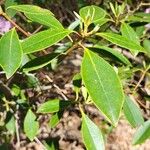
Rhododendron minus
Piedmont rhododendron · Small rhododendron
Description
Source: leafsnapRhododendron minus, the Piedmont rhododendron, is a rhododendron species native to Tennessee, North Carolina, South Carolina, Georgia, and Alabama. It has two subspecies: Rhododendron minus var. chapmanii and Rhododendron minus var. minus (the latter also known as Rhododendron carolinianum).
Care Guide
💧 Water Every 1-2 weeks
The Piedmont rhododendron flourishes in humid conditions, requiring regular moisture to maintain its evergreen leaves. To keep the plant healthy and promote growth, it is best to water it once every 1 to 2 weeks. This schedule provides the necessary hydration without risking drought stress or overwatering.
☀️ Light Partial sun
Piedmont rhododendron naturally grows in habitats such as forest understories or rocky areas, where it gets natural shade. It prefers partial sun but can tolerate full sun or full shade, illustrating its versatility and hardiness.
What are the sunlight requirements for plants?
Plants have varying needs for sunlight, with 'partial sun' requiring about 3-6 hours of sunlight and 'full sun' needing more than 6 hours of sunlight daily. It's crucial to observe the movement of sunlight through your garden to select the ideal spots offering a harmonious mix of light and shade, catering specifically to your plants' needs and promoting their well-being.
What is essential for Piedmont rhododendron's growth?
The Piedmont rhododendron, a native to forest understories and rocky areas, thrives under partial sun but can also adapt to full shade, making it a versatile perennial herbaceous plant. In conditions where natural sunlight is lacking, especially during winter or in less sunny locations, artificial lighting becomes critical for the plant's growth. LED lights, preferred for their customizable wavelength offerings, should be adjusted in terms of intensity (30-50W/sq ft for full sun, 20-30W/sq ft for partial sun, and 10-20W/sq ft for full shade), distance (12-36 inches above the plant), and duration (8-12 hours per day) to emulate natural sunlight conditions closely.
What are the symptoms of light deficiency in Piedmont rhododendron?
When the Piedmont rhododendron receives inadequate light, it may exhibit several symptoms indicating light deficiency. These include smaller new leaves, leggy or sparse growth, premature leaf drop, cessation of new growth, paler new leaves, and specific conditions like chlorosis (yellowing leaves), sunscald (damage from intense light), leaf curling (to minimize water loss and damage), wilting (loss of turgor pressure), and leaf scorching (brown, dry edges or patches on leaves). It's crucial to recognize and address these signs early to mitigate adverse effects on the plant's health.
How can you optimize light conditions for Piedmont rhododendron?
Optimizing light conditions for Piedmont rhododendron involves gradually acclimatizing the plant to its ideal sunlight exposure and considering the use of artificial lighting when natural light is insufficient. For indoor plants, gradually move them to sunnier spots each week until they receive 3-6 hours of direct sunlight daily or use desk, ceiling, or professional grow lights for at least 8 hours a day. Outdoor plants should be moved to progressively sunnier locations each week to prevent sunburn. Minimizing obstructions like pruning tree branches or transplanting smaller plants during their dormant period to sunnier locations can also help improve light exposure. Note that damaged parts may not recover, but new growth should be healthy following these adjustments.
🌡️ Temperature 10–32.2°C
The Piedmont rhododendron is highly adaptable to a wide range of climates, from sweltering summers to freezing winters. Still, it has a preferred temperature range for healthy growth. If temperatures climb too high, the plant can suffer from heat and humidity stress, which may lead to its death. In areas where temperatures get close to the lower limit of its cold tolerance, it is important to use insulation measures to protect the plant.
What is the Piedmont rhododendron?
The Piedmont rhododendron, scientifically known as Rhododendron minus, is a plant species. There are no additional details provided on its essentials or symptoms.
💨 Humidity
🪴 Soil 6-8
🌱 Fertilizer
Applying fertilizer at the right time is important for the Piedmont rhododendron. Begin fertilizing in early spring and continue once a month through early summer. Fertilizer encourages attractive blooms and supplies energy during both dormant and active growth phases.
🪴 Pot & Repot
✂️ Pruning
The Piedmont rhododendron is a bushy evergreen shrub that thrives when pruned carefully during its dormant period, from early to late winter. Start by removing any dead or diseased branches. Next, thin out overcrowded branches to improve air circulation. Shaping cuts can help encourage compact growth and stimulate vibrant new growth, leading to enhanced flower production.
🌿 Propagating
🐛 Diseases & pets
☠️ Toxicity
Characteristics
- Plant Type
- Shrub
- Life Cycle
- Perennial
- Genus
- Rhododendron
- Family
- Ericaceae
- Hardiness Zone
- 6-8
- Mature Height
- 0.91 m to 1.83 m
- Mature Spread
- 0.91 m to 1.83 m
- Leaf Color
- Green, Blue, Purple, Lavender
- Leaf Type
- Evergreen
- Flower Color
- Pink
- Flower Size
- 2.54 cm to 7.62 cm
- Bloom Time
- Mid spring, Late spring
- Planting Time
- Spring
- Harvest Time
- Mid summer, Late summer, Early fall