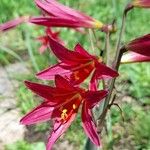
Rhodophiala bifida
Rhodophiala
Description
Source: leafsnapRhodophiala bifida, commonly known as the oxblood lily or schoolhouse lily, is a bulbous perennial native to South America. Classified under the Amaryllidaceae family, this plant is celebrated for its striking red flowers that bloom in late summer or early fall. The trumpet-shaped flowers rise on tall stems, which can reach heights of up to 18 inches. The plant's leaves are strap-like and grow from its base. Rhodophiala bifida thrives in well-drained soil and prefers full sun to partial shade. Although it is drought-tolerant once established, it benefits from occasional watering during dry spells. Propagation can be achieved by dividing the bulbs in early spring or by sowing seeds. Beyond its ornamental appeal, Rhodophiala bifida holds cultural significance, having been used for medicinal purposes by indigenous peoples of South America for centuries. Its bulbs contain alkaloids that exhibit antifungal properties. Overall, Rhodophiala bifida is a beautiful, hardy plant with cultural and medicinal importance extending beyond its aesthetic beauty.
Care Guide
💧 Water Every 7 days
The oxblood lily flourishes with moderate water availability and prefers consistent moisture. It benefits from being watered weekly. As an outdoor bulbous plant, it stores water in its bulbs, which helps it endure dry spells. This adaptation allows it to survive with infrequent watering during such periods.
☀️ Light Full sun
Oxblood lily does best when it gets unobstructed light for most of the day, though it can tolerate irregular lighting. Its native environment favors strong growth in plentiful sunshine. Excessive exposure can cause scorching, while too little light may impede flowering and reduce overall vitality.
What are the sun requirements for Oxblood Lily?
Oxblood Lily requires full sun, meaning it thrives best when exposed to more than 6 hours of sunlight daily. However, it can also grow in partial sun, with about 3-6 hours of sunlight. It's essential to observe the movement of sunlight in your garden to place your plants in ideal spots that offer a balance of light and shade, ensuring their growth and happiness.
How does sunlight exposure affect the growth of Oxblood Lily?
The Oxblood Lily thrives when it receives unfettered light for most of the day, echoing its natural habitat which encourages robust growth under abundant sunshine. While it can endure some variations in light, too much exposure may lead to scorching, and insufficient light could impede its blooming and overall vitality.
How can artificial lighting support the growth of Oxblood Lily?
Indoor Oxblood Lily plants may benefit from artificial lighting, especially when natural sunlight is insufficient. LED lights, mimicking the spectrum of natural light, are recommended. Full sun plants require 30-50W/sq ft, partial sun 20-30W/sq ft, and full shade 10-20W/sq ft of artificial light. The light source should be placed 12-36 inches above the plant and left on for about 8-12 hours daily to simulate natural sunlight conditions.
What are the symptoms of light deficiency in Oxblood Lily?
Symptoms of light deficiency in Oxblood Lily include smaller new leaves, leggy or sparse growth, faster leaf drop, slower or no new growth, and lighter-colored or chlorotic leaves. Excessive sunlight may cause symptoms such as sunscald, leaf curling, wilting, and leaf scorching, indicating the need for an adjustment in light exposure.
What solutions can improve light exposure for Oxblood Lily?
To enhance light exposure for Oxblood Lily, indoors ensure it receives at least 6 hours of direct sunlight daily, possibly by using a south-facing window or artificial lights for at least 8 hours a day. Outdoors, gradually relocate your plant to sunnier spots to avoid shock, and ensure new growth is healthy. If obstructions block sunlight, consider pruning or relocating your plant to a sunnier location, ensuring it has ample sunlight and good drainage.
🌡️ Temperature 15–35°C
Oxblood lily is quite adaptable to temperature, able to withstand higher heat and considerable temperature fluctuations. In hot weather, pay attention to watering and provide adequate shade to avoid sunburn. On the other hand, it has relatively low tolerance for cold; although it can handle some chill, extremely cold conditions can cause frost damage.
💨 Humidity
🪴 Soil 6-7
🌱 Fertilizer
For the Oxblood lily, the primary time to apply fertilizer is in early spring as the flowers begin to form. Using an appropriate fertilizer promotes better blooms and helps the Oxblood lily develop attractive flowers. Fertilizing in early spring ensures strong flowers during the season and supplies energy for its dormant growth phases.
🪴 Pot & Repot
✂️ Pruning
To help oxblood lilies thrive, prune them from early to late spring. Remove spent flowers and dead foliage to encourage new growth, but leave the green leaves intact for energy storage. To reduce the risk of disease, enhance air circulation around the plants. Always use clean, sharp tools for pruning. Afterward, apply a balanced fertilizer for the best results.
🌿 Propagating
🐛 Diseases & pets
☠️ Toxicity
Characteristics
- Plant Type
- Herb
- Life Cycle
- Perennial
- Genus
- Rhodophiala
- Family
- Amaryllidaceae
- Hardiness Zone
- 7-10
- Mature Height
- 25 cm to 49 cm
- Mature Spread
- 10 cm to 49 cm
- Leaf Color
- Green
- Leaf Type
- Deciduous
- Flower Color
- Red, Pink
- Flower Size
- 5.08 cm
- Bloom Time
- Late summer, Early fall
- Planting Time
- Autumn
- Harvest Time
- Mid fall, Late fall