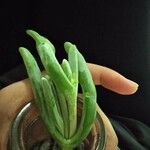
Rhombophyllum nelii
Elk horn
Description
Source: wikipedia (CC BY-SA)Rhombophyllum nelii is a succulent plant that is part of the Aizoaceae family. The species is endemic to South Africa and occurs in the Eastern Cape.
Care Guide
💧 Water
Elk's horns are native to arid environments and have adapted to efficiently store water, making them highly drought-tolerant. They need to be watered only every 2-3 weeks, allowing the soil to dry out in between waterings. These plants thrive in well-draining soil and benefit from rainwater during their active growing season, which complements their minimal irrigation requirements.
☀️ Light Full sun
Elks horns prefers abundant sunlight, allowing it to reach its full growth potential. It benefits from generous light during all stages of development. The intense sunlight of its native habitat explains this preference. Insufficient sunlight can impede growth, while excessive exposure does not cause significant harm.
🌡️ Temperature 20–37.8°C
Elks horns is native to regions with moderate ambient temperatures. It does best within a temperature range of 68 to 100 °F (20 to 38 °C). Seasonal adjustments are necessary, moving toward the cooler end of that range in winter to mimic its natural habitat.
💨 Humidity
🪴 Soil 6-7
🌱 Fertilizer
Elks horns need only light doses of fertilizer once or twice a year during the growing season. Do not fertilize in winter or summer when the plant is dormant. Cut back on fertilizer for repotted plants and wait a couple of months after repotting before you start feeding again. Fertilizing helps maintain healthy growth and promotes blooming.
🪴 Pot & Repot Every 2 years
When repotting Elks horns, choose a pot slightly larger than the current one that has good drainage. Use a gritty, well-draining succulent or cactus mix. Gently remove the plant from its old container, brush off excess soil, and set it back in at the same depth. Wait a few days before watering so any root damage can heal. Repot during spring or fall and place the plant in a brightly lit location.
✂️ Pruning
To preserve the shape of elk horns, trim any redundant or dense branches in the spring and fall. When propagating, cut stems with 5-6 leaves, seal the cuts with sulfur powder, and allow them to heal before planting. Use a watering can to slightly moisten the soil for the cuttings.
🌿 Propagating
🐛 Diseases & pets
☠️ Toxicity
Characteristics
- Plant Type
- Succulent
- Life Cycle
- Perennial
- Genus
- Rhombophyllum
- Family
- Aizoaceae
- Hardiness Zone
- 10-11
- Mature Height
- 8 cm to 15 cm
- Mature Spread
- 15 cm to 23 cm
- Leaf Color
- Gray, Light Gray
- Leaf Type
- Evergreen
- Flower Color
- Yellow
- Flower Size
- 5.08 cm
- Bloom Time
- Mid spring, Late spring, Early summer
- Planting Time
- Spring, Autumn
- Harvest Time
- Summer
- Native Area
- South Africa