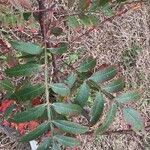
Rhus copallinum
Winged sumac · Black sumac · Dwarf sumac · Mountain sumac · Shining sumac
Description
Source: leafsnapRhus copallinum, commonly known as winged sumac or shining sumac, is a deciduous shrub or small tree belonging to the Anacardiaceae family. Native to eastern North America, it thrives in diverse habitats such as dry woods, rocky slopes, and open fields. Typically growing up to 10 feet tall, the plant has a spreading habit with multiple stems. Its leaves are pinnately compound, featuring 9 to 21 lance-shaped, serrated leaflets. The foliage takes on a bright red hue in the fall before shedding. In late spring or early summer, winged sumac produces small greenish-yellow flowers that later develop into clusters of red berries by late summer. These berries are an important food source for birds such as robins and blue jays. Beyond its ornamental value, Rhus copallinum offers several medicinal uses, including treatments for diarrhea, fever reduction, and pain relief from arthritis. However, caution is advised when handling the plant, as it contains urushiol, which can cause skin irritation similar to poison ivy. Overall, Rhus copallinum is an attractive native plant with ecological significance for wildlife and potential medicinal benefits for humans when used correctly.
Care Guide
💧 Water
☀️ Light Full sun
🌡️ Temperature 5–32.2°C
💨 Humidity
🪴 Soil 6-7
🌱 Fertilizer
🪴 Pot & Repot
✂️ Pruning
🌿 Propagating
🐛 Diseases & pets
☠️ Toxicity
Characteristics
- Plant Type
- Tree
- Life Cycle
- Perennial
- Genus
- Rhus
- Family
- Anacardiaceae
- Hardiness Zone
- 4-8
- Mature Height
- 2.13 m to 4.57 m
- Mature Spread
- 3.66 m to 5.49 m
- Leaf Color
- Green, Red, Orange
- Leaf Type
- Deciduous
- Flower Color
- White, Cream
- Flower Size
- 2.54 cm
- Bloom Time
- Early summer, Mid summer
- Planting Time
- Spring, Summer
- Harvest Time
- Mid summer, Late summer
- Native Area
- United States, Cuba, Canada