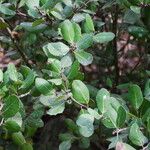
Rhus integrifolia
Lemonade sumac · Lemonadeberry · Sourberry
Description
Source: leafsnapRhus integrifolia, commonly known as lemonade sumac or lemonade berry, is a small evergreen shrub native to the coastal regions of California and Baja California. It belongs to the Anacardiaceae family and can grow up to 10 feet tall. The plant features glossy, leathery leaves that release a citrusy scent when crushed. In spring, lemonade sumac produces small clusters of white or pink flowers, which are followed by bright red berries in the summer. The berries have a tart flavor and were traditionally used by Native Americans to make a refreshing drink similar to lemonade. This drought-tolerant plant thrives in sandy or rocky soils with good drainage. It prefers full sun but can also tolerate partial shade, making it an excellent choice for coastal gardens due to its ability to withstand salty air. Besides its ornamental appeal, Rhus integrifolia possesses several medicinal properties. It is known for its anti-inflammatory effects on skin conditions like eczema and psoriasis, as well as its antibacterial properties. Overall, Rhus integrifolia makes an attractive addition to gardens with its year-round glossy green leaves and medicinal benefits. It is an interesting choice for gardeners who favor native plants of the California region.
Care Guide
💧 Water Every 7 days
Lemonade Berry thrives in coastal sage scrub and chaparral environments. It is highly drought-tolerant and efficient at storing water. This plant requires watering only once every 2 to 3 weeks and can endure extended dry spells. Despite arid conditions, it remains lush and evergreen.
☀️ Light Full sun
Lemonade Berry flourishes in settings where sunlight can reach it unobstructed throughout the day, encouraging healthy growth and development. It tolerates locations where light is filtered for portions of the day, but excessive or insufficient exposure can impede its growth, reflecting its origin in a sun-rich habitat.
What are the sunlight requirements for Lemonade Berry?
Lemonade Berry requires conditions where it can receive abundant sunlight throughout the day to thrive. It can tolerate some filtered sunlight but optimal growth is observed in full sun, defined as above 6 hours of sunlight daily. Partial sun, about 3-6 hours of sunlight, is also acceptable though not ideal. It's important to observe how sunlight moves through your garden to choose spots that provide a balance of light and shade, ensuring the plants' well-being.
How do I use artificial lighting for Lemonade Berry indoors?
When natural sunlight is insufficient for Lemonade Berry, especially indoors, during winter, or in less sunny spaces, artificial lighting can be used to support its growth. LED lights are recommended because they can provide specific wavelengths needed by plants. For full sun plants like Lemonade Berry, 30-50W per square foot is ideal. The light source should be placed 12-36 inches above the plant, mimicking natural sunlight duration, which is typically 8-12 hours per day.
What are the symptoms of inadequate sunlight for Lemonade Berry?
When Lemonade Berry does not receive enough sunlight, it may exhibit symptoms such as smaller new leaves compared to older ones, leggy or sparse growth, faster leaf drop, slower or halted growth, lighter-colored new leaves, chlorosis, sunscald, leaf curling, wilting, and leaf scorching. These signs indicate either insufficient sunlight or overexposure. It's crucial to monitor these symptoms and adjust the plant's exposure to light accordingly.
What solutions can I apply for Lemonade Berry's sunlight issues?
To address sunlight issues for Lemonade Berry, consider the following solutions depending on your setup. For indoors, gradually move the plant to a sunnier location each week until it receives at least 6 hours of direct sunlight daily or use artificial light if the plant is large. Outdoors, adapt the plant to more sunlight gradually to prevent sunburn. If sunlight is obstructed, prune any obstructions or transplant smaller plants to a sunnier location during their dormant period for optimal growth. Remember, parts of the plant affected by poor light may not recover, but new growth should be healthy with improved light conditions.
🌡️ Temperature 15–35°C
Lemonade Berry is suited to a native environment where temperatures range from 59 to 95 °F (15 to 35 ℃). It does best within this moderate temperature range. Seasonal adjustments may include providing additional shade during the peak of summer to help control temperatures.
What is the ideal temperature range for Lemonade Berry?
The Lemonade Berry thrives in native environments where temperatures range between 59 to 95 °F (15 to 35 °C). It is well-adapted to moderate temperatures within this range. When the temperature climbs higher during peak summer, it might be necessary to provide the plant with additional shade to manage the temperature effectively.
How does Lemonade Berry react to cold temperatures, and what measures should be taken if temperatures drop?
Lemonade Berry has a moderate tolerance to cold. It generally does not require additional cold protection measures when temperatures stay above its tolerable growing minimum. However, if temperatures are expected to drop below this minimum limit, it is necessary to implement temporary cold protection strategies. These can include wrapping the plant with materials like plastic film, fabric, or other suitable coverings to insulate it against the cold. Once temperatures rise, these protective measures should be removed promptly to prevent any adverse effects.
What are the signs of low temperature distress in Lemonade Berry, and how can they be addressed?
When exposed to temperatures below its suitable growth minimum, Lemonade Berry's leaves may begin to droop. In mild cases, the plant can recover, but in severe instances, the leaves will wilt and may eventually fall off. To help the plant cope with low temperatures, it is recommended to trim off frost-damaged parts. Additionally, wrapping the plant with non-woven fabric or cloth, and constructing a wind barrier can offer protection from cold winds in anticipation of low temperatures.
How should Lemonade Berry be cared for during high temperatures?
During summer, it's important to ensure that Lemonade Berry's temperature does not exceed its tolerable maximum. Exceeding this temperature can lead to the leaves changing color, drying, and curling, and the plant may suffer from sunburn. To mitigate this, trim away any sunburned or dried-up parts of the plant. Moving the plant to a shaded location or using a shade cloth to reduce direct sun exposure can also be beneficial. Additionally, watering the plant in the morning and evening will help keep the soil moist and support the plant during high temperatures.
💨 Humidity
🪴 Soil 6-7
🌱 Fertilizer
Timing is essential for fertilizing Lemonade Berry. Start fertilizing in early spring and continue monthly until early summer. Fertilizer encourages attractive blooms and provides energy during both dormant and active growth periods.
🪴 Pot & Repot Every 12 months
✂️ Pruning
Lemonade Berry is a drought-tolerant shrub known for its leathery leaves and clusters of berries. To maintain its shape and encourage healthy growth, it is recommended to perform light pruning from early to late winter. However, avoid heavy pruning to ensure that flowering and berry production are not reduced.
🌿 Propagating
🐛 Diseases & pets
☠️ Toxicity
Characteristics
- Plant Type
- Shrub
- Life Cycle
- Perennial
- Genus
- Rhus
- Family
- Anacardiaceae
- Hardiness Zone
- 8-10
- Mature Height
- 0.91 m to 3.66 m
- Mature Spread
- 3.05 m
- Leaf Color
- Green
- Leaf Type
- Evergreen
- Flower Color
- White
- Flower Size
- 2.54 cm
- Bloom Time
- Spring
- Planting Time
- Spring, Summer, Autumn
- Harvest Time
- Early summer, Mid summer
- Native Area
- Mexico