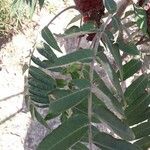
Rhus typhina
سماق آمریکایی · Stag's-horn Sumac · Staghorn sumac · Vinegar tree · Virginia sumac
Description
Source: leafsnapRhus typhina, commonly known as staghorn sumac, is a deciduous shrub or small tree native to North America. It typically grows to a height of 15-25 feet and features a spreading, open crown. The leaves are pinnately compound with serrated edges, and each lance-shaped leaflet can grow up to 12 inches long. In the fall, the foliage turns brilliant shades of red and orange. The most distinctive feature of Rhus typhina is its fuzzy red fruit clusters, which resemble velvet antlers or staghorn branches. These clusters persist through the winter months after the leaves have fallen. Staghorn sumac prefers full sun to partial shade and well-drained soil, but it can tolerate poor soil conditions such as rocky or sandy soils. Once established, it is also drought-tolerant. Native Americans have used this plant for medicinal purposes for centuries, owing to its anti-inflammatory properties. The fruit clusters can also be used in cooking as a spice or to make tea. Overall, Rhus typhina is an attractive plant with unique features, making it an interesting addition to any landscape design. It also has practical uses in traditional medicine and culinary arts.
🌳 Staghorn sumac is especially notable among plants for its broad range of uses. It’s not only attractive but also offers a variety of often-overlooked applications. Native North American tribes used it to produce natural dyes and to soften leather, and its ripe berries are made into a tangy "Indian lemonade." Most notably, staghorn sumac is increasingly being considered in energy circles as a potential biofuel, highlighting its role in sustainable energy solutions.
🎭 Affection and compassion, renewal
Care Guide
💧 Water Every 7 days
Staghorn sumac thrives in temperate regions and prefers consistent moisture, although it can tolerate short dry spells. To ensure healthy growth, water the plant every 1-2 weeks, keeping the soil evenly moist but not waterlogged. Typically grown outdoors, staghorn sumac does well in climates that experience seasonal rains during its active growth period.
When Should I Water My Staghorn Sumac?
The appropriate time to water staghorn sumac is essential for its health and vitality. Checking the top 1 to 2 inches of soil for dryness is a reliable indicator for when it's time to water. If the soil is dry to the touch, it needs water. However, it's important to avoid waterlogged soil and allow the soil to dry between waterings. Drooping or wilting leaves and a change in leaf color to a dull green or yellow are also signs that your staghorn sumac needs water. Environmental conditions, such as hot and dry weather or the growing season, might increase the plant's watering needs. Care should be taken to balance watering practices as both overwatering and underwatering can lead to issues that affect the plant's growth and health.
How Should I Water My Staghorn Sumac?
Watering staghorn sumac correctly involves several considerations to ensure optimal hydration without over-saturating the soil. Bottom-watering is an effective technique, allowing the plant to absorb moisture from the bottom up. For direct watering, using a watering can with a narrow spout helps direct water to the base of the plant and avoids wetting the foliage. Employing a moisture meter can guide the timing of your watering by accurately measuring the soil's moisture level. Additionally, implementing a mulching technique around the base of the plant helps retain soil moisture and reduces evaporation. Always monitor the moisture level of the soil and adjust watering frequency as needed, keeping in mind staghorn sumac's lower water requirements once it's well established.
How Much Water Does Staghorn Sumac Really Need?
Staghorn sumac's water needs depend on various factors including its size, the pot size, and the prevailing environmental conditions. A good practice is to water until water runs out of the bottom of the pot and then allow it to dry out before the next watering. This plant's ability to tolerate dry conditions once established means that the exact amount of water needed can vary. Observe your plant closely: if it's healthy, with vigorous growth and richly colored leaves, you're likely watering correctly. Signs of either under-watering or over-watering include wilting, yellowing leaves, slow growth, or the development of root rot. Proper watering ensures the plant's healthy growth by balancing moisture availability.
What Kind of Water is Best for Staghorn Sumac?
Staghorn sumac thrives best when watered with rainwater, as it is natural, free of chemicals, and has a balanced pH level. Distilled or filtered water are suitable alternatives, ensuring harmful contaminants are removed. Tap water is acceptable if other options are unavailable, but it should be treated to remove chlorine due to the plant's sensitivity to it. Letting tap water sit for 24 hours allows chlorine to evaporate, making it safer for the plant. Staghorn sumac generally prefers water at room temperature to avoid shock from extreme temperatures.
How Do Staghorn Sumac's Watering Needs Change with the Seasons?
Staghorn sumac's watering needs vary significantly across the seasons. In spring, the beginning of the growing season, the plant benefits from ample water to support new growth. Summer's heat increases evaporation, necessitating consistent watering without causing waterlog, and watering is best done in the early morning or late evening. By autumn, the plant's need for water decreases as growth slows, and waterings should be based on soil dryness. Winter marks a period of dormancy for staghorn sumac, significantly reducing its watering needs. Water infrequently, only when the soil has dried out, to avoid both overwatering and underwatering.
☀️ Light Full sun
For healthy growth, staghorn sumac requires a considerable amount of daylight. It mainly prospers in locations with plenty of sun but can also tolerate areas with moderate exposure. Its native habitat is bright, which shapes its sunlight preferences. Too little light can weaken it, while too much exposure may cause harm.
What are the sunlight requirements for Staghorn Sumac?
Staghorn Sumac thrives in locations with an abundance of sunlight but can also adapt well to moderately lit areas. It requires exposure to a significant amount of daylight to maintain healthy growth, originating from well-lit habitats. Full sun is defined as above 6 hours of sunlight, while partial sun refers to about 3-6 hours of sunlight daily. Observing how sunlight moves through your garden and selecting spots that offer a good balance of light and shade can ensure the optimal growth and happiness of your Staghorn Sumac plants.
How can artificial lighting be used for Staghorn Sumac?
When natural sunlight is not sufficient, especially during winter or in less sunny spaces, artificial lighting serves as an essential alternative for Staghorn Sumac's growth. For optimal growth under artificial lights, it's advisable to choose the right type of light, like LED, which can be customized to provide necessary wavelengths. Full sun plants need 30-50W per square foot, partial sun plants require 20-30W per square foot, and full shade plants should have 10-20W per square foot. The artificial light source should be placed 12-36 inches above the plant, simulating natural sunlight as closely as possible, and it should mimic natural daylight hours, usually needing 8-12 hours of light per day.
What are the symptoms of incorrect lighting for Staghorn Sumac?
Staghorn Sumac displays various symptoms when experiencing unsuitable lighting conditions. In low light, it may develop smaller new leaves, show leggy or sparse growth, experience faster leaf drop, and have slower or halted new growth. Leaves might turn lighter in color or exhibit chlorosis, a condition where leaves lose their green color and turn yellow. In case of excessive sunlight exposure, symptoms like sunscald, leaf curling, wilting, and leaf scorching can occur, which are indicators of damage due to intense light.
What solutions are recommended for Staghorn Sumac experiencing light-related issues?
To address light-related issues in Staghorn Sumac, gradual adaptation to the correct light conditions is key. For indoor plants, steadily moving them to sunnier spots each week until they receive at least 6 hours of direct sunlight daily is recommended. Artificial lighting, such as desk lamps or professional grow lights, can also provide additional light. Outdoors, it's important to move plants gradually to sunny areas to prevent shock and sunburn. Pruning trees to reduce shade or transplanting to sunnier locations are effective strategies. However, it's crucial to note that parts of the plant affected by insufficient sunlight may not recover, but new growth will be healthier with proper light exposure.
🌡️ Temperature 0–32.2°C
Staghorn sumac prefers growing in its native climate where temperatures range from -13 to 90 ℉ (-25 to 32 ℃). It does best when temperatures are 32 to 77 ℉ (0 to 25 ℃) and can withstand lows down to -13 ℉ (-25 ℃). In summer, frequent watering is recommended to help it cope with heat up to 90 ℉ (32 ℃).
What are the essential growing conditions for Staghorn sumac?
Staghorn sumac thrives best in its native growth environment with a temperature range of -13 to 90°F (-25 to 32°C), ideally between 32 to 77°F (0 to 25°C). It has strong cold resistance and can tolerate temperatures as low as -13°F (-25°C). During summer, to adjust to temperatures up to 90°F (32°C), it is recommended to water the plant frequently. Although staghorn sumac doesn't usually require special frost protection measures during winter, if temperatures are expected to drop significantly below the growth limit, it's important to wrap the trunk and branches with materials like non-woven fabric or cloth. Additionally, before the first freeze in autumn, watering the plant abundantly to keep the soil moist can prevent drought and water scarcity during winter and early spring.
How does staghorn sumac respond to low temperatures, and what are the solutions if damage occurs?
Staghorn sumac is notably cold-tolerant and fares best when temperatures are kept above the minimum tolerable limits. During winter, it should remain above these temperatures to avoid damage. If the temperatures fall below the plant's growth limit, while there may not be immediate visible changes during the winter, the branches could become brittle and dry come spring, resulting in no new shoots. The recommended solution for this is to prune away any dead branches that failed to produce new leaves in spring.
How does staghorn sumac react to high temperatures, and what measures should be taken for protection?
During the summer, it is crucial to ensure that staghorn sumac is not exposed to temperatures exceeding its maximum tolerable limits. Exceeding these temperatures can lead to lighter colored leaves, dry and withered tips, and increased susceptibility to sunburn. To protect the plant, remove sunburned and dried parts. Relocate the plant to a shaded area or use a shade cloth to shield it from the midday and afternoon sun. Additionally, watering the plant in the morning and evening helps maintain soil moisture and protect the plant.
💨 Humidity
🪴 Soil 6-7
🌱 Fertilizer
To encourage healthy development, fertilize your Staghorn sumac in early spring. Regular feeding improves overall health, producing vigorous growth, greater tolerance of harsh conditions, and increased resistance to diseases and pests. Follow a specific fertilization schedule for your Staghorn sumac to keep the foliage vibrant, deeply colored, and lush.
Why should I add fertilizer to my Staghorn sumac plant?
To ensure the overall health of your Staghorn sumac, it is important to regularly fertilize it regardless of the variety you own. Providing the right nutrients will promote stronger growth and enhance its ability to resist tough conditions, diseases, and pests. Maintaining the attractive foliage of your Staghorn sumac is also crucial. This can be achieved by following a consistent fertilization schedule specifically designed for your plant, which will result in vibrant leaves and a lush appearance.
When should I put fertilizer on my Staghorn sumac?
To ensure your Staghorn sumac thrives, start fertilizing it in late winter or early spring, giving it the necessary nutrients to grow strongly when the weather warms up. In warm climate regions, it's helpful to fertilize again in early fall. This not only provides additional nutrients for the following growing season but also helps the plant withstand the cold winter without leaf damage. Fertilizing earlier in the year ensures the branches have enough time to strengthen and withstand the winter chill.
When is the best time to not use fertilizer on my Staghorn sumac?
There are specific times during the year when you should not fertilize your Staghorn sumac. The first occasion is during the early and mid-winter months when the plant is dormant and does not require feeding. It is also not recommended to fertilize the plant during late spring and throughout the summer. This is because the weather tends to be hot and dry during that time, which can have a harmful effect on the Staghorn sumac if fertilized. To avoid any issues, it is best to follow a fertilization schedule that only includes feeding in early spring and early fall.
What kind of fertilizer does my Staghorn sumac require?
Staghorn sumacs primarily require nitrogen for their growth, but this doesn't mean that phosphorus and potassium are unimportant. In fact, these three nutrients are all necessary for the sumac's well-being. To provide a balanced diet, a fertilizer like 10-10-10 is a good choice. However, for optimal growth, a more specific nutrient ratio can be beneficial. Typically, fertilizers with slightly higher nitrogen content, like 10-6-4, tend to yield better results. You can choose between granular or liquid fertilizers when applying them.
How can I fertilize my Staghorn sumac plant?
To fertilize your Staghorn sumac, you have two options: granular fertilizer or liquid fertilizer. If you choose granular fertilizer, simply sprinkle it on the soil at the correct time. The slow-release nature of granular fertilizer gradually releases nutrients into the soil. It's a good idea to lightly water your Staghorn sumac before applying the fertilizer. Alternatively, you can use liquid fertilizer, although this is less common. To do this, mix the fertilizer with water and then pour the mixture around the base of your Staghorn sumac. Before fertilizing, it can be helpful to perform a soil test to determine if any adjustments to the pH are needed.
🪴 Pot & Repot 2-3 years
When repotting Staghorn sumac, pick a pot 1-2 inches (2.5–5.1 cm) larger that has good drainage. Use a well-draining potting mix. Repot in spring or fall, making sure the root ball sits slightly lower than the rim of the flower pot. Water thoroughly after repotting and place the plant in a warm spot with indirect sunlight.
✂️ Pruning
Staghorn sumac is renowned for its beautiful autumn colors and benefits greatly from proper pruning. Key techniques include removing dead wood, thinning out branches, and maintaining a balanced shape. The ideal time for pruning is early spring, which encourages growth, prevents disease, and improves the plant's overall appearance.
🌿 Propagating
🐛 Diseases & pets
☠️ Toxicity
Characteristics
- Plant Type
- Tree, Shrub
- Life Cycle
- Perennial
- Genus
- Rhus
- Family
- Anacardiaceae
- Hardiness Zone
- 3-8
- Mature Height
- 4.88 m to 11.89 m
- Mature Spread
- 6.1 m
- Leaf Color
- Green, Red, Orange
- Leaf Type
- Deciduous
- Flower Color
- Green, Yellow, Red
- Flower Size
- 4.06 cm to 6.35 cm
- Bloom Time
- Early summer, Mid summer
- Planting Time
- Spring, Autumn
- Harvest Time
- Mid summer, Late summer, Fall
- Native Area
- Continental US, Southern Canada