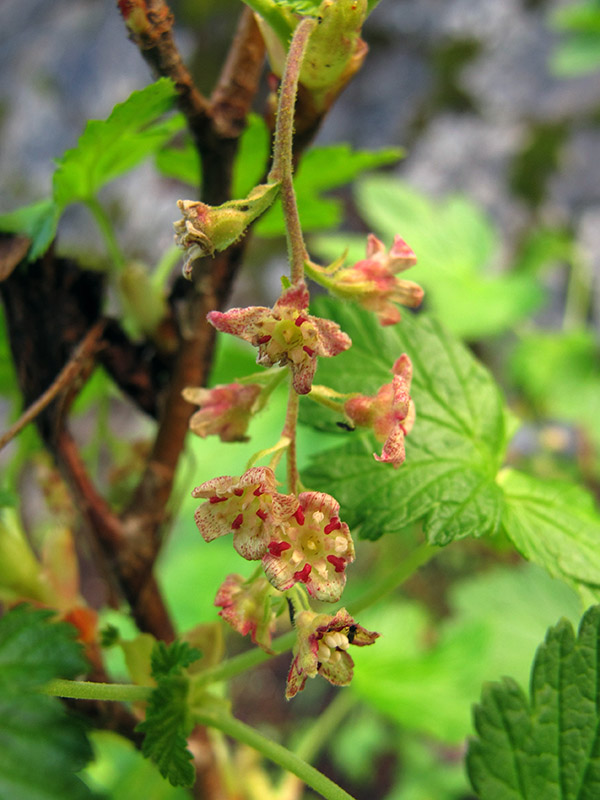
Ribes acerifolium
Mapleleaf currant · Maple-leaved currant · Maple-leaved black currant
Description
Source: leafsnapRibes acerifolium is a North American species of currant known by the common names mapleleaf currant and maple-leaved currant. It is native to the Canadian Province of British Columbia as well as to the northwestern United States (Washington, Idaho, Oregon).Ribes acerifolium is a trailing shrub up to 100 cm (40 inches) tall, with red or pink flowers and black berries.
🌳 In addition to being a pleasant fresh snack, red currants are transformed into tasty jams, jellies, and syrups that are popular in culinary traditions. They also have a subtle but important role in the making of certain high-quality liqueurs, contributing their distinctive tart-yet-sweet flavor that is often overshadowed by more common fruits.
🎭 Fixation, envy, peril, dread fury
Care Guide
💧 Water
☀️ Light Full sun
Red currant grows best with plenty of sunlight, though it can tolerate a significant lack of light. In its native habitat there is abundant sun, which promotes vigorous growth. Conversely, too much sunlight can cause wilting, while insufficient illumination may lead to stunted development.
🌡️ Temperature 5–32.2°C
Red currant temperature preferences match those of its native growth areas, which extend from mild to subarctic. The plant favors temperatures between 41 and 89 °F (5 and 32 °C). In summer, it benefits from temperature adjustments—being kept in a cooler spot to prevent heat stress.
💨 Humidity
🪴 Soil 6-6
🌱 Fertilizer
The red currant plant needs adequate nutrients to achieve optimal fruit production. Fertilize in early spring to encourage new growth and bloom development. Regular fertilization helps the plant stay healthy, produce more flavorful fruit, and prevents nutrient deficiency issues like yellow leaves and poor fruit production.
🪴 Pot & Repot 2-3 years
When repotting Red currant, select a pot 1–2 inches (2.5–5.1 cm) larger with ample drainage. Use a well-draining, potting mix. Repot in spring or fall, ensuring that the root ball is slightly lower than the rim of the flower pot. Water thoroughly after repotting and place in a warm spot with indirect sunlight.
✂️ Pruning
🌿 Propagating
🐛 Diseases & pets
☠️ Toxicity
Characteristics
- Plant Type
- Shrub
- Life Cycle
- Perennial
- Genus
- Ribes
- Family
- Grossulariaceae
- Hardiness Zone
- 4-8
- Mature Height
- 0.91 m to 2.13 m
- Mature Spread
- 0.91 m to 1.22 m
- Leaf Color
- Green
- Leaf Type
- Deciduous
- Flower Color
- Green, Yellow, White
- Flower Size
- 0.51 cm to 0.76 cm
- Bloom Time
- Mid spring, Late spring
- Planting Time
- Spring, Autumn
- Harvest Time
- Early summer, Mid summer
- Native Area
- Germany, Turkey, Italy, Netherlands, Hungary, Croatia, Slovenia, Belgium, France