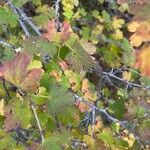
Ribes divaricatum
Wild black gooseberry · Coast gooseberry · Coastal black gooseberry · Spreading gooseberry · Straggly gooseberry
Description
Source: leafsnapRibes divaricatum, commonly known as the spreading gooseberry, is a deciduous shrub native to western North America. It typically reaches a height of 1-2 meters and has an open, spreading habit with arching branches. The dark green leaves are lobed and toothed, turning yellow in the fall. Small, pinkish-red flowers appear in clusters along the branches from late winter to early spring, before the leaves emerge. The fruit is an edible berry that ripens from green to red or black in late summer or early fall. This plant prefers moist soils and partial shade but can tolerate full sun if given adequate water. It is commonly found growing along streamsides or on forest edges but can also be used as an ornamental plant in landscaping due to its attractive foliage and flowers. In addition to its ornamental value, Ribes divaricatum has been used for medicinal purposes by indigenous peoples of North America to treat various ailments such as colds, coughs, sore throats, and fever. The fruit is also used in culinary applications, such as making jams or pies. Overall, Ribes divaricatum is a versatile plant with both aesthetic appeal and practical uses, making it a valuable addition to any garden or landscape design project.
Care Guide
💧 Water Every 7 days
For optimal growth and fruit development, spreading gooseberries require more frequent watering during mid-spring, late spring, and early summer. It's also important to adjust watering based on the weather and soil moisture levels. Make sure to water the plants when the soil surface has dried out completely, especially from spring through mid-summer.
☀️ Light Partial sun
Spreading gooseberry naturally occurs in habitats like forest understories or rocky sites, where it grows in natural shade. It prefers partial sun but can tolerate full sun or full shade, showing its adaptable, hardy nature.
What are the sun requirements for Spreading Gooseberry (Ribes divaricatum)?
The Spreading Gooseberry, or Ribes divaricatum, has specific sun needs to thrive. For full sun exposure, it requires above 6 hours of sunlight daily. If the plant is in partial sun, then it should receive about 3-6 hours of sunlight. It's important to observe how sunlight moves throughout your garden over the day to find spots that offer an ideal balance of light and shade. This careful selection will ensure that your Spreading Gooseberry plants remain healthy and happy.
🌡️ Temperature 5–32.2°C
Spreading gooseberry shows strong tolerance to a wide range of climates, from very hot summers to cold winters. Still, it requires an optimal temperature range for growth. If temperatures become too high, the plant is vulnerable to heat and humidity stress, which can lead to its death. In areas where temperatures approach the lower limit of its cold tolerance, it is important to provide insulation to protect the plant.
What is the botanical name of Spreading Gooseberry?
The botanical name of Spreading Gooseberry is Ribes divaricatum.
💨 Humidity
🪴 Soil 6-7
🌱 Fertilizer
The spreading gooseberry plant needs adequate nutrients for the best fruit production. Fertilize in early spring to support new growth and flower development. Regular feeding keeps the plant healthy, results in more tasty fruit, and prevents nutrient deficiency problems like yellowing leaves and poor fruit yield.
🪴 Pot & Repot
✂️ Pruning
To ensure healthy and productive gooseberry plants, it's important to prune them in early spring. Start by removing any weak branches and shaping the plant. This helps improve its structure. Additionally, thinning out crowded areas enhances air circulation, which reduces the risk of disease. Pruning after the harvest is also beneficial, as it boosts yield and overall plant health. By following these practices, you can increase fruit production and maintain a robust, attractive plant.
🌿 Propagating
🐛 Diseases & pets
☠️ Toxicity
Characteristics
- Plant Type
- Shrub
- Life Cycle
- Perennial
- Genus
- Ribes
- Family
- Grossulariaceae
- Hardiness Zone
- 5-8
- Mature Height
- 0.91 m to 2.74 m
- Mature Spread
- 0.91 m to 2.13 m
- Leaf Color
- Green, Dark Green
- Leaf Type
- Deciduous
- Flower Color
- White, Lavender
- Flower Size
- 1.02 cm to 1.52 cm
- Bloom Time
- Early spring, Mid spring
- Planting Time
- Spring, Summer
- Harvest Time
- Mid summer, Late summer