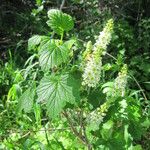
Ribes hudsonianum
Northern black currant · Western black currant · Hudson Bay currant · Stinking currant · Wild black currant
Description
Source: leafsnapRibes hudsonianum is a North American species of currant, known by the common name northern black currant. Ribes hudsonianum grows in moist wooded areas, such as mountain streambanks and in swamp thickets. They are upright to erect shrubs growing one half to 2 meters (20-80 inches) tall. They are aromatic, with a strong scent generally considered unpleasant. Stems are covered in shiny, yellow resin glands that lack spines or prickles. Leaves are up to 10 centimeters long, divided into three, or rarely five, sharp-toothed lobes, having long hairs on the undersides, studded with yellow glands. Inflorescences are erect, spikelike racemes of up to 50 flowers. Each flower is roughly tubular, with the whitish sepals spreading open to reveal smaller whitish petals within. Fruits are bitter-tasting, black berries, about a centimeter (0.4 inch) wide with a waxy surface, speckled with yellow glands. While bitter, they are edible.The species is divided into two varieties, each known simultaneously as northern black currants, and by their own individual common, and scientific names; the type variety, R. h. var. hudsonianum, is also known as the Hudson Bay currant; whereas R. h. var. petiolare is also known as the western black currant.Hudson Bay currants are found in every province in Canada from Quebec westward; and parts of the United States (Alaska, the Great Lakes region, the northern Rockies, Cascades, Blue Mountains, and other parts of the Northwest).Although Western black currants are found in British Columbia, they are distributed primarily south of Canada in the western U.S. (Wyoming, Montana, Idaho, Washington, Oregon, northern Nevada, northern California, and Utah).The only states or provinces where both varieties are present are British Columbia in Canada; and the U.S. states of Idaho and Washington.
Care Guide
💧 Water Every 7 days
For the best growth of northern black currants, it's important to increase watering during mid-spring, late spring, and early summer. Be sure to adjust the watering schedule based on the weather conditions and soil moisture levels. Water the plants whenever the surface soil becomes completely dry between spring and mid-summer.
☀️ Light Partial sun
Northern black currant occurs naturally in habitats like forest understories and rocky sites, where it grows under natural shade. It prefers partial sun but can tolerate both full sun and full shade, highlighting its hardy and adaptable nature.
What are the sunlight requirements for Northern black currant (Ribes hudsonianum)?
Northern black currant (Ribes hudsonianum) thrives in conditions where it can receive varying amounts of sunlight throughout the day. It requires full sun, which is defined as over 6 hours of sunlight daily, for optimal growth. Alternatively, it can also prosper in partial sun, needing about 3-6 hours of sunlight. It's important to observe the way sunlight moves through your garden, enabling you to select locations that provide a harmonious balance of light and shade, which is crucial for the well-being of your plants.
🌡️ Temperature 0–32.2°C
Northern black currant occurs in northern regions and in high-mountain zones. It is highly sensitive to temperature, preferring cool conditions and good airflow during summer. Excessive summer heat can damage Northern black currant and may even kill it. Providing suitable shade and regular misting in the hot summer months helps it endure the season. Generally, Northern black currant does not need specific winter protection, but it is important to water it sufficiently before the ground freezes.
What is Northern black currant?
Northern black currant, scientifically known as Ribes hudsonianum, is a plant species. However, specific details about its characteristics, essential information, or symptoms it may cause or treat were not provided. This entry solely identifies the plant by its common and botanical names without further elaboration on its uses, habitat, or any other relevant details.
💨 Humidity
🪴 Soil 6-8
🌱 Fertilizer
The timing of fertilizing Northern black currant is critical. Apply fertilizer in early spring and then every month until early summer. Fertilizer promotes attractive blooms and supplies energy both during dormancy and throughout active growth.
🪴 Pot & Repot
✂️ Pruning
The Northern black currant is a deciduous shrub known for its dark berries and clustered blooms. To ensure healthy growth, prune the shrub in early spring by removing dead wood and thinning out older canes. Maintaining an open center is also important for improving air circulation. Regular yearly pruning helps enhance the plant's vigor and increase berry production.
🌿 Propagating
🐛 Diseases & pets
☠️ Toxicity
Characteristics
- Plant Type
- Shrub
- Life Cycle
- Perennial
- Genus
- Ribes
- Family
- Grossulariaceae
- Hardiness Zone
- 2-7
- Mature Height
- 0.61 m to 1.52 m
- Mature Spread
- 0.91 m to 1.52 m
- Leaf Color
- Green, Dark Green
- Leaf Type
- Deciduous
- Flower Color
- White
- Flower Size
- 0.51 cm to 0.76 cm
- Bloom Time
- Early spring, Mid spring
- Planting Time
- Spring, Summer, Autumn
- Harvest Time
- Mid summer, Late summer, Early fall