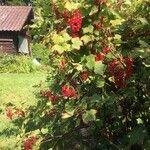
Ribes rubrum
Garden currant · Garden red currant · Red garden currant · Common currant · Red currant
Description
Source: leafsnapRibes rubrum, commonly known as red currant, is a deciduous shrub belonging to the Grossulariaceae family. Native to Europe and Asia, this plant has been cultivated for its edible fruit for centuries. It typically grows to a height of 1-2 meters and has a spreading habit with multiple stems. The leaves of Ribes rubrum are alternate, simple, and palmately lobed with three to five lobes. They are dark green in color and have a slightly hairy texture on the upper surface. The flowers of Ribes rubrum are small and greenish-yellow, appearing in clusters on the branches before the leaves emerge. The fruit is a small berry that ranges in color from bright red to dark purple when ripe. Red currants prefer cool climates but can tolerate some heat if provided with adequate moisture. They grow best in well-drained soil that is rich in organic matter. Red currants are highly nutritious, containing vitamins C and K as well as minerals such as potassium and iron. They can be eaten fresh or used to make jams, jellies, or sauces. Overall, the Ribes rubrum plant makes an excellent addition to any garden due to its attractive foliage and delicious fruits, which offer numerous health benefits. This makes it an ideal choice for gardeners seeking both beauty and utility from their plants.
🌳 In addition to being a pleasant fresh snack, red currants are transformed into tasty jams, jellies, and syrups that are popular in culinary traditions. They also have a subtle but important role in the making of certain high-quality liqueurs, contributing their distinctive tart-yet-sweet flavor that is often overshadowed by more common fruits.
🎭 Fixation, envy, peril, dread fury
Care Guide
💧 Water Every 7 days
Redcurrant plants, which originate from cool temperate regions, thrive in environments with moderate humidity and consistent moisture. To keep the soil lightly moist, water them once every 1-2 weeks. During the cooler months, increase watering to support flowering, mimicking their natural spring rain conditions.
How should I water my Redcurrant plant?
To ensure excellent root development, place a garden hose at the base of the plant instead of spraying the leaves directly. If the plant is exposed to direct sunlight outdoors, the leaves will need more water. You can use bubblers to moisten the roots of each plant, or use soaker hoses that cover the whole garden or bed. When adding or removing plants, make sure to water deeply to encourage deep root growth. Drain any excess water and wait for the soil to dry before watering again. To prevent diseases, water the plants at ground level rather than spraying from above. On a sunny day, it may be beneficial to spray the entire bush with water. Whether the Redcurrant plant is in a pot or in the ground, remember that it prefers deep watering rather than light sprinkling.
What should I do if I give Redcurrant plants too much or too little water?
If a Redcurrant plant is overwatered, it can exhibit several signs such as yellowing leaves, leaf drop, and wilting. The plant may also look dull and unhealthy, with mushy stems. It is recommended to adjust your watering schedule when these signs start to appear. On the other hand, wilting can also indicate under watering, which can be identified by crispy and dry leaves. In such cases, watering the plant thoroughly when the soil is dry is necessary. While sufficient water will help the Redcurrant recover, the plant may still display dryness and yellow leaves a few days later due to damage to the root system. Once the plant returns to normal, the yellowing of leaves will cease. When keeping the Redcurrant indoors, always check the moisture levels in the pot and avoid overwatering. Look for any signs of black spots, and if present, allow the soil to dry out by refraining from watering for a few days. Overwatering can result in root rot, indicated by discolored and slimy roots. If root rot is detected, it is advisable to transfer the plant to a different pot and take measures to prevent further dampness in the soil. When planting a Redcurrant outdoors, ensure the soil is adequately moist by checking with your fingers. If the soil feels too dry, it may indicate under watering, and proper watering is essential for the plant's recovery.
How frequently should I give water to my Redcurrant?
The Redcurrant prefers deep and infrequent watering, especially when planted in pots. To ensure the soil does not dry out too quickly, it is recommended to soak them with a gallon of water each time. In colder regions, watering is required every 3 to 5 days. Outdoor or indoor, water in the morning when the soil is dry. Check the soil moisture by feeling the top 2-3 inches; if dry, water the plant fully. During hot days, check the soil daily as it can dry out quickly. If you have a garden, irrigation of the soil is necessary. In hot climates, water once a week when the top 2 to 3 inches of soil are dry. If there is an abundance of rainfall, additional watering may not be needed to prevent root rot. When growing Redcurrant outdoors, adding mulch can help retain water. Sandy soil drains faster, so more frequent watering is essential. Clay soil requires less frequent watering, and 2-3 days without water can be tolerated to prevent root rot. Keep track of watering dates on a calendar and look for drooping leaves as a sign that watering may be needed.
How much water should I give my Redcurrant plant?
The Redcurrant typically requires a gallon of water on a regular basis. For potted plants, water them deeply until the water starts dripping from the bottom of the pot. Allow the soil to dry before watering again. Use a water calculator or moisture meter to determine the amount given to your plant each week. During the flowering period, provide plenty of water but allow the moisture to evaporate to avoid root rot. If the Redcurrant is planted outside and has sufficient rainfall, it may not require additional watering. When the Redcurrant is young or newly planted, ensure it receives 1-2 inches of rain per week. As the Redcurrant grows, it can rely solely on rainfall. Only when it's extremely hot or there has been no rainfall for 2-3 weeks, consider watering the Redcurrant fully during cooler times of the day to prevent heat damage. Additional watering is needed during prolonged dry spells.
Should I change how often I water my Redcurrant plant depending on the time of year or the weather where I live?
The Redcurrant plants need outdoor exposure to rainfall, but if the weather remains persistently dry, you will need to water them. During the spring and fall growing seasons, the soil should be kept moist but not soggy. It's beneficial to alternate between dry and moist soil conditions to promote healthy growth. In the summer, hot weather can cause water to evaporate quickly, so you may need to water the plants more frequently to keep the soil moist. In winter, the Redcurrant plants require less water as they lose their leaves and enter a dormant state. To aid in water evaporation, you can use a well-draining soil mixture like terracotta. Once the plants leaf out in spring and go dormant again, you can rely on fall and winter rains to keep them viable without additional watering. Adequate drainage is crucial for Redcurrant plants, especially during winter when they dislike sitting in water. If you have the plants in pots, their root growth will be limited, so ensure they are watered properly, particularly during summer. For best results, water the entire root system deeply once or twice a week, based on the weather conditions. Avoid shallow sprinkles that only reach the leaves as they can encourage fungal growth and may not properly hydrate the roots. Even during dormancy in the fall and winter, do not let the plants dry out completely. Over-watering should also be avoided as the plants can suffer if the soil does not drain well, especially in winter. Applying mulch whenever possible helps reduce stress, conserve water, and support healthy blooming.
☀️ Light Full sun
Red currant grows best with plenty of sunlight, though it can tolerate a significant lack of light. In its native habitat there is abundant sun, which promotes vigorous growth. Conversely, too much sunlight can cause wilting, while insufficient illumination may lead to stunted development.
What are the sunlight requirements for Redcurrant?
Redcurrant thrives best under full sun, needing more than 6 hours of sunlight daily, but it can also grow under partial sun, which is about 3-6 hours of sunlight. It's essential to observe your garden's sunlight patterns to find the perfect spot that provides a good balance of light and shade, ensuring the plant's health and happiness.
How important is sunlight for the growth of Redcurrant plants?
Sunlight plays a crucial role in the growth of Redcurrant plants. These plants flourish most in abundant daylight but can tolerate some absence of it. Originating from habitats with copious sunlight, they demonstrate vigorous growth under ideal light conditions. However, too much sunlight can lead to wilting, while insufficient light may cause stunted growth. For indoor plants, artificial lighting can be a vital solution to provide optimal growth conditions when natural sunlight is lacking.
What artificial lighting requirements do indoor Redcurrant plants have?
Indoor Redcurrant plants require adequate lighting for optimal growth, especially when natural sunlight is insufficient. Artificial lights, such as LED lights, are recommended because they can be customized to provide specific wavelengths needed by the plants. For full sun plants, 30-50W/sq ft of artificial light is necessary, while partial sun plants need 20-30W/sq ft, and full shade plants require 10-20W/sq ft. The light source should be placed 12-36 inches above the plant to mimic natural sunlight, with the duration mimicking natural daylight hours, generally 8-12 hours per day.
What are the symptoms of light deficiency in Redcurrant plants?
Redcurrant plants may show several symptoms when they receive insufficient light, including small leaves that are smaller than previous ones, leggy or sparse growth with longer spaces between leaves or stems, faster leaf drop, slower or no growth as the plant enters survival mode, and lighter-colored new leaves due to a lack of chlorophyll. These symptoms indicate that the plant is not receiving enough sunlight.
How can you address sunlight-related issues in Redcurrant plants?
To address insufficient sunlight, gradually move your Redcurrant plants to a sunnier location, ensuring at least 6 hours of direct sunlight daily if indoors, use a south-facing window or artificial lights for additional light. For outdoor plants, finding the best sunlight spot is crucial, and moving the plants gradually to avoid sunburn is recommended. Reducing obstructions, like pruning trees, can also help increase sunlight exposure. If necessary, transplant smaller plants during their dormant period to a brighter location.
🌡️ Temperature 5–32.2°C
Red currant temperature preferences match those of its native growth areas, which extend from mild to subarctic. The plant favors temperatures between 41 and 89 °F (5 and 32 °C). In summer, it benefits from temperature adjustments—being kept in a cooler spot to prevent heat stress.
What temperature is best for Redcurrant?
The ideal temperature for Redcurrant to thrive is between 65 to 80 degrees Fahrenheit (18 to 27 degrees Celsius). During the main growing period, the maximum tolerable temperature is 95 degrees Fahrenheit (35 degrees Celsius), while the minimum tolerable temperature is 15 degrees Fahrenheit (-10 degrees Celsius). This species can handle low temperatures and survive freezing winters. The recommended temperature ranges are as follows: Perfect: 65 to 80 degrees Fahrenheit (18 to 27 degrees Celsius), Highest: 85 to 95 degrees Fahrenheit (30 to 35 degrees Celsius), Lowest: -5 to 15 degrees Fahrenheit (-20 to -10 degrees Celsius) or colder.
Do I need to change the temperature for Redcurrant plants at different stages of growth?
According to research, Redcurrant plants may experience stunted growth when exposed to prolonged periods of high temperatures, especially during the development of axillary buds and the growth of main shoots. To promote healthy growth after germination or transplanting, it is recommended to maintain consistent and cooler temperatures, ideally around 65℉ (18℃).
How can I make sure Redcurrant stays warm during cold seasons?
Redcurrant can tolerate freezing temperatures if planted in the ground in areas where the winter temperature does not drop below 15℉ (-10℃). However, if they are planted in pots or containers, the roots must be shielded from the cold. This can be achieved by wrapping the container in a blanket or bringing it indoors for complete protection from the elements.
If the temperature is too high or low, what harm will happen to the Redcurrant?
Redcurrant is more likely to be harmed if the temperature is consistently too high rather than too low. When it gets too hot, the plant's ability to germinate seeds and efficiently conduct photosynthesis is reduced due to heat stress-triggered hormonal changes. This will be evident through signs like wilting, leaf browning, and, in some cases, plant death. On the other hand, if Redcurrant gets too cold, important plant functions such as nutrient uptake and photosynthesis will stop, potentially leading to the plant's demise. Even a single freezing event during the growing season can result in a phase transition in the plant's membrane, which can cause the same negative effects and ultimately lead to plant death.
What should I remember about temperature for Redcurrant?
To keep Redcurrant plants healthy and ensure successful budding, flowering, and new growth, it is crucial to maintain a consistent soil temperature. This can be achieved by regularly watering the plants, applying mulch to bare soil, and planting them in shaded areas.
💨 Humidity normal (40-60%)
This plant will thrive in moderate humidity, which is probably the level in your home. However, misting it a few times a week can be very beneficial. Make sure the room has good ventilation.
🪴 Soil 6-6
🌱 Fertilizer Every 110 days
The red currant plant needs adequate nutrients to achieve optimal fruit production. Fertilize in early spring to encourage new growth and bloom development. Regular fertilization helps the plant stay healthy, produce more flavorful fruit, and prevents nutrient deficiency issues like yellow leaves and poor fruit production.
Why should I put fertilizer on my Redcurrant plant?
Plants need nutrients to grow, and fast-growing plants can quickly deplete the soil of these nutrients. Redcurrant plants, in particular, benefit from regular fertilization to ensure they have enough nutrients to stay healthy and produce delicious fruit. When plants are not fertilized for a long time, they can encounter a variety of problems. The most common issue is yellow leaves caused by a lack of nutrients. Other signs of nutrient deficiency include reddish leaves, misshapen leaves, withered tips, or large portions of the plant dying back. Bark disorders, slow growth, poor shoot development, and a lack of fruit production are also possible effects of nutrient deficiency.
When should I fertilize my Redcurrant plant?
The best time to fertilize Redcurrant is in early spring, before the buds start to grow. During this period, Redcurrant uses its stored reserves from winter to support new growth. To ensure enough energy for bloom development, it is recommended to fertilize 2 to 4 weeks before the expected blooming period. This gives the nutrients enough time to soak into the soil and be absorbed by the plant. It is possible to continue feeding Redcurrant during spring, but it is not advised to fertilize in autumn as it may lead to excessive late-season foliage, making the leaves vulnerable to winter damage.
When is it not a good idea to put fertilizer on my Redcurrant plant?
To ensure proper growth and avoid potential harm, it is recommended to not fertilize Redcurrant in its first year and to be cautious with fertilizer use when it is not necessary. Similarly, refrain from fertilizing if the plant has been pruned by 20% or more in the previous year. Diseased or damaged plants should also be left unfertilized as it can do more harm than good. It's important to address the root cause of any issues before considering fertilizer as a solution. Another key guideline is to avoid fertilizing Redcurrant after the peak of summer as this may cause excessive growth before winter. Similarly, refrain from fertilizing during hot and dry times when the soil is dry, as the fertilizer may not be as effective and can stimulate growth that requires more water. It is best to apply fertilizer earlier in the season when temperatures are cooler. Lastly, keep in mind that Redcurrant can absorb fertilizer applied to nearby plants or lawns, so be cautious to avoid inadvertently giving plants a double dose of fertilizer.
What kind of plant food does my Redcurrant need?
Using fertilizer that contains a balance of nitrogen, phosphorus, and potassium can bring many benefits to plants. Nitrogen is important for leaf growth and chlorophyll production. Phosphorus helps support the root system and promotes the development of blossoms, fruits, and seeds. Potassium plays a role in photosynthesis and the movement of water and nutrients throughout the plant. When choosing a fertilizer, you can opt for a commercial one that is specifically designed for a particular type of tree. Alternatively, you can use organic sources of nitrogen such as manure, feather meal, or blood meal. To ensure you apply fertilizer accurately, conducting a soil test can give you a better understanding of the condition of your soil. For commercial fertilizers, if your soil lacks sufficient phosphorus and potassium according to the soil test, you can use a balanced granular fertilizer with a ratio of 10-10-10 or similar. In most cases, nitrogen in the soil is continuously depleted with rainfall. If your soil already has enough phosphorus and potassium, it would be more appropriate to use a high-nitrogen fertilizer with a ratio of 6-2-1 or 10-2-2.
How should I feed my Redcurrant plant?
When growing Redcurrant, it is important to follow specific directions for the type of fertilizer you are using. Over-fertilizing should be avoided, so determining the correct amount is crucial, especially for fruit trees. A general guideline is to use the age of the tree or the diameter of the trunk to determine how much fertilizer to use. As a rough estimate, use one-tenth of a pound of fertilizer per year or per inch of trunk, with a maximum of one pound. Remember that Redcurrant trees should not be fertilized in their early years. To apply granular or organic fertilizers, such as blood meal, sprinkle the substance around the base of the tree, extending all the way to the drip line (the area under the farthest-reaching branches). Avoid direct contact with the trunk. Over time, the granules will break down and seep into the soil, allowing the roots to absorb the nutrients. After fertilizing, spread a one-inch layer of compost around the base of the tree and thoroughly water it.
🪴 Pot & Repot 2-3 years
When repotting Red currant, select a pot 1–2 inches (2.5–5.1 cm) larger with ample drainage. Use a well-draining, potting mix. Repot in spring or fall, ensuring that the root ball is slightly lower than the rim of the flower pot. Water thoroughly after repotting and place in a warm spot with indirect sunlight.
✂️ Pruning
Redcurrants produce clusters of tart berries. To ensure optimal growth, prune them during early to late winter. Begin by removing dead wood, thinning out the branches, and reducing old growth by one-third each year. Always use clean tools to prevent disease, and make sure to prune back to a healthy bud to promote vigorous development.
🌿 Propagating
🐛 Diseases & pets
☠️ Toxicity
Characteristics
- Plant Type
- Shrub
- Life Cycle
- Perennial
- Genus
- Ribes
- Family
- Grossulariaceae
- Hardiness Zone
- 4-8
- Mature Height
- 0.91 m to 2.13 m
- Mature Spread
- 0.91 m to 1.22 m
- Leaf Color
- Green
- Leaf Type
- Deciduous
- Flower Color
- Green, Yellow, White
- Flower Size
- 0.51 cm to 0.76 cm
- Bloom Time
- Mid spring, Late spring
- Planting Time
- Spring, Autumn
- Harvest Time
- Early summer, Mid summer
- Native Area
- Germany, Turkey, Italy, Netherlands, Hungary, Croatia, Slovenia, Belgium, France