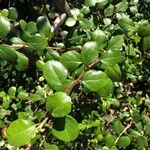
Ribes viburnifolium
Island gooseberry
Description
Source: leafsnapRibes viburnifolium, commonly known as evergreen currant, is a species of flowering plant in the Grossulariaceae family. This plant is native to California and is found in the coastal ranges and foothills from San Luis Obispo County to San Diego County. Typically, the evergreen currant grows up to 6 feet tall and 6 feet wide, forming a dense and rounded shape. Its leaves are dark green, glossy, and leathery, with slightly serrated edges. The small, pinkish-white flowers, each with five petals, bloom from late winter through early spring. Evergreen currants prefer well-drained soils rich in organic matter but can tolerate some drought once they are established. They are also resilient to coastal conditions, including salt spray. This plant is popular as an ornamental shrub, valued for its attractive foliage throughout the year. Additionally, it provides habitat for birds like hummingbirds, which feed on its nectar-rich flowers. Overall, Ribes viburnifolium is an excellent choice for gardeners seeking an appealing evergreen shrub that offers year-round interest and supports local wildlife populations.
Care Guide
💧 Water Every 7 days
The evergreen currant is well-suited for arid conditions. It requires minimal moisture and only needs to be watered every 2-3 weeks. Its drought tolerance and ability to retain water in its leaves enable it to thrive in areas with irregular rainfall. This makes it an excellent choice for an outdoor evergreen plant.
☀️ Light Full sun
Evergreen currant does best in locations where sunlight is plentiful and lasts throughout the day. It can tolerate partial shade, but insufficient light may cause stunted growth or generally poor health. Its native habitat is sun-drenched areas, and closely reproducing those conditions is essential for optimal results.
What are the sunlight requirements for Evergreen currant?
Evergreen currant requires abundant sunlight to thrive, with a preference for full sun exposure, which is above 6 hours of sunlight daily. It can tolerate partial sun, approximately 3-6 hours of sunlight, but inadequate light can lead to stunted growth or poor health. Therefore, it's essential to find spots in your garden that provide a perfect balance of light and shade, mimicking its native sun-drenched environments for optimal growth.
How can artificial lighting support indoor Evergreen currant plants?
Indoor Evergreen currant plants require adequate lighting for optimal growth, especially when natural sunlight is insufficient, such as in winter or less sunny spaces. Artificial lights, particularly LED lights, are recommended because they can provide specific wavelengths needed by the plants. Full sun plants need 30-50W/sq ft, partial sun plants require 20-30W/sq ft, and full shade plants need 10-20W/sq ft of artificial light. The light source should be placed 12-36 inches above the plant for 8-12 hours per day to mimic natural sunlight.
What are the symptoms of insufficient light in Evergreen currant?
When Evergreen currant does not receive enough light, especially indoors during winter, several symptoms can appear. These include smaller new leaves, leggy or sparse growth, faster leaf drop, slower or no new growth, lighter-colored new leaves, chlorosis (leaves turning yellow), sunscald, leaf curling, wilting, and leaf scorching. These symptoms indicate light deficiency and potentially excessive sunlight exposure in some cases.
What solutions can address insufficient light for Evergreen currant?
To combat insufficient light for Evergreen currant, gradually move plants to sunnier locations, ensuring at least 6 hours of direct sunlight daily. For indoor plants, consider using artificial light if moving them isn't feasible, keeping lamps on for at least 8 hours daily or investing in professional grow lights. Outdoors, avoid sudden changes in light intensity to prevent sunburn. Reducing obstructions like trees can help, and transplanting smaller plants during their dormant period to a sunnier location can improve sunlight exposure.
🌡️ Temperature 20–35°C
Evergreen currant comes from milder-climate regions and performs best at temperatures of 68 to 95 °F (20 to 35 °C). In winter, keep it in surroundings warmer than 68 °F (20 °C) because it does not tolerate frost.
What is the ideal temperature range for Evergreen currant?
Evergreen currant, or Ribes viburnifolium, thrives best in milder climates, ideally between 68 to 95 °F (20 to 35 °C). It is important to keep the plant in environments above 68 °F (20 °C) during winter, as it is intolerant to frost. Although the plant has some cold tolerance and generally does not require additional measures when the temperature is above 0°C, precautions should be taken to protect it from temperatures below 0°C, such as wrapping the plant with appropriate materials.
How does Evergreen currant react to and recover from low temperatures?
Evergreen currant has moderate tolerance to low temperatures but performs best when the environment is above 20°C. In the event that temperatures fall below -5°C, the plant's leaves may droop, and in severe cases, wilt and eventually fall off. To aid recovery and protect the plant from future low temperatures, it's recommended to trim off frost-damaged parts, wrap the plant with materials like non-woven fabric or cloth, and construct a wind barrier.
What are the effects of high temperature on Evergreen currant and how can it be protected?
During the summer, it's crucial to keep the Evergreen currant below 35°C, as temperatures exceeding 41°C can result in lighter leaf color, dry and withered leaf tips, curled leaves, and increased susceptibility to sunburn. To protect the plant, trim away sunburned and dried-up parts, move it to a shaded location, or use shade cloth to protect it from the midday and afternoon sun. Additionally, watering the plant in the morning and evening helps keep the soil moist and aids in temperature management.
💨 Humidity
🪴 Soil 6-7
🌱 Fertilizer
Timing is important when fertilizing Evergreen currant. Apply fertilizer in early spring and continue monthly until early summer. Fertilizer encourages attractive blooms and supplies energy during both dormant and active growth periods.
🪴 Pot & Repot
✂️ Pruning
Evergreen currant benefits from pruning in late spring, particularly focusing on removing dead or damaged branches and doing some light shaping. Thinning out dense areas improves air circulation and increases sunlight exposure. To maintain its blooming potential, it's best to avoid heavy pruning. Pruning after the plant has flowered helps promote its health, vigor, and longevity.
🌿 Propagating
🐛 Diseases & pets
☠️ Toxicity
Characteristics
- Plant Type
- Shrub
- Life Cycle
- Perennial
- Genus
- Ribes
- Family
- Grossulariaceae
- Hardiness Zone
- 9-10
- Mature Height
- 61 cm to 91 cm
- Mature Spread
- 1.22 m to 1.83 m
- Leaf Color
- Dark Green
- Leaf Type
- Evergreen
- Flower Color
- Pink
- Flower Size
- 1.52 cm to 5.08 cm
- Bloom Time
- Late winter, Early spring
- Planting Time
- Autumn
- Harvest Time
- Late spring, Early summer
- Native Area
- Mexico