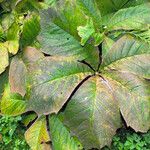
Rodgersia podophylla
Rodgersia · Rodger’s bronze leaf
Description
Source: leafsnapRodgersia podophylla is a species of flowering plant in the saxifrage family native to Japan and Korea. Growing to 2 m (6.6 ft) tall and broad, it is a herbaceous perennial with handsome spiky leaves, and occasional creamy-white flower panicles in June and July. It is extensively grown for ornamental use in gardens where it prefers damp shady positions on neutral to acid soils. Though hardy to −20 °C (−4 °F) it enjoys a sheltered location. It is chosen primarily for its clumps of large 5- or 7-toothed palmate leaves, which open bronze, turning green in summer and bronze-red in autumn. It can spread by underground rhizomes, eventually covering a large area. The compact cultivar ‘Rotlaub’ has gained the Royal Horticultural Society’s Award of Garden Merit.
🌳 Rodgersia's large, textured leaves and elongated flowers complement more delicate plants beautifully, adding definition to woodland gardens or areas near ponds and waterways. As its foliage transitions from bright green to bronze hues, it brings an extra splash of color to the autumn garden landscape.
Care Guide
💧 Water Every 1-2 weeks
Rodgersia thrives best in moist environments and needs to be watered every 1-2 weeks to maintain consistent moisture. Adding mulch around the plant helps retain soil moisture. Due to its large size and attractive foliage, Rodgersia is typically grown outdoors, reflecting its natural habitat in damp woodlands.
How should I water my Rodgersia plant?
To properly water the Rodgersia, it is recommended to use filtered water at room temperature. Tap water may contain harmful particles for this plant, so filtered water is a better choice. Since the Rodgersia is accustomed to warm environments, it is best to avoid using cold water as it can shock the plant. It is also advised to avoid overhead watering, as it can cause problems with the foliage. Instead, simply apply filtered room temperature water directly to the soil until it is thoroughly soaked. This helps moisten the roots and allows them to continue spreading and collecting necessary nutrients.
What should I do if I give too much or too little water to my Rodgersia plant?
Overwatering your Rodgersia can be harmful and is a more common issue compared to underwatering. When the plant receives too much water, its stems and leaves may wilt and turn yellow. Prolonged overwatering can also lead to diseases like root rot, mold, and mildew, which can be fatal to the plant. On the other hand, underwatering is less common due to the plant's drought tolerance. However, when underwatering does occur, the leaves can become brittle and brown. It is important to recognize the signs of overwatering early on, as some diseases like root rot may not be fixable if left unattended for too long. If you notice signs of overwatering, reduce your watering schedule immediately and consider replacing the poorly draining soil with a loose, well-draining potting mix. If your Rodgersia seems to be receiving too little water, increase your watering frequency until the symptoms improve.
How frequently should I water my Rodgersia?
If your Rodgersia plant is in a pot, the most accurate way to determine if it needs water is to stick your finger in the soil. If the top two to three inches of soil feels dry, it's time to water it. If you're growing your Rodgersia outdoors in the ground, you can use a similar method to check the soil. Again, if the top few inches of soil have dried out, it's time to water. Usually, during the spring and early fall, you'll need to water this plant about once a week using this approach. However, during extremely hot weather, you may need to water it twice or more per week. Nevertheless, mature, well-established Rodgersia plants have a remarkable ability to withstand periods of drought.
How often should I water my Rodgersia plant?
When watering your Rodgersia, it's important to give it a good amount of water. Make sure that the first two to three inches of soil are dry before watering. Give the plant a thorough watering, making sure the soil is completely soaked. You should add enough water so that it drains out of the pot's drainage holes. If you don't see any excess water draining, it means you haven't watered enough. However, be careful not to let water accumulate in the soil, as this can be harmful to the plant. On the other hand, if water doesn't drain well from the pot, it could indicate poorly draining soil, which is bad for the plant's health. If the plant is outside, it typically needs about 1 inch of rain per week.
How should I water my Rodgersia as it grows in different stages?
The water needs of the Rodgersia can vary depending on its growth stages. In the first few years or after transplanting, it requires more water to support the growth of new roots. These roots need extra moisture to develop properly. As the plant matures, it will require less water. Additionally, during the bloom period, the Rodgersia may need more water as the flowers use up a significant amount of moisture.
☀️ Light Partial sun
Rodgersia does best in sites that combine sun and shade. Continuous sun enhances its coloration, but prolonged exposure may cause stress. Native to locations where trees provide overhanging cover, it is accustomed to a balance of light and shade for healthy growth.
What are the sun requirements for Rodgersia plants?
Rodgersia plants thrive in conditions that offer a mix of sun and shade. They require partial sun, about 3-6 hours of sunlight, or full sun, which is above 6 hours of sunlight daily. The ideal environment for these plants is one that mimics their natural habitat, where trees provide an overhang, offering a balance of light and shade. This balance is essential for their health and growth. Observing how sunlight moves through your garden will help you choose the perfect spots that provide this balance, ensuring your Rodgersia plants' happiness.
How do I use artificial lighting for indoor Rodgersia plants?
Indoor Rodgersia plants require adequate lighting for optimal growth, especially when natural sunlight is insufficient. In such cases, artificial lights, such as LED lights, are highly recommended because they can offer the specific wavelengths of light that plants need. For full sun plants, 30-50W per square foot of artificial light is needed; partial sun plants require 20-30W per square foot, and full shade plants need 10-20W per square foot. The light source should be placed 12-36 inches above the plant to mimic natural sunlight, and the duration should mimic natural daylight hours, typically 8-12 hours per day. This setup is vital in promoting faster, healthier growth.
What are the symptoms of light deficiency in Rodgersia?
When Rodgersia is grown indoors with insufficient light, it may exhibit symptoms indicating light deficiency. These can include smaller new leaves compared to previous ones, leggy or sparse growth due to longer spaces between leaves or stems, faster leaf drop as the plant conserves resources, slower or halted growth, lighter-colored new leaves indicating a lack of chlorophyll, and signs of chlorosis where leaves lose their green color and turn yellow. Additionally, excessive sunlight can cause sunscald, leaf curling as a defense mechanism against sun exposure, wilting due to increased water loss, and leaf scorching characterized by brown, dry, and crispy leaf edges.
What are the solutions for Rodgersia experiencing light-related issues?
For indoor Rodgersia experiencing light deficiency, gradually shifting them to sunnier spots each week until they receive 3-6 hours of sunlight daily can help, as can using artificial light if the plant is large or not easily movable, with lights on for at least 8 hours daily. For outdoors, avoid drastic light intensity changes to prevent sunburn by gradually moving plants to sunnier spots each week. Minimizing obstructions, such as pruning trees that block sunlight, and transplanting smaller plants during their dormant period to locations with better sunlight and drainage, are effective solutions. Note, parts of the plant damaged by insufficient light may not recover fully, but new growth should be healthy after adjusting the light exposure.
🌡️ Temperature 15–32.2°C
Rodgersia is native to cooler climates and thrives in temperatures of 59 to 89.6 °F (15 to 32 ℃). To shield it from extreme cold or warm conditions, make seasonal adjustments such as providing shade in summer or adding insulation in winter.
What are the ideal growing conditions for Rodgersia?
Rodgersia thrives in cooler climates, ideally in temperatures ranging from 59 to 89.6 °F (15 to 32 °C). To help it cope with extreme temperatures, seasonal adjustments are essential. During summer, providing shade can protect it from heat, while during winter, it usually doesn't require special frost protection due to its strong cold resistance. However, in regions where temperatures are expected to fall below -15°C, additional cold protection should be provided by covering the plant with insulating materials like soil or straw. Additionally, watering the plant abundantly before the first freeze in autumn to ensure the soil remains moist can be beneficial. This helps mitigate drought stress and water scarcity during the colder months.
How does Rodgersia respond to low temperatures, and what should be done in spring for plants affected by cold?
Rodgersia is notable for its cold tolerance, optimally growing in temperatures above 15°C but maintaining resilience down to -10°C. If temperatures drop below -15°C, while there may not be immediate visible damage during the winter, there could be a noticeable decrease in sprouting or even no sprouting at all come spring. For such plants, it's recommended to remove any parts that have failed to sprout once spring arrives. This helps in promoting new growth and maintaining plant health.
What are the signs of high temperature stress in Rodgersia, and how can it be alleviated?
During the peak of summer, when temperatures exceed 32°C, Rodgersia can experience stress, manifested by leaves that may lighten in color, become prone to curling, show signs of sunburn, or in severe cases, lead to the wilting and drying out of the plant. To help alleviate high temperature stress, it's advisable to trim away the damaged portions to prevent further deterioration. Relocating the plant to a shaded area or utilizing shade cloth can protect it from direct sun, especially during the midday and afternoon. Ensuring the soil remains moist through morning and evening watering can also help reduce temperature-induced stress.
💨 Humidity
🪴 Soil 5-7
🌱 Fertilizer
For Rodgersia, the ideal time to apply fertilizer is early spring when flower buds are forming. The proper fertilizer promotes improved blooms and helps Rodgersia produce attractive flowers. Fertilizing in early spring ensures strong flowers during the season and supplies energy for dormant growth periods.
Why should I add fertilizer to my Rodgersia?
Fertilization is important for Rodgersia for several reasons. It provides essential nutrients for the plant's growth above and below ground. However, Rodgersia has relatively low fertilization needs and can survive without it. Yet, annual fertilization can greatly benefit the plant by keeping it alive and promoting better and longer-lasting flowers. Those who want their Rodgersia to look its best should make sure to fertilize it annually.
When should I fertilize my Rodgersia?
The best time to fertilize a Rodgersia is in late winter to early spring when it is transitioning from its dormant phase to active growth. Fertilizing at this time promotes healthy growth and sets the plant up for a successful season. While early spring is the most beneficial time, fall can also be acceptable for fertilization. However, it is not recommended to fertilize in summer or winter.
When is it a bad time to fertilize my Rodgersia plant?
To ensure proper fertilization for your Rodgersia plant, it is recommended to only fertilize during late winter and early spring. This plant has low fertilization needs, so a single annual feeding is sufficient. It is important to avoid overfertilization, which can easily occur if you continue fertilizing throughout spring, summer, and fall. The only exception is if you skipped fertilizing in spring, in which case it is acceptable to feed the plant in the fall. Additionally, there is no need to fertilize during the winter when the Rodgersia is in a dormant growth phase and does not produce new growth. Therefore, it is not advisable to fertilize during most of the winter.
Which fertilizer does my Rodgersia plant need?
For a Rodgersia, any general-purpose fertilizer with a balanced amount of the main plant nutrients will work well. However, some nutrient blends can provide even more benefits. Many gardeners believe that higher levels of phosphorus can lead to stronger roots and better flowers, which makes it a good approach for a flowering plant like Rodgersia. Granular or liquid fertilizers can be used as long as they contain ample nutrients. In addition to manufactured fertilizers, you can also opt for more organic methods to improve the soil for your Rodgersia. Compost, manure, and similar materials are effective in creating a healthy growing medium.
How can I help you fertilize your Rodgersia plant?
The most common way to fertilize a Rodgersia is by applying granular or pellet fertilizer to the soil around the plant. It's important to remember that the best time to fertilize is when the plant is transitioning from its winter dormant growth phase to a phase of active growth. In early spring, wait until the plant starts sending shoots through the soil, and then apply the fertilizer. Alternatively, some people might prefer using liquid fertilizer instead of granular. If you choose this option, make sure to dilute the fertilizer with water before applying it. Regardless of the type of fertilizer you use, it's always a good idea to moisten the soil before, during, and after application.
🪴 Pot & Repot
✂️ Pruning
Rodgersia is known for its large, palmate leaves and ornamental charm. To encourage healthy growth and improve air circulation, prune the plant from early to late spring. Start by removing any dead or damaged leaves. Be sure to use clean tools to prevent the spread of disease, and trim back any leggy stems to promote more robust foliage.
🌿 Propagating
🐛 Diseases & pets
☠️ Toxicity
Characteristics
- Plant Type
- Herb
- Life Cycle
- Perennial
- Genus
- Rodgersia
- Family
- Saxifragaceae
- Hardiness Zone
- 7
- Mature Height
- 2.13 m
- Mature Spread
- 2.13 m
- Leaf Color
- Green, Bronze, Red
- Leaf Type
- Deciduous
- Flower Color
- White, Pink
- Flower Size
- 2.54 cm
- Bloom Time
- Early summer, Mid summer
- Planting Time
- Spring
- Harvest Time
- Mid summer
- Native Area
- Koppen, Japan, South Korea, China