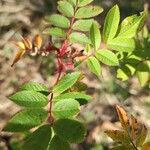
Rosa woodsii
Woods's rose · Wild rose · Wood's rose · Woods' Rose · Rosehip
Description
Source: leafsnapRosa woodsii, commonly known as Woods' rose, is a deciduous shrub native to North America. It typically reaches a height of 3 to 6 feet and features arching branches with thorny stems. The leaves are pinnately compound with 5 to 9 dark green, glossy leaflets. In late spring or early summer, the plant produces pink or white flowers, which are followed by red rose hips in the fall. Woods' rose commonly grows in open woods, meadows, and along stream banks throughout the western United States. It serves as an important food source for wildlife such as birds and small mammals, who either consume the fruit or use the shrub for cover. Native Americans have historically used the plant for medicinal purposes, including treating colds, sore throats, stomach ailments, and skin irritations. The roots were also used to make a tea believed to have healing properties. Woods' rose can be cultivated as an ornamental plant in gardens, appreciated for its attractive flowers and fruit. It prefers well-drained soil and full sun exposure but can tolerate some shade. Overall, Rosa woodsii is a significant native plant species that offers ecological benefits and holds cultural importance due to its traditional medicinal uses by Native Americans.
🌳 The wild-looking woods' rose shrub is an ideal choice for informal woodland and cottage gardens. It can serve as an accent to complement other plants or stand out as the main attraction in garden beds. Its beautiful roses, which are highly valued, bloom from late spring to early summer for a brief period. Even in winter, this shrub is striking, as its stems are adorned with bright red fruits.
🎭 Love, Psychic Abilities, Healing
Care Guide
💧 Water Every 7 days
Woods' rose thrives in conditions of balanced moisture and benefits from regular watering every one to two weeks. It is typically found outdoors, where its growth is closely tied to rainfall patterns. This plant flourishes best in its natural habitat with a moderate water supply.
What's the best way to water my Woods' rose plant?
To promote excellent root development, place a garden hose at the base of the plant. Avoid spraying the leaves directly, especially if they are outdoors and exposed to direct sunlight. Instead, focus on watering the roots. Bubblers can be used to moisten the roots of each plant individually. Soaker hoses are also a good option, as they can cover the entire garden or bed and ensure deep watering when adding or removing plants. After watering, drain any excess water and wait for the soil to dry before watering again. It is best to water at ground level to prevent diseases. On a sunny day, consider spraying the entire bush with water. Whether your rose is potted or in the ground, remember that Woods' rose prefers deep watering rather than light sprinkling.
If I give too much or too little water to Woods' rose, what should I do?
If a Woods' rose is overwatered, its leaves may turn yellow, drop off, and wilt. The plant may also appear dull and unhealthy, with mushy stems. Adjusting your watering schedule can help alleviate these symptoms. However, wilting can also be a sign of under watering. In this case, the leaves may become crispy and dry. To address under watering, check the soil for dryness and provide ample watering when necessary. While sufficient water will help the Woods' rose recover, it may still exhibit dryness and yellowing leaves for a few days due to root damage. Once the plant returns to normal, the yellowing of leaves will cease. When growing a Woods' rose indoors, always check the moisture levels in the pot and avoid overwatering. Look out for signs of black spots, and if present, allow the soil to dry by refraining from watering for a few days. Overwatering can lead to root rot, indicated by discolored and slimy roots. If root rot is present, consider transferring the plant to a different pot and taking steps to prevent future occurrences. When planting a Woods' rose outdoors, ensure sufficient moisture by checking the soil's dryness. Inadequate watering may be the cause, and appropriate watering is necessary for recovery.
How frequently should I water my Woods' rose?
The Woods' rose prefers deep and infrequent watering, especially when planted in pots. To ensure proper watering, soak the plant with a gallon of water each time. Since the water storage capacity of flower pots is limited, the soil tends to dry out quickly. If you live in a cold region, you should water the plant every 3 to 5 days. Watering is best done early in the morning when the soil is dry, whether you have the plant indoors or outdoors. To determine if watering is needed, check the soil inside the pot. If the top 2-3 inches of soil are dry, it's time for a full watering. On hot days, you may need to monitor the moisture daily since the heat can dry out the pot's soil rapidly. If you have a garden, you'll also need to irrigate the soil. In a hot climate, watering once a week is generally sufficient. Just make sure to water when you notice that the top 2 to 3 inches of soil have become too dry, whether indoors or outdoors. Take into consideration the amount of rainfall the plant receives and avoid watering if there has been sufficient rain, as excess water can lead to root rot. Woods' rose typically grows during spring and fall. For outdoor plants, adding a layer of mulch about 3 to 4 inches deep can help conserve water. Keep in mind that sandy soil tends to drain faster, so plants in this type of soil will require more frequent watering. On the other hand, plants in clay soil can be watered less frequently, typically every 2-3 days, to prevent root rot. To help keep track of watering schedules, consider marking the dates on a calendar and pay attention to the leaves. If you notice drooping leaves, you may need to water the plant a day earlier than scheduled.
How much water should I give my Woods' rose?
The Woods' rose generally needs about a gallon of water on a regular basis. For potted plants, water them deeply until the water is dripping from the bottom of the pot, then wait for the soil to dry before watering again. You can use a water calculator or moisture meter to track the amount you give the plant each week. During the flowering period, provide plenty of water but let the moisture evaporate afterwards to avoid root rot. If the Woods' rose is planted outside and receives adequate rainfall, it may not need additional watering. However, when it is young or newly planted, ensure it gets 1-2 inches of rain per week. As the Woods' rose grows, it can survive solely on rainfall. In hot weather or during periods without rain for 2-3 weeks, consider fully watering the Woods' rose during the cooler parts of the day to prevent heat damage. Additional watering may be necessary during prolonged dry spells.
Should I water my Woods' rose more or less depending on the time of year or the weather conditions?
The Woods' rose needs rain when grown outdoors, but if it's consistently dry, you will need to water it. The soil should be kept moist but not soggy during the spring and fall. Alternating between dry and moist soil conditions will help the Woods' rose thrive. In the summer, hot weather can cause water to evaporate quickly, so if there's not enough rainfall, you'll need to water more often to keep the soil moist. During the winter, the Woods' rose requires less water because it drops its leaves and goes dormant. You can use a well-draining but moisture-retentive soil mixture like terracotta to help water evaporate faster. Once the Woods' rose starts leafing out and going dormant in the spring, you can stop watering altogether, as it can rely on fall and winter rains to survive. After spring, you can cultivate the Woods' rose to promote growth and blooming when the temperature warms up. Adequate drainage is crucial at all times, especially during winter, to prevent ponding or drought. If the plant is in a pot, it has limited root growth, so frequent watering is necessary, especially during summer. It's important to water the entire root system deeply once or twice a week, depending on the weather, instead of shallow sprinkles that reach the leaves. Avoid allowing the Woods' rose to dry out completely in the fall and winter, even during dormancy. Be cautious not to overwater the plants, as they dislike sitting in water for too long, as it can lead to their death in winter. Applying mulch whenever possible helps reduce stress, conserve water, and promote healthy blooms.
☀️ Light Full sun
Woods' rose does best with plenty of sunlight, which supports strong growth and flowering. It can grow in areas with fewer hours of sun but still needs a substantial amount of light. All stages of its development require considerable sun exposure. Too little or too much light can reduce its vigor and its ability to flower.
How many hours of sunlight should Woods' rose get each day to grow healthily?
To promote healthy growth in Woods' rose, it is important to provide it with a minimum of 3-6 hours of sunlight each day. While most plants that can tolerate part sun can also thrive in full sun, Woods' rose is more adaptable because it requires less light for photosynthesis.
What kind of sunlight does Woods' rose require?
Woods' rose thrives in full or partial sun. They prefer direct morning light but require protection from strong afternoon sun during the summer. Too much hot afternoon sun can burn the leaves and harm the plant's health and appearance, especially in temperate environments.
Can the sun harm Woods' rose? How can I keep Woods' rose safe from the sun and heat?
When moving Woods' rose from indoors to outdoors, it is important to be cautious of direct sunlight which can cause damage. To prevent overexposure, gradually move the pots from a shaded area to a brighter spot. However, even when acclimated to the sun, plants can still be harmed by excessive heat. In extreme heat, it is crucial to keep the soil consistently moist to help the plants cope with the high temperatures. For protection during heatwaves, relocating container plants to areas with afternoon shade or using a shade cloth can shield the sensitive Woods' rose from the extreme weather.
Should I keep Woods' rose away from the sun?
Woods' rose thrives with bright morning sun and some full sun exposure. However, it struggles with the harsh, hot midday sun of summer. When planted in the ground, Woods' rose can gradually adapt to the increasing intensity of the summer sun. On the other hand, potted plants that have been indoors or in a protected location may get injured if suddenly exposed to direct summer sun during the hottest part of the day. To prevent damage, it is recommended to plant or place Woods' rose in an understory location where taller trees and plants, a building, or a landscape feature can provide shade during midday.
What will happen if Woods' rose doesn't get enough sunlight?
If Woods' rose doesn't get enough sun, it may turn pale green or have drooping, yellow leaves. It's normal for a few leaves to fall off, but if they keep falling without new ones growing back, that means there's a problem. Even if Woods' rose manages to grow in limited light, the new growth will be weak, pale, and prone to bugs. If you notice these signs, changing the lighting conditions will help a lot.
🌡️ Temperature 5–32.2°C
The woods' rose is a temperate, woody plant that does best in temperatures between 41 and 90℉ (5 and 32℃). It comes from cooler regions and needs a cool environment to develop properly. In hotter seasons, providing some shade is advised to protect the plant from excessive heat.
What is the ideal temperature range for Woods' rose to grow?
Woods' rose thrives in a temperate climate, favoring temperatures between 41 to 90°F (5 to 32°C). Originating from cooler areas, it necessitates a cooler environment for optimal growth. During the hotter seasons, it's advisable to provide some shade to shield the plant from excessive heat. Moreover, although Woods' rose possesses a strong cold resistance and usually doesn't require special frost protection measures during winter, when winter temperatures are expected to plummet below -30°C, it's crucial to provide cold protection by wrapping the trunk and branches with non-woven fabric or cloth.
How should Woods' rose be cared for during winter?
Before the onset of the first freeze in autumn, it is highly recommended to water Woods' rose abundantly, making sure the soil remains moist and enters a frozen state. This is a proactive measure to prevent drought and water scarcity for the plant during the cold months of winter and the early days of spring. If winter temperatures are anticipated to fall below -30°C, safeguarding the plant with cold protection measures, such as wrapping the trunk and branches, becomes important.
What are the signs of cold and heat stress in Woods' rose, and how can these be addressed?
Woods' rose demonstrates resilience to cold, ideally remaining above -25°C during winter. Should temperatures drop below -30°C, while there may not be immediate visible damage in winter, come spring, the branches may turn brittle and dry, failing to sprout new shoots. The solution is to prune away any dead branches that do not produce new leaves in spring. In contrast, high temperatures above 32°C, especially exceeding 35°C, may cause leaves to lighten in color, tips to dry and wither, and increase susceptibility to sunburn. Managing this involves trimming sunburned and dried parts, relocating the plant to a shadier spot or using a shade cloth to protect it during peak sun hours, and ensuring the soil is kept moist with morning and evening watering.
What is the scientific name of Woods' rose?
The scientific name of Woods' rose is Rosa woodsii.
💨 Humidity
🪴 Soil 6-7
🌱 Fertilizer
Fertilize your Woods' rose in early spring to encourage healthy growth. Regular fertilization boosts overall health, producing vigorous growth, greater resilience to harsh conditions, and improved resistance to diseases and pests. Maintain a specific fertilization schedule for your Woods' rose to ensure foliage that is vibrant, deeply colored, and lush in appearance.
Why should I put fertilizer on my Woods' rose plant?
No matter which type of Woods' rose you have, regular fertilization is essential for maintaining the plant's overall health. Providing the right nutrients promotes stronger growth and increased resilience, allowing the plant to better withstand challenging growing conditions and fight off diseases and pests. Since the foliage of your Woods' rose is an appealing characteristic, it is important to keep it in good condition. This involves establishing a consistent fertilization routine tailored to your specific Woods' rose variety, which will result in vibrant, lush leaves.
When should I fertilize my Woods' rose for the best results?
To keep your Woods' rose healthy, it's best to fertilize it during late winter or early spring. This provides the necessary nutrients for the rose to grow well once the weather warms up. If you live in a warm climate area, it can also be helpful to give your Woods' rose an extra round of fertilizer in early fall. This not only supplies the soil with more nutrients for the following growing season, but also helps the rose withstand winter without damage to its foliage. Fertilizing earlier in the fall ensures that new branches have enough time to grow and be strong enough to survive the cold.
When is the best time to not fertilize my Woods' rose?
There are a few specific times throughout the year when you should avoid fertilizing your Woods' rose. The first instance is during the early and mid-winter months when the plant is dormant and does not require any feeding. Additionally, it is not recommended to fertilize the rose during late spring and the entire summer, as the weather tends to be hotter and dryer during this period. These conditions can potentially have a detrimental effect on the rose if it is fertilized. To prevent any negative outcomes, it is advisable to establish a fertilization schedule that only involves feeding in the early spring and early fall.
Which kind of fertilizer should I use for my Woods' rose?
For Woods' roses, nitrogen is generally the most important nutrient, but that doesn't mean that phosphorus and potassium are not important. In fact, Woods' roses typically require a decent amount of all three main nutrients. Using a balanced fertilizer like a 10-10-10 can be effective, but a more tailored nutrient ratio often leads to optimal growth. Generally, fertilizers with a slightly higher nitrogen content, such as a 10-6-4 ratio, tend to work well. Additionally, you have the option to use either a granular or liquid-based fertilizer when feeding your Woods' roses.
How do I give my Woods' rose plant nutrients?
To fertilize your Woods' rose, you have two options: using granular fertilizer or liquid fertilizer. For granular fertilizer, simply sprinkle it on the soil at the appropriate time. The slow-release property of granular fertilizer ensures that nutrients are gradually released into the soil over time. Before applying the fertilizer, it is advisable to lightly water your Woods' rose. Another option is to use liquid fertilizer, although this is less common. To use this method, mix the fertilizer with water and then pour the mixture onto the soil around the base of your Woods' rose. Additionally, it can be helpful to perform a soil test before fertilizing to determine if any adjustments to the pH levels are necessary.
🪴 Pot & Repot 2-3 years
When repotting Woods' rose, select a pot 1-2 inches (2.5–5.0 cm) larger with ample drainage. Use a well-draining potting mix. Repot in spring or fall, making sure the root ball is slightly lower than the rim of the flower pot. Water thoroughly after repotting and place it in a warm spot with indirect sunlight.
✂️ Pruning
The Woods' rose is a versatile plant known for its vibrant pink flowers. To maintain its health and beauty, it's important to prune it in early spring. Start by removing any dead wood and thinning out older canes to improve air circulation. Annual pruning encourages healthy growth and an abundance of blooms. Make sure to use clean, sharp tools to prevent disease and promote vigorous flowering throughout the season.
🌿 Propagating
🐛 Diseases & pets
☠️ Toxicity
Characteristics
- Plant Type
- Shrub
- Life Cycle
- Perennial
- Genus
- Rosa
- Family
- Rosaceae
- Hardiness Zone
- 4-8
- Mature Height
- 0.2 m to 4.88 m
- Mature Spread
- 0.91 m to 2.13 m
- Leaf Color
- Green, Yellow
- Leaf Type
- Deciduous
- Flower Color
- Pink
- Flower Size
- 1.52 cm to 2.54 cm
- Bloom Time
- Late spring, Early summer
- Planting Time
- Spring
- Harvest Time
- Mid summer