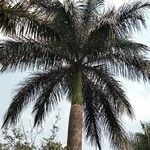
Roystonea oleracea
Caribbean royal palm · South American royal palm · Royal palm · Cabbage palm
Description
Source: leafsnapRoystonea oleracea, sometimes known as the Caribbean royal palm, palmiste, imperial palm or cabbage palm, is a species of palm which is native to the Lesser Antilles, Colombia, Venezuela, and Trinidad and Tobago. It is also reportedly naturalized in Guyana and on the islands of Mauritius and Réunion in the Indian Ocean.Its specific epithet oleracea means "vegetable/herbal" in Latin and is a form of holeraceus (oleraceus). The plant's buds was eaten in the West Indies.
Care Guide
💧 Water Once a week
☀️ Light Full sun
The Caribbean royal palm grows naturally in open habitats, such as sunny meadows and the edges of forests, where light is plentiful. It does best in Full Sun but can withstand Partial Sun, adapting well to different light conditions.
🌡️ Temperature 20–37.8°C
The Caribbean royal palm comes from tropical regions, where the climate is generally warm and humid. Consequently, it is well adapted to high heat and moisture. It does not tolerate sudden temperature shifts and prefers a steady temperature, so avoiding indoor temperature fluctuations is important. It typically cannot withstand cold and needs higher temperatures to grow. If the surrounding temperature falls too low, the plant may stop growing or even die.
💨 Humidity
🪴 Soil 6-7
🌱 Fertilizer
Early spring, when the Caribbean royal palm comes out of dormancy, is the best time to fertilize it. This encourages overall growth and flower development. Fertilization improves the foliage, stems, and branches, and promotes flowers that are large, vibrant, and long-lasting. It helps transport nutrients from the roots to the flowers and enhances the plant’s health and resistance to disease.
🪴 Pot & Repot
✂️ Pruning
The fact that royal palms automatically shed their old fronds without the need for pruning is one of its advantages. The majority of the time, pruning only entails removing any brown or yellow fronds. Since the tree is still receiving nutrients from the green fronds, it is not recommended to remove them from any palm tree.
🌿 Propagating
🐛 Diseases & pets
☠️ Toxicity
Many of the palm trees in the Sunshine State are poisonous to both people and animals. Some types of palm trees produce toxins in their leaves, seeds, or cones, which can result in major health issues or even death. Learn about the deadly palm trees in Florida to keep your family safe.
Characteristics
- Plant Type
- Tree, Palm
- Life Cycle
- Perennial
- Genus
- Roystonea
- Family
- Arecaceae
- Hardiness Zone
- 10-12
- Mature Height
- 14.94 m
- Mature Spread
- 4.88 m
- Leaf Color
- Dark Green, Forest Green
- Leaf Type
- Evergreen
- Flower Color
- White
- Flower Size
- 0.25 cm to 0.51 cm
- Bloom Time
- All year round
- Planting Time
- Spring, Summer, Autumn
- Harvest Time
- All year round
- Native Area
- Colombia, Guatemala, Venezuela, Trinidad and Tobago